



| HEADLINE |

|

JS passes Tk 9.38T FY26-27 budget
Published : Wednesday, 1 July, 2026 at 12:00 AM
Business Correspondent


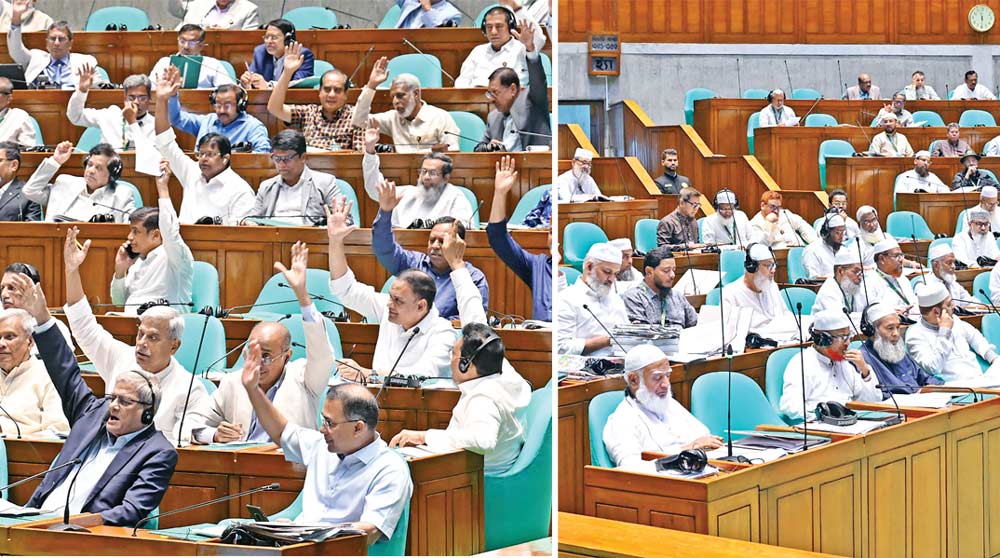 Parliament on Tuesday passed the Tk 938,000 crore national budget for FY2026-27 by voice vote of the parliament members. However, the government has set ambitious macroeconomic targets for the 2026-27 fiscal year, aiming to raise economic growth to 6.5 per cent while bringing inflation down to 7.5 percent.
 The budget is the first to be presented by the BNP-led by Prime Minister Tarique Rahman, government after it assumed office following its landslide victory in the general election held on February 12. The last national budget under a BNP administration was presented for FY2006-07 by then Finance Minister M Saifur Rahman. This budget is the maiden one by Finance Minister Amir Khosru Mahmud.
The current session of the Parliament was adjourned until July 7, after the passage of the budget.
The budget projects a deficit of Tk 243,000 crore, equivalent to 3.6 percent of the country's Gross Domestic Product (GDP). The overall budget size represents 13.7 percent of the projected GDP.
To accelerate economic recovery, Finance Minister Amir Khosru Mahmud Chowdhury unveiled a 3R Strategy, designed to revitalise the economy and steer Bangladesh towards becoming a $1 trillion economy. The strategy consists of three phases recovery and stabilization, restoration and reconstruction for acceleration.
The government plans to implement the strategy gradually over the next one to five years.
The budget sets a revenue collection target of Tk 695,000 crore, including Tk 604,000 crore to be collected by the National Board of Revenue (NBR).
To facilitate budget implementation, the finance minister also tabled the Appropriation Bill, 2026, seeking parliamentary approval for government expenditure amounting to Tk 1,515,439 crore. The bill was later passed by voice vote.
* Total revenue collection target Tk 695,000 crore
* The budget projects a deficit of Tk 243,000 crore
* 43 MPs from Jamaat, NCP, and independent members participated in discussions
* Opposition lawmakers were present during passage of Appropriation Bill, did not object to its approval
On Monday, Parliament had already approved the Finance Bill, 2026, incorporating several significant amendments, including raising the tax-free income threshold and abolishing the requirement to disclose investment information.
Before the Appropriation Bill was passed, ministers presented and justified expenditure under 59 grant demands covering both development and non-development spending.
Opposition lawmakers submitted 1,343 cut motions against the 59 grant demands, but all were rejected by voice vote after debate.
A total of 43 lawmakers from Bangladesh Jamaat-e-Islami, the National Citizen Party (NCP), and independent members participated in discussions on cut motions involving 36 ministries, divisions, and institutions. These included the Prime Minister's Office, Cabinet Division, Ministry of Public Administration, Finance Division, Internal Resources Division, Ministry of Commerce, Ministry of Foreign Affairs, Ministry of Home Affairs, Ministry of Health, Ministry of Agriculture, Ministry of Road Transport and Highways, Ministry of Railways, Ministry of Civil Aviation and Tourism, Ministry of Posts and Telecommunications, and the Anti-Corruption Commission, among others.
At the request of Opposition Leader Dr Shafiqur Rahman, the Speaker applied the guillotine procedure, allowing the remaining grant demands to be approved together by voice vote without detailed discussion.
Opposition and independent lawmakers were present during the passage of the Appropriation Bill and did not raise any objections before its approval.
Loading...
Loading...
Also read



Editor : Iqbal Sobhan Chowdhury
Published by the Editor on behalf of the Observer Ltd. from Globe Printers, 24/A, New Eskaton Road, Ramna, Dhaka.
Editorial, News and Commercial Offices : Aziz Bhaban (2nd floor), 93, Motijheel C/A, Dhaka-1000.
Phone: PABX- 41053001-06; Advertisement: 41053012; 01793317829, 01550707291, E-mail: [email protected], [email protected] Online: email: [email protected] 41053014; 01550707297 Advertisement: 01550707296
Published by the Editor on behalf of the Observer Ltd. from Globe Printers, 24/A, New Eskaton Road, Ramna, Dhaka.
Editorial, News and Commercial Offices : Aziz Bhaban (2nd floor), 93, Motijheel C/A, Dhaka-1000.
Phone: PABX- 41053001-06; Advertisement: 41053012; 01793317829, 01550707291, E-mail: [email protected], [email protected] Online: email: [email protected] 41053014; 01550707297 Advertisement: 01550707296


