



| HEADLINE |

|

Could mass vaccination bar measles spread?
Immunisation gaps, weak primary healthcare fuel infections
Published : Thursday, 2 July, 2026 at 12:00 AM
Arifur Rahman Rabbi


 More than two months after Bangladesh completed a nationwide measles vaccination campaign targeting nearly all high-risk children under five, the outbreak continues to spread, with hundreds of new infections and suspected deaths reported every day. The persistence of the disease has prompted public health experts to question why mass immunisation has yet to curb transmission and to warn that vaccination alone may not be enough to bring the outbreak under control.
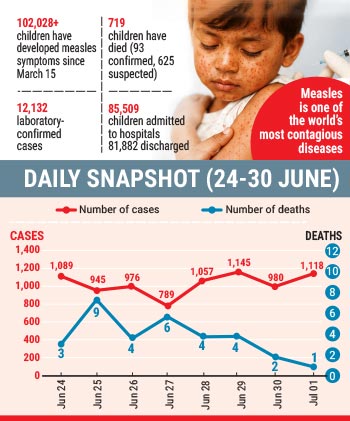
According to the Directorate General of Health Services (DGHS), one child with suspected measles died in the 24 hours ending Wednesday, while 167 laboratory-confirmed cases and 951 suspected infections were reported during the same period.
Since the outbreak was first detected on March 15, 102,028 children have developed measles symptoms, including 12,132 laboratory-confirmed cases. Official data show that 719 children have died, comprising 93 confirmed measles deaths and 626 deaths among children with suspected infections.
The DGHS data also show that 85,509 children have been admitted to hospitals with measles-related complications since the outbreak began, while 81,882 have since been discharged.
The government launched a nationwide measles vaccination campaign in April, bringing nearly all high-risk children under the age of five under immunisation. Health authorities had expected vaccinated children to develop protective antibodies within four weeks, resulting in a significant decline in infections and deaths.
However, although fatalities have declined somewhat, hospitals continue to receive a steady flow of measles patients, prompting health experts to question why transmission remains high months after the campaign.
Public health experts say the outbreak reflects years of gaps in routine immunisation, widespread child malnutrition and weaknesses in the country's primary healthcare system. They say further research is needed to determine why infections have not fallen as expected following the special vaccination drive.
Dr Be-Nazir Ahmed, an infectious disease expert and former director of the Disease Control unit at the Directorate General of Health Services, said measles is among the world's most contagious viral diseases, with a single infected person capable of infecting 10 to 15 others.
He said at least 95 per cent vaccination coverage is needed to interrupt transmission, warning that the virus spreads rapidly when coverage falls below that threshold.
According to him, the current outbreak is largely the result of an "immunity gap" created by disruptions to routine immunisation programmes over the past several years. Vaccine shortages in some areas and missed immunisations have left thousands of children vulnerable to infection.
Public health expert Dr Mushtaq Hossain, a former adviser to the Institute of Epidemiology, Disease Control and Research (IEDCR), said a special vaccination campaign alone would not be sufficient to contain the outbreak.
He said strengthening routine immunisation, improving children's nutritional status, ensuring early diagnosis and expanding access to timely treatment are equally important to reducing infections and deaths.
He also stressed that measles management should not remain concentrated in intensive care units of major hospitals. Community clinics and primary healthcare facilities must be equipped to diagnose and treat patients early, he said, adding that effective local-level management is essential to preventing severe complications and fatalities.
Public health specialist Dr Zakia Ferdausi Khanam said a single dose of the measles vaccine administered at nine months provides 80 to 95 percent protection, while a second dose at 15 months raises effectiveness to nearly 98 percent.
She, however, noted that malnourished children often take longer to develop protective immunity, making adequate nutrition an important component of disease prevention alongside vaccination.
Health Minister Sardar Md Sakhawat Hossain has blamed years of neglect of routine measles immunisation under previous governments for contributing to the current outbreak.
He said the present government had to respond immediately after taking office by launching a nationwide vaccination campaign to bring all eligible children under immunisation. The minister added that children who were missed during the campaign would also be vaccinated, while efforts to contain the outbreak would continue.
Despite the ongoing response, health experts warn that Bangladesh is unlikely to bring the outbreak under control unless it restores high routine vaccination coverage, addresses childhood malnutrition and strengthens primary healthcare services to detect and manage infections at the community level.
Loading...
Loading...
Also read



Editor : Iqbal Sobhan Chowdhury
Published by the Editor on behalf of the Observer Ltd. from Globe Printers, 24/A, New Eskaton Road, Ramna, Dhaka.
Editorial, News and Commercial Offices : Aziz Bhaban (2nd floor), 93, Motijheel C/A, Dhaka-1000.
Phone: PABX- 41053001-06; Advertisement: 41053012; 01793317829, 01550707291, E-mail: [email protected], [email protected] Online: email: [email protected] 41053014; 01550707297 Advertisement: 01550707296
Published by the Editor on behalf of the Observer Ltd. from Globe Printers, 24/A, New Eskaton Road, Ramna, Dhaka.
Editorial, News and Commercial Offices : Aziz Bhaban (2nd floor), 93, Motijheel C/A, Dhaka-1000.
Phone: PABX- 41053001-06; Advertisement: 41053012; 01793317829, 01550707291, E-mail: [email protected], [email protected] Online: email: [email protected] 41053014; 01550707297 Advertisement: 01550707296


