



| HEADLINE |

|

Nipa Tripura brings light and hope to Khagrachhari's remote hills
Published : Saturday, 4 July, 2026 at 12:00 AM
Farhana Naznin


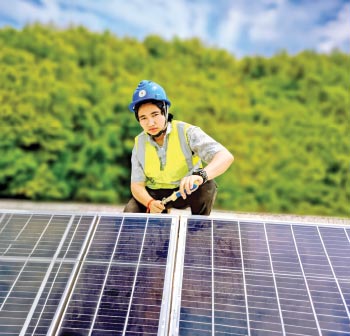 In the remote village of Gachhban Amritpara in Khagrachhari Sadar Upazila, where the future of most young women is traditionally confined to marriage and family life, 22-year-old Nipa Tripura dared to dream differently. While helping her farmer father cultivate jhum fields, she developed an unusual fascination with electrical wires, switchboards, and repairing faulty equipment. Today, that childhood curiosity has transformed her into a skilled Assistant Solar Technician and an emerging green entrepreneur, bringing light and hope to one of Bangladesh's most remote hill regions.
According to the latest Labour Force Survey by the Bangladesh Bureau of Statistics (BBS), women's participation in technical and vocational education is increasing. However, women still account for less than one percent of professionals in the electrical and mechanical sectors. Defying social stereotypes and financial hardship, Nipa has become a remarkable exception.
After her three elder sisters got married, Nipa joined her brother in supporting their father with farming. Despite persistent financial struggles, she remained determined to pursue a career in technology. Although she completed her SSC (Vocational) in 2021, the COVID-19 pandemic and severe financial hardship prevented her from continuing her formal education. To support her family, she later took a job as a sales assistant at a handicraft shop in Khagrachhari town while continuing to search for better opportunities.
A turning point came when she heard a public announcement about a free three-month Electrical Installation and Maintenance course offered by Ananda Vocational Training Centre under the Skills for Industry Competitiveness and Innovation Program (SICIP), implemented by Palli Karma-Sahayak Foundation (PKSF) with support from the Finance Division of the Government of Bangladesh. Encouraged by her father, Nipa enrolled in August 2025. Among the 25 trainees, only two were women.
"At first, I was afraid of handling electrical wires," Nipa recalls. "But our trainers guided us patiently and taught us how to work safely using protective gloves and shoes. Once I gained confidence, nothing seemed impossible."
Her trainer, Md. Masud Rana, praised her dedication and technical skills.
"From house wiring and coil winding to motor control and solar system installation, Nipa mastered every tool and technique with remarkable precision. Her punctuality, discipline, and ability to work as part of a team are truly commendable."
After completing the training in December 2025, Nipa began her career as an Assistant Solar Technician under the Solar and Cookstove Project. She now earns a fixed monthly salary of Tk 12,000, along with additional income from installing solar systems in the field.
Her journey, however, was far from easy. She often faced discouraging remarks such as, "Electrical work is for men. Why didn't you learn sewing instead?" Yet she remained steadfast, determined to prove her critics wrong through hard work and professionalism. Today, she says, she receives far more appreciation than criticism.
Nipa's financial independence has brought significant relief to her family. With her savings and a small loan, they purchased a rice milling machine, which now generates an additional income of around Tk 500 per day.
Inspired by her achievements, five women are currently receiving professional training in electrical trades�"including fan motor rewinding, solar panel installation, and house wiring�"while another five are training in mobile phone servicing.
Looking ahead, Nipa dreams of more than just a stable job. She is saving part of her earnings to establish a solar panel sales and service centre in Khagrachhari. Through this venture, she hopes to create employment opportunities for unemployed youth in her community while promoting clean energy solutions in the region.
"My message to other women is simple," she says. "Don't let fear stand in your way. If you work with confidence, determination, and dedication, success will surely follow."

Loading...
Loading...
Also read



Editor : Iqbal Sobhan Chowdhury
Published by the Editor on behalf of the Observer Ltd. from Globe Printers, 24/A, New Eskaton Road, Ramna, Dhaka.
Editorial, News and Commercial Offices : Aziz Bhaban (2nd floor), 93, Motijheel C/A, Dhaka-1000.
Phone: PABX- 41053001-06; Advertisement: 41053012; 01793317829, 01550707291, E-mail: [email protected], [email protected] Online: email: [email protected] 41053014; 01550707297 Advertisement: 01550707296
Published by the Editor on behalf of the Observer Ltd. from Globe Printers, 24/A, New Eskaton Road, Ramna, Dhaka.
Editorial, News and Commercial Offices : Aziz Bhaban (2nd floor), 93, Motijheel C/A, Dhaka-1000.
Phone: PABX- 41053001-06; Advertisement: 41053012; 01793317829, 01550707291, E-mail: [email protected], [email protected] Online: email: [email protected] 41053014; 01550707297 Advertisement: 01550707296


