



| HEADLINE |

|
Empowering rural women thru digital transformation
Published : Monday, 6 July, 2026 at 12:00 AM
Dr Usharani Boruah


 On September 6, 2024, the United Nations General Assembly (UNGA) officially proclaimed July 6 as World Rural Development Day, recognising that sustainable rural development is fundamental to achieving the Sustainable Development Goals (SDGs) by 2030. The resolution underscores the indispensable role of rural communities in eliminating poverty, ensuring food security, protecting natural resources, and fostering inclusive economic growth. It also highlights the vital contributions of rural women to agriculture, food production, poverty reduction, economic empowerment and improved livelihoods. Significantly, July 6 also marks the Foundation Day of the Centre on Integrated Rural Development for Asia and the Pacific (CIRDAP), making the occasion especially meaningful for promoting inclusive and sustainable rural development across the Asia-Pacific region.
The establishment of World Rural Development Day is both timely and significant. At a time when the world is confronting climate change, food insecurity, widening inequalities and rapid technological transformation, it reminds us that sustainable development cannot be achieved unless rural communities are empowered to thrive. The Asia-Pacific region is home to more than one billion rural women. They are the backbone of agriculture and rural economies, contributing not only to food production but also to household welfare, environmental stewardship and community resilience.
Yet the contribution of rural women often remains largely invisible. Behind every meal placed on our tables are women whose labour is frequently unpaid, undervalued and overlooked. Despite producing food, managing natural resources, and supporting rural households, many continue to face unequal access to land, agricultural inputs, finance, education, technology, extension services and markets. These structural inequalities limit not only women’s opportunities but also the productivity and resilience of rural economies. Empowering rural women is therefore one of the smartest economic and development investments any country can make. When women have equal access to education, land, finance, technology, markets and leadership opportunities, agricultural productivity rises, household incomes increase, children’s health and education improve, and rural economies become more resilient.
For rural women, digital technologies such as Artificial intelligence, Geographic Information Systems, drones, satellite imagery, precision agriculture, mobile advisory services, digital financial platforms and e-commerce can be particularly transformative. Mobile phones and digital platforms now provide access to weather forecasts, pest and disease alerts, technical guidance, market prices, financial services and online training that were previously beyond the reach of many rural communities. Women entrepreneurs are increasingly using digital tools to expand businesses in dairy, horticulture, fisheries, agro-processing, handicrafts and rural tourism, while digital finance is improving access to savings, credit, insurance and secure payment systems. These innovations are enabling women to diversify their livelihoods, strengthen household incomes, and participate more actively in local and national economies.
Sustainable rural development also demands investments in people, institutions, innovation and partnerships that strengthen the resilience of rural communities. For nearly five decades, CIRDAP has worked with its Member Countries to promote inclusive and people-centred rural development through applied research, policy dialogue, capacity building, knowledge exchange and regional cooperation. CIRDAP’s Women, Youth and Rural Development Programme (WYRDP) has demonstrated that when rural women and young people are equipped with knowledge, skills, technology and institutional support, they become powerful agents of change. Their innovations strengthen agricultural productivity, improve household incomes, enhance food security, and create more resilient communities capable of adapting to economic and environmental challenges.
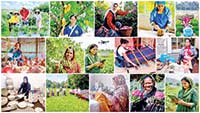
In Nepal, CIRDAP collaborated with the Local Development Training Academy (LDTA) to promote Gender Responsive Budgeting (GRB) at the local government level. The initiative helped ensure that development investments responded more effectively to the needs of women and disadvantaged communities. In India, CIRDAP partnered with the National Institute of Rural Development and Panchayati Raj (NIRDPR) to promote inclusive livelihoods for transgender and gender-diverse youth through vocational training, entrepreneurship development and skills enhancement. In Sri Lanka, CIRDAP worked with the Hector Kobbekaduwa Agrarian Research and Training Institute (HARTI) to support women and young people in establishing sustainable income-generating enterprises. CIRDAP’s project, Improving Rural Women’s Sustainable Livelihood through Empowerment in the Sericulture Value Chain, in Iran, seeks to strengthen women’s participation in silk production across the provinces of Guilan, Mazandaran and Golestan.
As the Asia-Pacific region navigates rapid technological change and increasing climate uncertainty, governments must place rural women at the heart of national development strategies. Equal access to education, land, finance, and technology and digital connectivity, markets, healthcare, and leadership opportunities should no longer be viewed as social welfare measures; they are strategic investments that strengthen agricultural productivity, economic resilience and national development.
At the same time, greater investment is needed in rural infrastructure, broadband connectivity, digital literacy, agricultural research, climate-smart technologies and women-led enterprises. Expanding partnerships among governments, development organisations, research institutions, financial institutions, civil society and the private sector will be essential for ensuring that innovation reaches even the most remote rural communities.
World Rural Development Day reminds us that rural development is about more than agriculture and infrastructure - it is about empowering people, strengthening communities, and creating opportunities for shared prosperity. As we observe this day, let us promote policies that advance gender equality, expand digital inclusion, foster innovation, and strengthen regional cooperation. Above all, rural women must have the opportunities and resources to shape the future of their communities.
The writer is Librarian & Gender Coordinator, Centre on Integrated Rural Development for Asia and the Pacific (CIRDAP), Dhaka
Loading...
Loading...
Also read



Editor : Iqbal Sobhan Chowdhury
Published by the Editor on behalf of the Observer Ltd. from Globe Printers, 24/A, New Eskaton Road, Ramna, Dhaka.
Editorial, News and Commercial Offices : Aziz Bhaban (2nd floor), 93, Motijheel C/A, Dhaka-1000.
Phone: PABX- 41053001-06; Advertisement: 41053012; 01793317829, 01550707291, E-mail: [email protected], [email protected] Online: email: [email protected] 41053014; 01550707297 Advertisement: 01550707296
Published by the Editor on behalf of the Observer Ltd. from Globe Printers, 24/A, New Eskaton Road, Ramna, Dhaka.
Editorial, News and Commercial Offices : Aziz Bhaban (2nd floor), 93, Motijheel C/A, Dhaka-1000.
Phone: PABX- 41053001-06; Advertisement: 41053012; 01793317829, 01550707291, E-mail: [email protected], [email protected] Online: email: [email protected] 41053014; 01550707297 Advertisement: 01550707296


