



| HEADLINE |

|

The Billion-Dollar Quarter-finals
Where every win is worth far more than glory
Published : Wednesday, 8 July, 2026 at 12:00 AM
Sports Desk


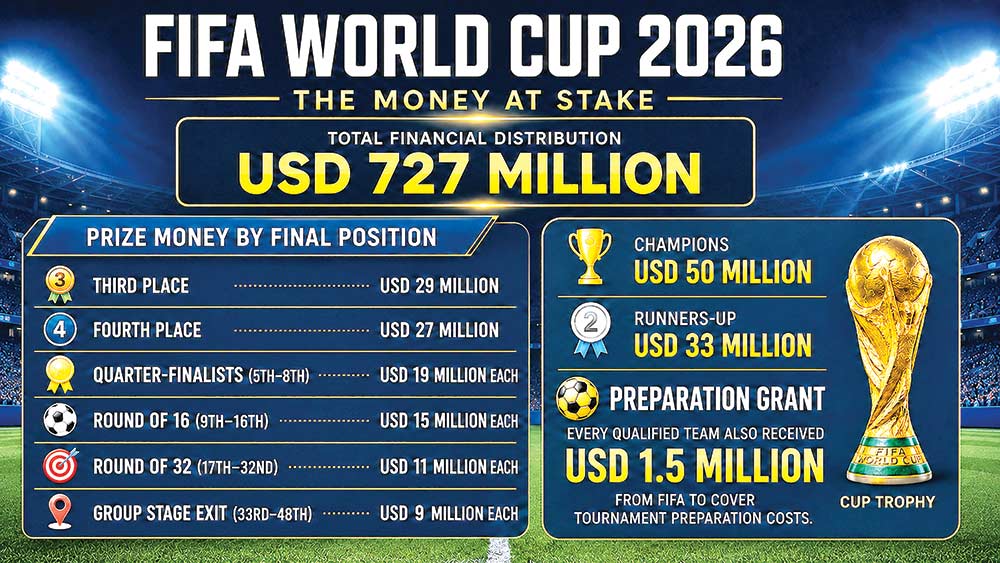 As the FIFA World Cup enters the quarter-final stage, the battle is no longer only for a place in the semi-finals. Every remaining team is also competing in one of the most valuable sporting events in the world, where success brings not only prestige but also millions of dollars in prize money, commercial rewards and long-term financial benefits.
For players, coaches and supporters, the focus remains on lifting the trophy. Behind the scenes, however, every victory reshapes football's economic landscape.
Prize money is only the beginning
Reaching the quarter-finals guarantees another significant financial reward from FIFA, but that is only part of the story.
Every additional round increases the prize fund distributed to national football associations. The eventual champions receive the tournament's largest financial reward, yet even teams that fall short leave with substantial earnings that can be invested in youth academies, coaching programmes, training facilities and the long-term development of football.
For smaller football nations, a deep World Cup run can transform the future of the sport for an entire generation.
Every victory creates new business opportunities
Success on the pitch immediately increases commercial value off it.
Sponsors receive greater global exposure as teams play more matches in front of worldwide television audiences. Shirt manufacturers enjoy higher merchandise sales, while airlines, tourism authorities and corporate partners all benefit from the international attention generated by a successful World Cup campaign.
For co-hosts and emerging football nations alike, each victory strengthens the country's sporting image and creates opportunities that extend well beyond the tournament itself.
Players become more valuable The transfer market is another major winner.
Outstanding performances on football's biggest stage often increase a player's market value within days. Scouts from Europe's leading clubs closely monitor every knockout match, knowing that one exceptional tournament can transform a promising talent into one of the world's most sought-after footballers.
History has repeatedly shown that World Cups create new stars, and this year's tournament is already producing players whose reputations-and valuations-continue to rise.
A global television spectacle
The World Cup remains one of the largest television events on the planet.
As the tournament reaches its decisive stages, audiences grow even larger. Broadcasters compete for record viewership, advertisers pay premium rates for commercial slots, and digital platforms experience enormous engagement across highlights, interviews and social media.
The quarter-finals are therefore more than football matches-they are global entertainment events watched by hundreds of millions of people.
Where dreams and economics meet
The quarter-finals are often remembered for dramatic goals and unforgettable moments, but they also represent a turning point in football's financial ecosystem.
Every tackle, every goal and every victory carries value beyond the scoreboard. Success influences sponsorship agreements, strengthens football federations, raises player valuations and inspires future investment in the game.
Only one nation will eventually lift the World Cup trophy. Yet for the teams still standing, every step forward is already generating rewards that extend far beyond medals and celebrations.
In modern football, the road to World Cup glory is measured not only in goals and trophies, but also in opportunity, investment and economic impact-making the quarter-finals one of the most valuable stages in global sport.

Loading...
Loading...
Also read



Editor : Iqbal Sobhan Chowdhury
Published by the Editor on behalf of the Observer Ltd. from Globe Printers, 24/A, New Eskaton Road, Ramna, Dhaka.
Editorial, News and Commercial Offices : Aziz Bhaban (2nd floor), 93, Motijheel C/A, Dhaka-1000.
Phone: PABX- 41053001-06; Advertisement: 41053012; 01793317829, 01550707291, E-mail: [email protected], [email protected] Online: email: [email protected] 41053014; 01550707297 Advertisement: 01550707296
Published by the Editor on behalf of the Observer Ltd. from Globe Printers, 24/A, New Eskaton Road, Ramna, Dhaka.
Editorial, News and Commercial Offices : Aziz Bhaban (2nd floor), 93, Motijheel C/A, Dhaka-1000.
Phone: PABX- 41053001-06; Advertisement: 41053012; 01793317829, 01550707291, E-mail: [email protected], [email protected] Online: email: [email protected] 41053014; 01550707297 Advertisement: 01550707296


