



| HEADLINE |

|

Tech-savvy fuel pumps cheat motorists



 Meter tampering, short-fueling and fuel quality fraud continue to plague filling stations across Bangladesh despite regular inspections by the Bangladesh Standards and Testing Institution (BSTI), with unscrupulous operators using increasingly sophisticated technology to shortchange motorists.
BSTI-led mobile courts routinely inspect filling stations, seal faulty dispensing units and prosecute operators found guilty of manipulating fuel measurements. Yet consumer complaints continue to surface.
Officials say one of the most common methods involves reprogramming or replacing a dispenser's firmware or motherboard to alter the pulse count per litre�"the number of electronic signals generated as fuel flows through the meter. By manipulating the pulse equivalent, the dispenser displays a higher volume than the amount actually delivered into a vehicle's fuel tank.
Moin Uddin Mia, an official of BSTI told The Daily Observer that BSTI stated that such drives will continue round the year in the public interest to ensure fair trade practices and protect consumers.
A high official of BSTI told this correspondent that meter tampering at fuel stations often involves the use of specialized microchips or modified pulser circuits that trick the dispenser's digital readout into showing a higher volume of fuel than is actually flowing into your tank.
Reprogramming or replacing the motherboard's firmware to alter the pulse counts per liter. The machine displays a higher volume on the screen than what is actually delivered to your vehicle tank, according to sources.
Sources added that some fueling station owners may also install hidden analog oscillators or pulse manipulator devices directly into the pulser circuitry. Attendants repeatedly press and release the manual trigger on the nozzle instead of using the automatic lock. This erratic pressure flow triggers the meter to skip ahead without dispensing full volume.
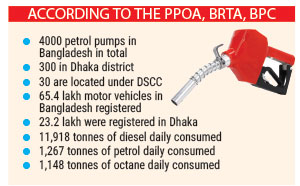
According to Bangladesh Petroleum Corporation (BPC) average daily fuel consumption is approximately 11,918 tonnes of diesel, 1,267 tonnes of petrol, and 1,148 tonnes of octane. Diesel makes up the vast majority of the country's fuel demand, primarily fueling the agriculture and transport sectors, while petrol and octane cover the rest.
Reports from energy officials and consumer rights agencies confirm that many filling stations in Bangladesh engage in meter tampering, often shortchanging consumers by 5% to 10%. Both CNG and liquid fuel pumps have been found to artificially manipulate dispensers Mixing regular petrol with cheaper solvents, palm oil, or excessive ethanol. This directly decreases your mileage and harms internal engine parts over time.
Rahamat Ali , the motorcyclist who started the agitation, said for several weeks it felt like his two-wheeler's mileage dropped whenever he refilled there.
I have asked them several times to get a BSTI-approved pot or something to prove that they are not cheating...But they always say that they do not have any pot, he told The Daily Observer.
BSTI has fined Ramna Filling Station in the capital Tk 2 lakh for tampering with measurements. Simultaneously, two faulty diesel dispensing units at the pump have been sealed off and shut down. The fine was imposed on Wednesday (July 8) by a mobile court conducted by the BSTI.
During the operation, three dispensing units at the Ramna Filling Station, located at 22 Bangabandhu Avenue in the capital, were inspected. Evidence was found that two of the diesels dispensing units were delivering 870 milliliters and 100 milliliters less fuel, respectively, for every 10 liters dispensed.
The national standards regulatory agency has also filed cases against the stations owners for violating the Standards of Weights and Measures Act 2018 by cheating on the customers.
In a drive to curb malpractice in fuel measurement across Dhaka Metropolitan City, BSTI conducted two separate mobile court operations under the Weight and Measures Standards Act, 2018.
According to the Petrol Pump Owners Association, there are a total of about 4000 petrol pumps across the country while there are 300 in Dhaka district and 80 in Dhaka city.
There are about 50 pumps located within Dhaka North City Corporation area while 30 are located under Dhaka South City Corporation.
Bangladesh Road Transport Authority (BRTA) & Bangladesh automotive industry estimates Last year that the number of registered motor vehicles in Bangladesh reached 65.4 lakh, of which 23.2 lakh were registered in Dhaka.

Loading...
Loading...
Also read



Editor : Iqbal Sobhan Chowdhury
Published by the Editor on behalf of the Observer Ltd. from Globe Printers, 24/A, New Eskaton Road, Ramna, Dhaka.
Editorial, News and Commercial Offices : Aziz Bhaban (2nd floor), 93, Motijheel C/A, Dhaka-1000.
Phone: PABX- 41053001-06; Advertisement: 41053012; 01793317829, 01550707291, E-mail: [email protected], [email protected] Online: email: [email protected] 41053014; 01550707297 Advertisement: 01550707296
Published by the Editor on behalf of the Observer Ltd. from Globe Printers, 24/A, New Eskaton Road, Ramna, Dhaka.
Editorial, News and Commercial Offices : Aziz Bhaban (2nd floor), 93, Motijheel C/A, Dhaka-1000.
Phone: PABX- 41053001-06; Advertisement: 41053012; 01793317829, 01550707291, E-mail: [email protected], [email protected] Online: email: [email protected] 41053014; 01550707297 Advertisement: 01550707296


