



| HEADLINE |

|

Mass accused, weak evidence stall July Uprising probes



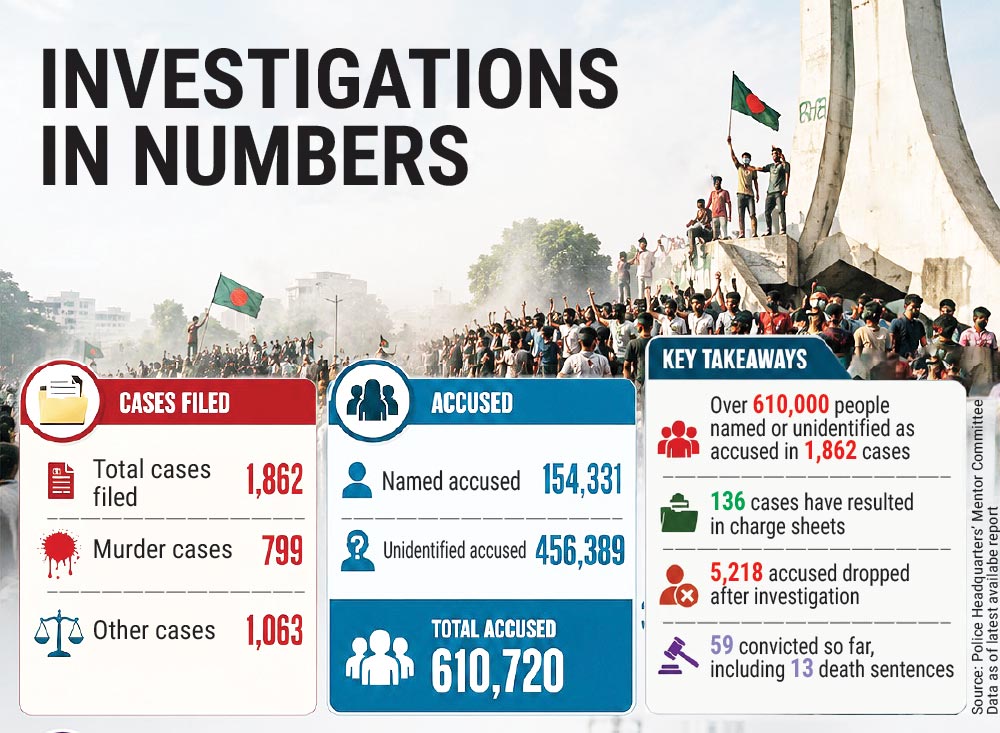 Investigations into cases filed over last year's July uprising are being hampered by an unprecedented number of accused, weak evidence and inconsistencies in case records, raising fresh concerns over the pace of justice for killings during the movement that led to the fall of the Sheikh Hasina government.
According to Police Headquarters' Mentor Committee, which oversees investigations into uprising-related cases, a total of 1,862 cases have been filed across the country against 154,331 named and 456,389 unidentified accused�"a combined 610,720 people.
Of the total cases, 799 involve murder, while the remaining 1,063 relate to attempted murder and other offences.
During investigations, police also dropped 5,218 accused from 839 murder and other cases after finding insufficient evidence. Some names were excluded before charge sheets were submitted, while others were removed through interim investigation reports.
Investigators say one of their biggest challenges is the unusually high number of accused named in many cases, making it difficult to determine individual criminal liability.
According to officials familiar with the investigations, many cases contain inconsistencies between the allegations and the actual crime scenes. In some instances, complainants allegedly have no direct relationship with the victims, while the same individuals have been named as accused in multiple murder cases arising from different incidents.
Investigators also said government officials, including police personnel, have been named in many cases, further complicating the investigation process.
Police officials said the combination of discrepancies in case records, insufficient evidence and allegations of irregularities in some investigations has slowed efforts to prepare legally sustainable investigation reports.
Murder cases have proved particularly challenging, as post-mortem reports are unavailable in a large number of cases.
Investigators said they must carefully examine whether charge sheets can withstand judicial scrutiny when forensic reports are unavailable. According to Police Headquarters, the Criminal Investigation Department (CID) is investigating 117 cases, including 88 Category A and 29 Category B cases. Investigations have so far been completed in three Category A cases. The Police Bureau of Investigation (PBI), meanwhile, has been assigned 251 cases, including 89 murder cases and 162 other criminal cases. It has disposed of 202 cases, comprising 48 murder and 154 non-murder cases.
Among those disposed cases, investigators found evidence supporting the allegations in 100 cases, while allegations could not be substantiated in 32 cases. Another 29 cases were returned by courts for various reasons.
Separately, the International Crimes Tribunal has so far delivered verdicts in seven cases related to the July uprising. A total of 59 people have been convicted, including 13 sentenced to death, while the remaining convicts received life imprisonment or other jail terms.
Police spokesperson and Assistant Inspector General AHM Shahadat Hossain said the investigation findings reflected the complex nature of many of the cases.
"In several incidents, multiple murder cases were filed over a single killing, and many of the accused were found not to have been involved. That is why FRTs were submitted," he told the media.
Officials involved in the investigations said the sheer scale of the cases, coupled with overlapping allegations and evidentiary challenges, means completing the remaining investigations is likely to take considerable time.

Loading...
Loading...
Also read



Editor : Iqbal Sobhan Chowdhury
Published by the Editor on behalf of the Observer Ltd. from Globe Printers, 24/A, New Eskaton Road, Ramna, Dhaka.
Editorial, News and Commercial Offices : Aziz Bhaban (2nd floor), 93, Motijheel C/A, Dhaka-1000.
Phone: PABX- 41053001-06; Advertisement: 41053012; 01793317829, 01550707291, E-mail: [email protected], [email protected] Online: email: [email protected] 41053014; 01550707297 Advertisement: 01550707296
Published by the Editor on behalf of the Observer Ltd. from Globe Printers, 24/A, New Eskaton Road, Ramna, Dhaka.
Editorial, News and Commercial Offices : Aziz Bhaban (2nd floor), 93, Motijheel C/A, Dhaka-1000.
Phone: PABX- 41053001-06; Advertisement: 41053012; 01793317829, 01550707291, E-mail: [email protected], [email protected] Online: email: [email protected] 41053014; 01550707297 Advertisement: 01550707296


