



| HEADLINE |

|

Rajshahi jute farmers fear water shortage during retting
Higher output and strong prices raise hopes, but insufficient water might hurt fibre quality and profits
Published : Sunday, 19 July, 2026 at 12:00 AM
Our Correspondent


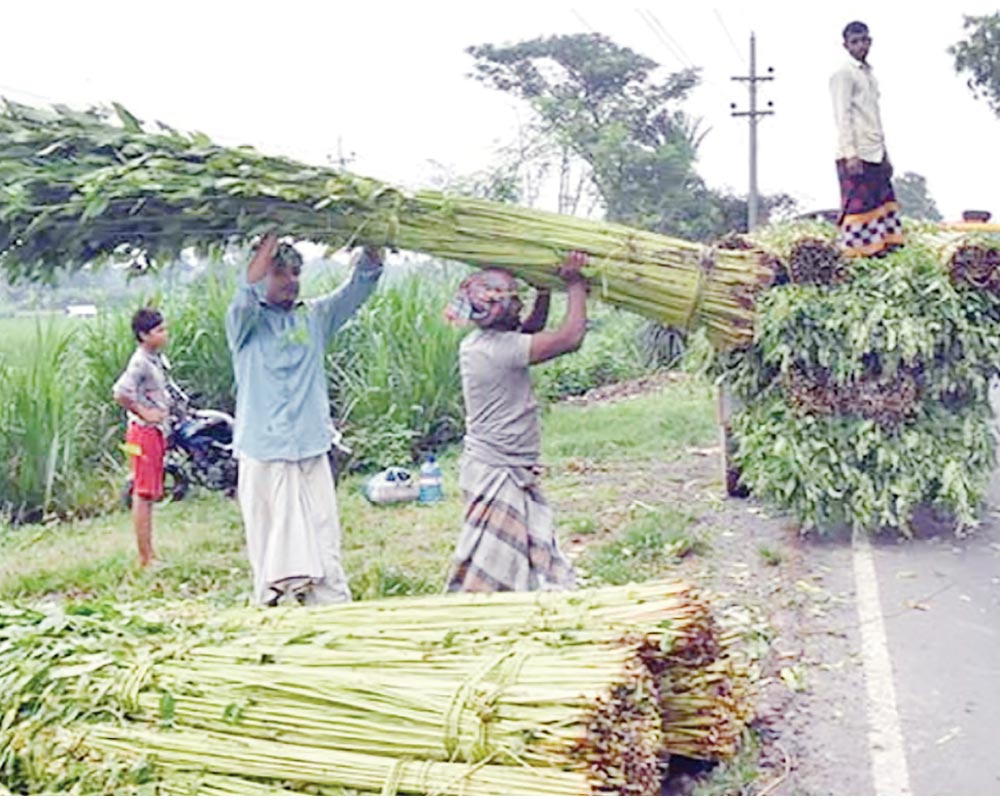 RAJSHAHI, July 18: Jute cultivation has increased in Rajshahi this season, encouraged by rising demand for the eco-friendly fibre and favourable market prices, but farmers are worried that a lack of water for retting could affect fibre quality and reduce their profits.
Once known as Bangladesh's "golden fibre", jute lost much of its importance due to the growing use of cheap synthetic fibres, the closure of jute mills, rising production costs and unfavourable weather. However, renewed global demand for environmentally friendly products and the expansion of private jute mills have encouraged farmers to return to the crop.
According to the Department of Agricultural Extension (DAE), jute has been cultivated on 18,399 hectares in Rajshahi District this season, up from 17,305 hectares last year. The production target has been set at 49,333 tonnes, 656 tonnes higher than last year's output.
Officials said the crop has performed well this year due to favourable weather and relatively low disease incidence. Harvesting of early varieties has already begun in some areas, while large-scale harvesting and retting are expected to start within the next two weeks.
During a visit to Nowhata Jute Market on Monday, this correspondent found newly harvested jute arriving at the market, where it was selling for Tk 4,000 to Tk 4,500 per maund. Farmers said the current prices were satisfactory and hoped they would remain stable throughout the season.
Despite the favourable market, farmers remain concerned about the availability of water for retting -- the process of soaking harvested jute to separate the fibre.
Insufficient rainfall in Rajshahi has left many canals and water bodies with low water levels, raising fears that poor retting conditions could result in darker, coarser fibre that fetches lower prices.
Shahidul Islam, a farmer from Paba Upazila, said the cost of seeds, fertiliser, irrigation and labour had all increased this year.
"Our biggest concern now is retting. If there is not enough water or retting is delayed, the fibre loses its colour and quality, reducing its market value," he said.
Rakibul Islam, a farmer from Tanore Upazila, said he was optimistic about the yield but worried that a shortage of suitable water bodies would make retting difficult if many farmers harvested their crops at the same time.
"Additional spending on water and labour will reduce our profit. Without government support in making water bodies available for retting, many farmers may face difficulties," he said.
Saidur Rahman, who cultivated jute on five bighas of land in Bagmara Upazila, said crop conditions were better than in recent years but called for easier marketing and greater government support to encourage farmers.
Dr Md Abdul Majid, additional deputy director of the DAE in Rajshahi, said jute cultivation had increased by 1,094 hectares compared to last year and prospects for a good harvest were bright.
He said farmers facing water shortages were being advised to adopt the ribbon retting method, which requires less water and space while producing good-quality fibre.
The Department of Jute expects Rajshahi to produce 381,696 quintals of jute this year, compared with 360,494 quintals last year, an increase of 21,202 quintals.

Loading...
Loading...
Also read



Editor : Iqbal Sobhan Chowdhury
Published by the Editor on behalf of the Observer Ltd. from Globe Printers, 24/A, New Eskaton Road, Ramna, Dhaka.
Editorial, News and Commercial Offices : Aziz Bhaban (2nd floor), 93, Motijheel C/A, Dhaka-1000.
Phone: PABX- 41053001-06; Advertisement: 41053012; 01793317829, 01550707291, E-mail: [email protected], [email protected] Online: email: [email protected] 41053014; 01550707297 Advertisement: 01550707296
Published by the Editor on behalf of the Observer Ltd. from Globe Printers, 24/A, New Eskaton Road, Ramna, Dhaka.
Editorial, News and Commercial Offices : Aziz Bhaban (2nd floor), 93, Motijheel C/A, Dhaka-1000.
Phone: PABX- 41053001-06; Advertisement: 41053012; 01793317829, 01550707291, E-mail: [email protected], [email protected] Online: email: [email protected] 41053014; 01550707297 Advertisement: 01550707296


