



| HEADLINE |

|
Erosion-hit Chilmari victims demand protection, rehabilitation


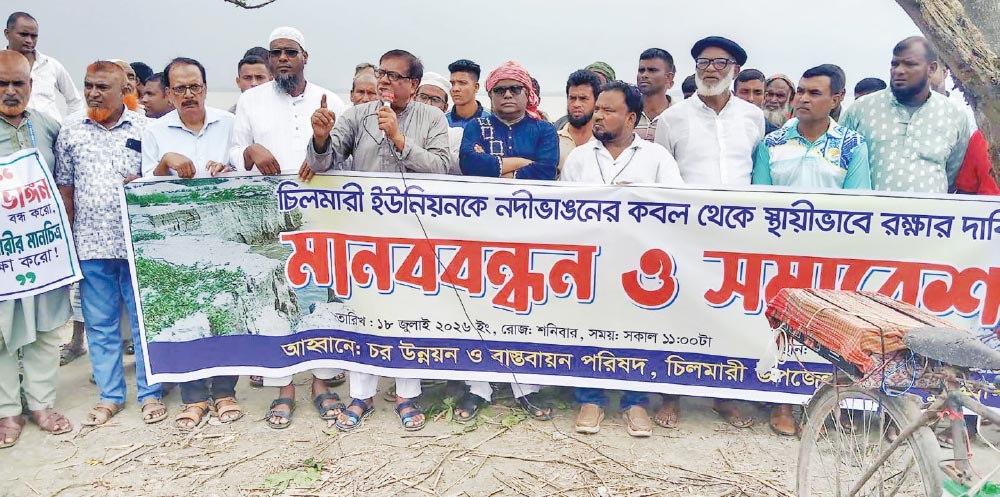 CHILMARI , KURIGRAM, July 18: Thousands of river erosion victims formed a human chain and held a rally in Kurigram's Chilmari Upazila on Saturday, demanding urgent measures to protect the area from the relentless erosion of the Brahmaputra River.
The programme was held at the erosion-hit Bishalpara area, where participants called for immediate riverbank protection works, rehabilitation of affected families and the creation of a separate ministry for the development of char (river island) areas.
The rally was chaired by Prof Shafiqul Islam Bebu, President of the Kurigram Char Development and Implementation Council. Among those who addressed the gathering were freedom fighter and Chilmari Upazila BNP Convener Abdul Bari Sarkar, the council's Senior Vice-President Principal Khaza Sharif Uddin Ahmed Rintu, Chilmari unit President Assistant Professor Abu Hanifa, Member Secretary Assistant Professor Fazlul Haque, Sonali Othith Football Club General Secretary Wazed Ali Jhinuk, Chilmari Union Parishad Chairman Aminul Islam Kazi, women's leader Shahnaz Sultana, and erosion victims Asir Uddin and Shahjahan Ali.
Speakers said the Brahmaputra's continuous erosion washes away homes, cropland, educational institutions and other infrastructure every year, leaving thousands of families homeless and destitute. They urged the authorities to implement sustainable riverbank protection measures.
Prof Bebu said erosion is currently affecting at least 42 locations along 16 rivers in Kurigram District. Over the past decade, nearly 200,000 people have lost their homes and been forced to relocate, yet no government agency maintains comprehensive data on erosion-affected families.
He said erosion victims lose not only land and property but also their memories, livelihoods and social ties. Many families remain uncertain about where they will seek shelter or keep their children and livestock during floods.
Referring to countries such as the Netherlands, Canada, the UK and Colombia, he said erosion victims there receive prompt compensation and rehabilitation, while Bangladesh still lacks an effective mechanism.
He also claimed that more than 20 million people in about 100 upazilas across 32 districts are affected by river erosion and the challenges of living in char areas. To address these issues, he called for establishing a separate ministry for char affairs, similar to the Ministry of Chittagong Hill Tracts Affairs.
The rally also demanded a long-term river management plan, adequate compensation and rehabilitation for affected families, and improved education, healthcare and transport services in char regions.
Loading...
Loading...
Also read



Editor : Iqbal Sobhan Chowdhury
Published by the Editor on behalf of the Observer Ltd. from Globe Printers, 24/A, New Eskaton Road, Ramna, Dhaka.
Editorial, News and Commercial Offices : Aziz Bhaban (2nd floor), 93, Motijheel C/A, Dhaka-1000.
Phone: PABX- 41053001-06; Advertisement: 41053012; 01793317829, 01550707291, E-mail: [email protected], [email protected] Online: email: [email protected] 41053014; 01550707297 Advertisement: 01550707296
Published by the Editor on behalf of the Observer Ltd. from Globe Printers, 24/A, New Eskaton Road, Ramna, Dhaka.
Editorial, News and Commercial Offices : Aziz Bhaban (2nd floor), 93, Motijheel C/A, Dhaka-1000.
Phone: PABX- 41053001-06; Advertisement: 41053012; 01793317829, 01550707291, E-mail: [email protected], [email protected] Online: email: [email protected] 41053014; 01550707297 Advertisement: 01550707296


