



| HEADLINE |

|
One year of Milestone tragedy: Little progress on removing hazardous buildings


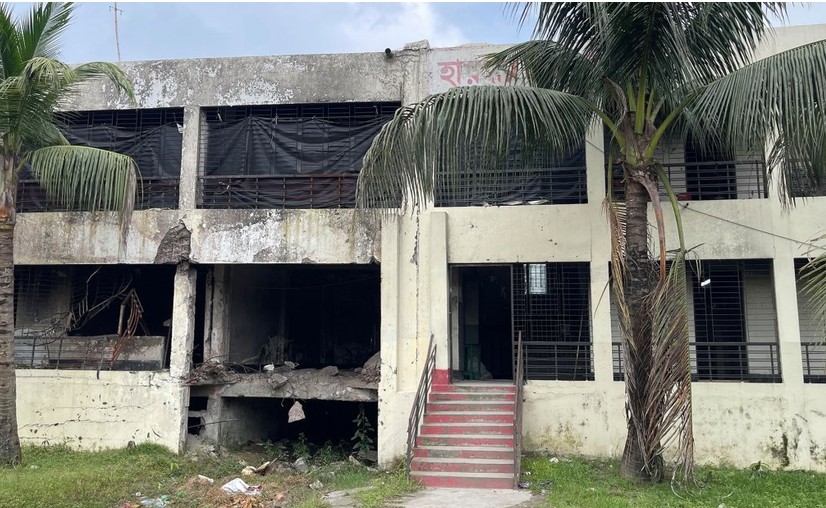
One year after a Bangladesh Air Force FT-7BGI training aircraft crashed on Milestone School and College compound in Dhaka's Uttara, most of the key safety measures ordered by the Rajdhani Unnayan Kartripakkha (RAJUK) remain unimplemented, while hundreds of potentially hazardous buildings continue to stand around Hazrat Shahjalal International Airport.
The findings are based on RAJUK documents, minutes from inter-agency meetings, interviews with relevant officials, and discussions with urban planners, aviation experts, and families affected by the tragedy.
An investigation found that despite multiple inter-agency meetings, recommendations, and policy discussions over the past year, there has been no visible progress in removing high-risk structures surrounding the airport.
RAJUK Chairman Engineer Md Riazul Islam Rizu said the agency has identified 630 problematic buildings constructed between 2015 and 2025. However, legal proceedings and demolition efforts remain incomplete in most cases.
An investigation found that despite multiple inter-agency meetings, recommendations, and policy discussions over the past year, there has been no visible progress in removing high-risk structures surrounding the airport.
RAJUK Chairman Engineer Md Riazul Islam Rizu said the agency has identified 630 problematic buildings constructed between 2015 and 2025. However, legal proceedings and demolition efforts remain incomplete in most cases.
He said disagreements between RAJUK and the Civil Aviation Authority of Bangladesh (CAAB) over building-height assessments and technical issues have delayed the implementation.
7 Emergency Safety Directives Issued
According to documents from RAJUK's Chief Engineer's Office, seven emergency safety directives were issued following the July 21, 2025 crash. These included: demolition of the crash-damaged building; removal of U-shaped tin-shed structures and the three-storey English Version academic building located within the MRT depot safety buffer zone; strict enforcement of approved land-use classifications; closure of unauthorized hostel operations; compliance with the Bangladesh National Building Code (BNBC) 2020 on fire and structural safety; identification of buildings exceeding CAAB's height restrictions in Uttara Sectors 5, 12 and 14; formulation of an Air Funnel Zone policy to regulate high-density development along aircraft approach and departure corridors.
According to documents from RAJUK's Chief Engineer's Office, seven emergency safety directives were issued following the July 21, 2025 crash. These included: demolition of the crash-damaged building; removal of U-shaped tin-shed structures and the three-storey English Version academic building located within the MRT depot safety buffer zone; strict enforcement of approved land-use classifications; closure of unauthorized hostel operations; compliance with the Bangladesh National Building Code (BNBC) 2020 on fire and structural safety; identification of buildings exceeding CAAB's height restrictions in Uttara Sectors 5, 12 and 14; formulation of an Air Funnel Zone policy to regulate high-density development along aircraft approach and departure corridors.
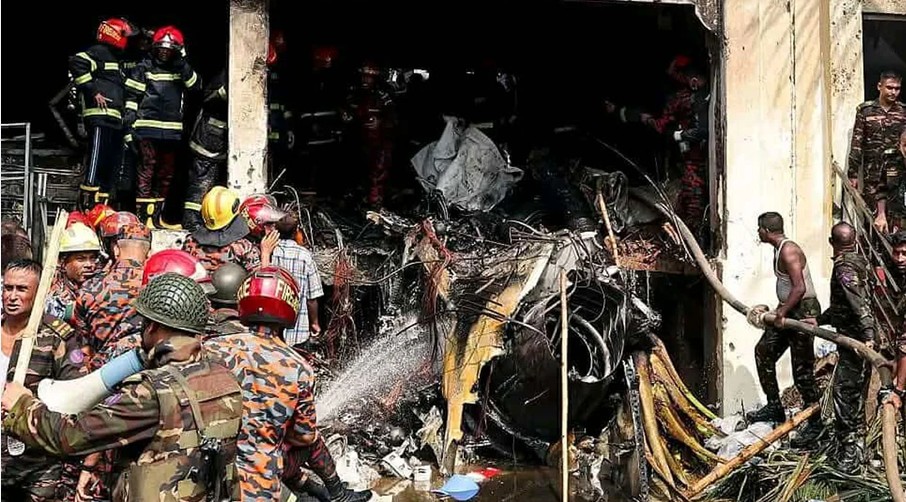
The FT-7BGI training aircraft crashed into the Haider Ali building at Milestone School and College's Diabari campus on this day last year, killing 36 people, mostly children.
The investigation commission said Flight Lt Toukir Islam had not received flying training with sufficient continuity, affecting his proficiency and ability to respond to the emergency. It also found inadequate supervision by his officer commanding or ground supervisor.
The investigation commission said Flight Lt Toukir Islam had not received flying training with sufficient continuity, affecting his proficiency and ability to respond to the emergency. It also found inadequate supervision by his officer commanding or ground supervisor.
Closed-circuit camera footage showed a black mark on the aircraft’s windscreen before the crash. The air force’s internal inquiry said it could have been caused by a bird strike or another airborne object.
Victims' Families Demand Accountability
Relatives of those affected by the Milestone tragedy say regulatory agencies cannot avoid responsibility by shifting blame onto one another.
''After such a major disaster, one institution cannot simply blame another to escape accountability. People want to know why these risks were allowed to develop in the first place and who was responsible,'' a family member said.
They argue that despite numerous committees and meetings over the past year, progress has remained largely confined to paperwork, while most of the underlying safety risks remain unresolved.
''After such a major disaster, one institution cannot simply blame another to escape accountability. People want to know why these risks were allowed to develop in the first place and who was responsible,'' a family member said.
They argue that despite numerous committees and meetings over the past year, progress has remained largely confined to paperwork, while most of the underlying safety risks remain unresolved.
Experts Warn of Future Risks
BUET professor Hadiuzzaman said international aviation safety standards require strict protection of airport air funnel zones.
''Delays in implementing safety recommendations will leave Bangladesh vulnerable to similar accidents in the future. Protecting the air funnel zone requires not only regulations but also effective land-use control."
S.K. Mehedi Hasan, General Secretary of the Bangladesh Institute of Planners (BIP), said the Milestone tragedy reflects a longstanding national pattern.
"A major accident occurs, an investigation committee is formed, recommendations are made, agencies become active for a short period, and then everything gradually fades away. Before the recommendations are implemented, attention shifts elsewhere. When another accident happens, the same discussion begins again," he added.
BUET professor Hadiuzzaman said international aviation safety standards require strict protection of airport air funnel zones.
''Delays in implementing safety recommendations will leave Bangladesh vulnerable to similar accidents in the future. Protecting the air funnel zone requires not only regulations but also effective land-use control."
S.K. Mehedi Hasan, General Secretary of the Bangladesh Institute of Planners (BIP), said the Milestone tragedy reflects a longstanding national pattern.
"A major accident occurs, an investigation committee is formed, recommendations are made, agencies become active for a short period, and then everything gradually fades away. Before the recommendations are implemented, attention shifts elsewhere. When another accident happens, the same discussion begins again," he added.
Loading...
Loading...
Also read






Editor : Iqbal Sobhan Chowdhury
Published by the Editor on behalf of the Observer Ltd. from Globe Printers, 24/A, New Eskaton Road, Ramna, Dhaka.
Editorial, News and Commercial Offices : Aziz Bhaban (2nd floor), 93, Motijheel C/A, Dhaka-1000.
Phone: PABX- 41053001-06; Advertisement: 41053012; 01793317829, 01550707291, E-mail: [email protected], [email protected] Online: email: [email protected] 41053014; 01550707297 Advertisement: 01550707296
Published by the Editor on behalf of the Observer Ltd. from Globe Printers, 24/A, New Eskaton Road, Ramna, Dhaka.
Editorial, News and Commercial Offices : Aziz Bhaban (2nd floor), 93, Motijheel C/A, Dhaka-1000.
Phone: PABX- 41053001-06; Advertisement: 41053012; 01793317829, 01550707291, E-mail: [email protected], [email protected] Online: email: [email protected] 41053014; 01550707297 Advertisement: 01550707296


