



| HEADLINE |

|
Contractual appointments ignore merit in civil service: Experts
10 to 11 of the country's approximately 80 secretary-level officials are currently serving on contractual terms
Published : Thursday, 23 July, 2026 at 12:00 AM
Special Correspondent


 Public administration experts have called for sweeping reforms to Bangladesh's civil service, warning that the growing dependence on contractual appointments to top bureaucratic posts, coupled inconsistent personnel decisions, is steadily eroding meritocracy, institutional continuity and administrative efficiency.
Their concerns have resurfaced amid fresh debates over repeated appointment reversals, the prolonged retention of officials as Officers on Special Duty (OSD), delayed promotions and perceived flaws in the government's vetting and promotion process.
Administrative analysts say contractual appointments have traditionally been reserved for exceptional circumstances, particularly where highly specialized expertise is unavailable within the regular civil service. However, they argue that the practice has expanded significantly in recent years.
According to experts, around 10 to 11 of the country's approximately 80 secretary-level officials are currently serving on contractual terms. Several of the government's most influential positions�"including the Cabinet Secretary, Principal Secretary to the Prime Minister, Public Administration Secretary and Home Secretary�"are occupied by contractual appointees. As members of the Superior Selection Board (SSB), these officials also play a central role in determining promotions, postings and other key personnel decisions across the bureaucracy.
Experts noted that both the previous interim administration and the current elected government have defended contractual appointments by arguing that many experienced officers had previously been deprived of promotion opportunities. However, analysts questioned whether political considerations have increasingly outweighed merit in senior appointments, with successive governments often placing trusted officials in strategic administrative positions.
Governance expert and SUJAN Secretary Badiul Alam Majumdar expressed concern over appointing officials who return to active service after spending 10 to 15 years outside regular administration.
He said Bangladesh's bureaucracy has undergone a major digital transformation during that period through electronic file management, online approvals and integrated digital governance systems, raising questions about how long-absent officials can quickly adapt to modern administrative practices.
Quoting a former Cabinet Secretary, Badiul said appointing one contractual secretary effectively delays the promotion of at least four career officers by blocking advancement at successive levels�"from secretary to additional secretary, joint secretary and deputy secretary.
He also criticized repeated reversals of administrative decisions, citing instances where appointment orders were cancelled shortly after being issued before revised notifications were published. Such inconsistencies, he said, raise questions about the effectiveness of the government's vetting process.
Analysts also pointed to broader structural challenges, including prolonged OSD status for experienced officers, compulsory retirements, delayed promotions in non-administration cadres and the continued use of supernumerary positions to facilitate promotions for certain groups of officials.
They argued that these practices have reduced the availability of experienced officers for regular administrative responsibilities while creating disparities among different civil service cadres.
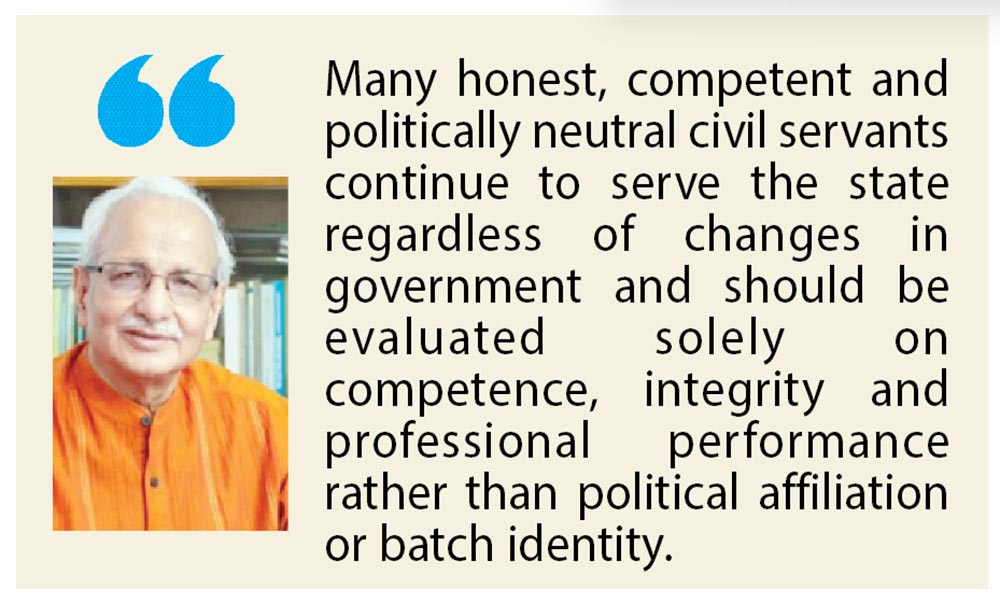
Badiul said, “Many honest, competent and politically neutral civil servants continue to serve the state regardless of changes in government and should be evaluated solely on competence, integrity and professional performance rather than political affiliation or batch identity.”
Loading...
Loading...
Also read



Editor : Iqbal Sobhan Chowdhury
Published by the Editor on behalf of the Observer Ltd. from Globe Printers, 24/A, New Eskaton Road, Ramna, Dhaka.
Editorial, News and Commercial Offices : Aziz Bhaban (2nd floor), 93, Motijheel C/A, Dhaka-1000.
Phone: PABX- 41053001-06; Advertisement: 41053012; 01793317829, 01550707291, E-mail: [email protected], [email protected] Online: email: [email protected] 41053014; 01550707297 Advertisement: 01550707296
Published by the Editor on behalf of the Observer Ltd. from Globe Printers, 24/A, New Eskaton Road, Ramna, Dhaka.
Editorial, News and Commercial Offices : Aziz Bhaban (2nd floor), 93, Motijheel C/A, Dhaka-1000.
Phone: PABX- 41053001-06; Advertisement: 41053012; 01793317829, 01550707291, E-mail: [email protected], [email protected] Online: email: [email protected] 41053014; 01550707297 Advertisement: 01550707296


