



| HEADLINE |

|

The Promise of a Pen
Published : Saturday, 8 August, 2026 at 12:00 AM
Farid Ahmad


 Every morning, just before the clock struck nine, the small house came alive with the same familiar voice. "Romeo! Breakfast is getting cold. Poorna will be here any minute." Mrs. Rani's call drifted through every room, warm and reassuring, mingling with the rickshaw bells and the vegetable seller's cries from the lane outside. Upstairs, twelve-year-old Romeo was turning his room upside down in search of his missing blue pen.
"You've lost it again?" his mother called.
"I'll find it!"
A moment later he emerged, slightly breathless, the pen tucked behind his ear as though it had been there all along.
Mrs. Rani laughed. "One day you'll lose everything except your kind heart."
"I hope not," Romeo replied, slipping into his chair.
She placed a plate of hot parathas before him and handed him his tiffin box.
"Take this with you."
Romeo frowned. "Everyone buys snacks at school. Homemade food looks old-fashioned."
Mrs. Rani smiled as she poured him a glass of water.
"Then let everyone buy snacks. Now finish your breakfast."
Before Romeo could think of another argument, the doorbell rang.
Poorna stepped inside with her usual cheerful smile. She and Romeo had studied together since elementary school. They argued over mathematics, borrowed each other's books, and laughed over jokes that nobody else found amusing. Adults sometimes noticed the differences between them. The children never did.
"I brought you something," Poorna said, carefully unwrapping a bundle of damp newspaper.
Inside lay a tiny papaya sapling.
"I planted several seeds at my grandmother's village," she explained. "This one was the strongest."
Romeo accepted the little plant as though it were something precious.
"It already has four leaves."
"It'll have many more if you look after it."
"I will."
As they entered the house, Poorna noticed a shy teenage girl standing quietly near the kitchen, her hands folded before her.
"I haven't seen her before."
Mrs. Rani glanced towards the girl.
"This is Maya. She came to us last week."
She could not have been older than thirteen. Since her father's death, her widowed mother had struggled to raise five daughters and had finally sent Maya to work in the city.
Poorna smiled gently.
"Have you ever been to school?"
Maya shook her head.
"There was a school in our village," she said softly. "But my father didn't think girls needed education."
For a brief moment, the room fell silent.
Then Romeo smiled.
"Maybe nobody told him that girls can be better students than boys."
The corners of Maya's lips lifted into the faintest smile.
Romeo handed her the sapling.
"Come on. Let's plant it."
The three children walked into the small garden behind the house. Romeo dug a shallow hole while Maya lowered the sapling into the earth. Poorna gently pressed the soil around its roots.
From the veranda, Mrs. Rani watched them with quiet satisfaction.
"Trees grow where they are cared for," she said.
No one replied.
The little tree swayed gently in the morning breeze, unaware that it had just become part of their story.
That afternoon, while looking for the same blue pen yet again, Romeo wandered onto the back veranda.
Maya sat alone with an old newspaper spread across her lap.
She was tracing the printed letters with her fingertip, slowly moving from one line to another.
"Can you read?" Romeo asked.
She looked up and shook her head.
"I only like looking at the letters."
"They don't have to remain strangers," Romeo said.
Maya looked at him, uncertain.
"Would you like to learn?"
She did not answer immediately.
Instead, she nodded.
It was a small gesture, almost hesitant.
Neither of them realized that it would become the beginning of a journey that would change them both.
The lessons began the very next evening.
After finishing his homework, Romeo cleared one corner of the dining table and spread out an old primer, a worn exercise book and his blue pen. As usual, he spent a minute searching for the pen before discovering it inside his mathematics book.
Poorna laughed.
"You'll never change."
"Probably not," Romeo admitted.
He placed the pen gently before Maya.
"We'll begin with this."
She hesitated.
"What if I spoil it?"
"It's only a pen," Romeo said. "It becomes valuable when someone uses it."
Maya picked it up carefully, holding it as though it might slip through her fingers.
Romeo wrote the first letter of the alphabet on the page.
"Now you try."
Her hand trembled. The first line leaned awkwardly, the second even more so. Embarrassed, she put the pen down.
"I can't."
"You've only just begun," Romeo said. "Nobody learns to write in one evening."
Poorna pulled a chair beside her.
"And nobody learns without making mistakes."
The lessons soon became part of the household routine.
Every afternoon, after school, Romeo completed his homework before calling Maya to the dining table. Some days Poorna joined them; on others she left little notes with new words for Maya to practise. Mrs. Rani often listened from the kitchen, smiling quietly as unfamiliar letters slowly turned into words.
Weeks passed.
Maya began recognizing signboards on the road to the market. She read bus destinations aloud, sounded out newspaper headlines and copied shopping lists into a small notebook Mrs. Rani had given her.
One evening Romeo pushed the exercise book towards her.
"Today you won't copy anything. Write something of your own."
Maya looked at the blank page for a long moment.
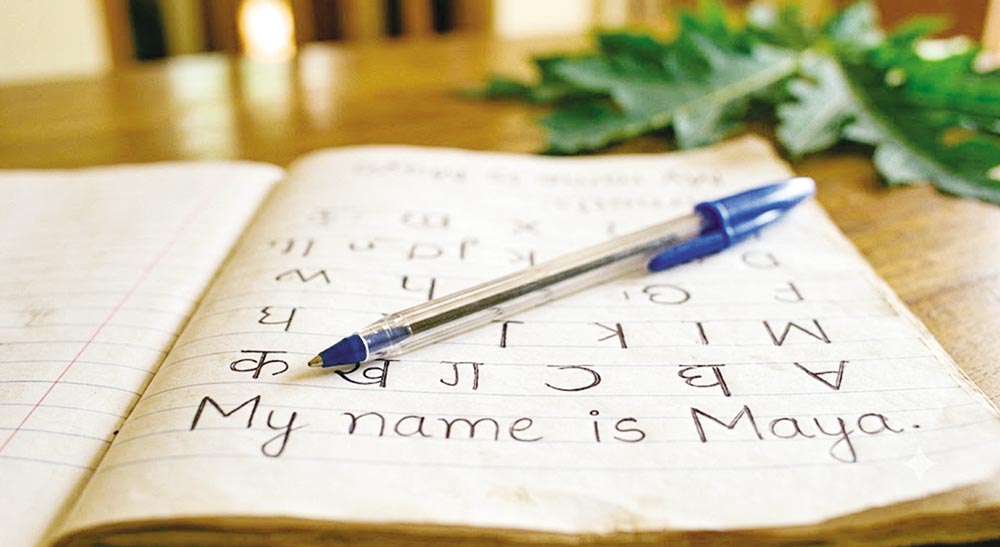
Then, slowly and carefully, she wrote:
My name is Maya.
She traced the letters lightly with her fingertip, hardly believing they were her own. Until that moment, her name had lived only in the voices of others. Now she had written it herself.
Mrs. Rani looked over Maya's shoulder.
"You wrote that all by yourself?"
Maya nodded.
Mrs. Rani smiled.
"Very good."
Maya smiled shyly.
It was the broadest smile they had seen on her face.
From then on, confidence came as steadily as the words themselves.
She labelled spice jars in the kitchen, wrote shopping lists and sometimes surprised Romeo by reading short newspaper reports before he did.
One afternoon Ruby, Romeo’s elder sister, returned home from college carrying several forms.
"Our department has started a literacy program," she announced over lunch. "Each student is expected to teach someone who has never had the chance to go to school."
"That's a wonderful idea," Mrs. Rani said.
Ruby nodded.
"It is. Though some students seem more interested in the marks than the teaching."
A few days later, her wealthy friend Monalisa came to visit.
While waiting for Ruby, she noticed a neatly written shopping list on the dining table.
"Who wrote this?"
"Maya," Mrs. Rani replied.
"The house assistant?"
Mrs. Rani smiled.
"The very same."
Monalisa looked genuinely surprised.
When Maya entered with a tray of tea, Monalisa asked her to write a few lines on a blank sheet of paper.
She did.
Monalisa studied the page thoughtfully.
Later she spoke to Ruby in private, but Romeo happened to overhear part of the conversation.
"If Maya appears in the literacy assessment under my project," Monalisa said, "I'll receive full credit."
Ruby looked uncomfortable.
"That isn't really the purpose."
"It won't hurt anyone."
Romeo stepped into the room.
"It might."
The two young women turned towards him.
"If Maya writes for someone else," he asked quietly, "what will she learn?"
No one answered.
He continued after a moment.
"If she helps you, then the girls who work in your house should also get the chance to study."
The room fell silent.
Monalisa lowered her eyes.
After a while she said quietly, "Perhaps I hadn't thought about it that way."
Ruby smiled.
"I think you've just learned something yourself."
The conversation ended there, but something had changed.
For Monalisa, the literacy program was no longer simply another college assignment.
For Maya, it was another reminder that learning was not something to be borrowed or borrowed from. It was something that slowly became part of a person's life.
That evening, as they finished their lesson, Romeo held out the familiar blue pen.
"I think this belongs to you now."
Maya looked surprised.
"I can't take your pen."
"You can."
"But you'll need it."
Romeo laughed.
"I'll probably lose another one tomorrow."
For the first time, Maya accepted the pen without hesitation.
She slipped it carefully into her exercise book before closing it, as though she were protecting something far more valuable than plastic and ink.
Winter arrived quietly.
The papaya sapling had grown into a healthy young plant, its broad leaves reaching towards the pale morning sun. Almost every few days, Romeo paused to see how much taller it had become.
"So it's winning the race," Poorna teased.
"What race?"
"The one between you and the tree."
Romeo laughed. "I'm still taller."
"For now."
Life settled into its familiar rhythm. Maya's lessons continued, and the dining table remained their little classroom each evening. She now read newspaper headlines aloud to Mrs. Rani, kept the household shopping list, and sometimes smiled when Romeo misspelled a difficult word.
Then, one Friday afternoon, the doorbell rang.
Standing outside was a weary woman in a faded cotton sari. Dust clung to its hem, as though the long journey from the village had travelled with her.
"Mother!"
Maya hurried to embrace her.
After tea had been served, the conversation slowly turned serious.
"I've come to take Maya home for a few days," Chapa said quietly.
Mrs. Rani smiled. "That's good. She has been missing you."
Chapa hesitated. Then she lowered her eyes.
"A marriage proposal has come."
The smile faded from Mrs. Rani's face.
"So soon?"
Chapa nodded. "The boy drives a private car in the nearby town. People say he is honest. His family hasn't asked for dowry."
She paused before adding, almost apologetically, "Since my husband died, feeding five daughters has become harder every month. I don't know how much longer I can manage."
Mrs. Rani was silent for a moment.
"You should have told us earlier," she said gently.
Chapa gave a weary smile. "Everyone has their own burdens."
"Even so," Mrs. Rani replied, "you shouldn't have had to carry this one alone."
She looked towards Maya, who sat quietly by the window.
"It isn't easy raising five daughters by yourself."
Chapa's eyes filled with tears.
After a long pause, Mrs. Rani said softly, "I wish our society made life a little easier for mothers like you."
No one spoke for a while.
Before they left, Mrs. Rani quietly slipped an envelope into Chapa's hand.
"I can't accept this," Chapa protested.
"You can."
"It is too much."
Mrs. Rani closed the woman's fingers around the envelope.
"It isn't charity. Think of it as one mother standing beside another."
Tears welled in Chapa's eyes.
That evening, Maya packed the few things she owned: two dresses, an exercise book filled with careful handwriting, and the blue pen she treasured most.
Poorna watched silently.
"You'll write to us?"
"I will."
"And you'll keep teaching yourself?"
Maya smiled.
"I don't want to stop now."
When she stepped into the garden, she paused beside the papaya tree.
"It has grown so much."
Romeo nodded.
"It still needs looking after."
Maya gently touched one of its leaves.
"So do people."
The next morning, Romeo and Poorna walked with Maya and her mother to the end of the lane.
The winter mist had not yet lifted.
Maya waved once before boarding the bus.
Then she was gone.
The evenings felt strangely quiet after that.
The chair beside the dining table remained empty.
Romeo still misplaced his pens.
But no one waited for them anymore.
Only the papaya tree continued to grow.
Weeks turned into months.
One rainy afternoon, the postman delivered a letter.
Romeo recognized the handwriting before opening the envelope.
It was Maya's.
He unfolded the letter carefully.
Dear Teacher,
I wanted to keep my promise, but I was married soon after reaching home.
Please don't be unhappy with me.
My husband is kind. When I told him that I had learned to read and write, he said I should never stop learning.
Every evening I gather the children from our neighborhood and teach them the alphabet, just as you taught me.
The blue pen you gave me is still with me.
I want every girl in this village to know how to write her own name.
Please give my respects to Uncle and Aunty.
Tell Poorna I still remember the papaya tree.
Your grateful student,
Maya
Romeo folded the letter and looked towards the kitchen.
"Ma..."
Mrs. Rani came over, drying her hands on the end of her sari.
"What is it?"
Without a word, Romeo handed her the letter.
She read it quietly from beginning to end. When she finished, she folded it carefully and returned it to him.
"She hasn't forgotten," she said softly.
Romeo nodded.
A few moments later, he walked into the garden.
The little sapling Poorna had brought from her grandmother's village had grown into a young tree, its broad green leaves sheltering the season's first papayas.
He rested his hand against the trunk.
Years ago, three children had planted a tree there.
None of them had realized that another seed had been planted the same morning.
He smiled. Maya had learned to read. Somehow, it felt as though they had both been students.
Romeo looked up at the papaya tree and thought of the blue pen he had once been so afraid of losing.
Perhaps some things were meant to be passed on.
Somewhere, in a distant village, Maya was helping a little girl write her name for the very first time.

Loading...
Loading...



Editor : Iqbal Sobhan Chowdhury
Published by the Editor on behalf of the Observer Ltd. from Globe Printers, 24/A, New Eskaton Road, Ramna, Dhaka.
Editorial, News and Commercial Offices : Aziz Bhaban (2nd floor), 93, Motijheel C/A, Dhaka-1000.
Phone: PABX- 41053001-06; Advertisement: 41053012; 01793317829, 01550707291, E-mail: [email protected], [email protected] Online: email: [email protected] 41053014; 01550707297 Advertisement: 01550707296
Published by the Editor on behalf of the Observer Ltd. from Globe Printers, 24/A, New Eskaton Road, Ramna, Dhaka.
Editorial, News and Commercial Offices : Aziz Bhaban (2nd floor), 93, Motijheel C/A, Dhaka-1000.
Phone: PABX- 41053001-06; Advertisement: 41053012; 01793317829, 01550707291, E-mail: [email protected], [email protected] Online: email: [email protected] 41053014; 01550707297 Advertisement: 01550707296


