



| HEADLINE |

|
Commentary
Our public hospitals held hostage by ‘Dalals' Will it change?
Published : Tuesday, 28 July, 2026 at 12:00 AM
Observer Special


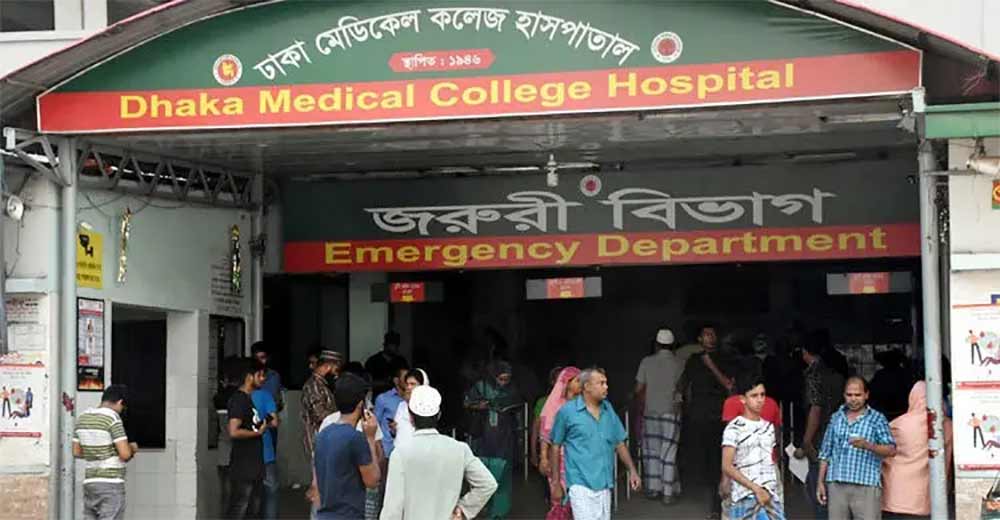 News reports and secret video recordings from Dhaka's leading public hospitals are almost regularly exposing a disturbing reality: Organised broker syndicates, in collaboration of hospital staffs, operating openly at hospital entrances while targeting distressed patients and their confused relatives before they can even reach a doctor. Despite periodic crackdowns by the Rapid Action Battalion (RAB), police and mobile courts, these brokers or intermediaries continue to lure patients to private healthcare facilities in exchange for commissions by turning treatment and desperation into a profitable business. Their wider and constant presence suggest that the problem extends beyond individual offenders, and more about an organised criminal ecosystem that has proved remarkably resilient. Hospital authorities either keep a blind eye or patronise the hospital staff to continue the illegal syndicate causing sufferings and harassment of patients and their attendants.
 However, for decades, these middlemen have thrived in and around the country's public healthcare facilities. They target patients arriving from rural areas, particularly the elderly and distressed family members unfamiliar with the hospital system. Through deception, intimidation and false promises, they then divert patients to private clinics, diagnostic centres and hospitals in exchange for hefty commissions.
The problem is neither new nor hidden, but dangerously continues to flourish.
Reflecting back in the last six months, law-enforcement operations, as reported in the media clearly demonstrate both the scale and persistence of this patient brokering syndicate business.
In March 2026, a joint operation at Dhaka Medical College Hospital (DMCH) detained around 50 suspected brokers, with 33 receiving jail sentences and financial penalties. Authorities stated that many had been exploiting patients for a long period. In May, police detained another 40 suspected brokers during another anti-broker drive at DMCH. And earlier, in June, the Rapid Action Battalion (RAB) detained 13 suspected brokers from three government hospitals in Dhaka, including medical facilities in Sher-e-Bangla Nagar.
Moreover, intelligence reports too, have mentioned the existence of organised networks harassing and misleading patients.
As far as reprimanding the dalals are concerned, the pattern is unmistakable. Authorities conduct raids, dozens are arrested, some are jailed, and yet the syndicates return. This raises an uncomfortable question: If arrests alone were sufficient, why does the problem persist year after year?
The answer is simple. We are fighting a twenty-first-century criminal enterprise with twentieth-century methods.
The broker economy survives because it exploits information weaknesses and irregularities. A frightened patient arriving at a crowded hospital often has no idea where to go, which counter to approach, how to obtain a ticket, where a specialist sits, or how long treatment will take. The broker fills this information vacuum. There are paid staffs at the reception and information desk. But seldom proper persons are either not available or he or she is not sincere to help the patients or their attendants.
Many patients are falsely told that doctors are unavailable, hospital beds are full, tests cannot be performed, or treatment quality is poor. They are then directed to private hospitals where cut or commission is embedded in consultation fees, diagnostic charges and hospital bills. The result is unnecessary expenses, repeated tests and in some cases, treatment at dubious hospitals that may lack adequate oversight. He Health Minister announced a nationwide campaign to eliminate broker syndicates from public hospitals and warned hospital authorities that action would be taken if such activities continued on their premises. The government has also expanded help desks and strengthened security arrangements. But the situation did not improve. Will the Health Minister and his Ministry would be sincere and serious to monitor whether their decisions are properly carried out.
However, we believe law enforcement alone cannot solve a system that has become deeply entrenched.
Technology must now become the government's most powerful weapon.
First, every major public hospital should introduce a fully digital patient-navigation system. From registration to consultation, every step should be visible through mobile applications, digital kiosks and electronic displays. Patients should know exactly where to go without relying on unofficial guides.
Second, hospitals should implement QR-code-based appointment and queue management systems. A patient should be able to verify their queue position instantly on a mobile phone or display board. This would eliminate opportunities for brokers to sell fake priority access or manipulate waiting lists.
Third, artificial intelligence-powered surveillance systems should be installed at hospital entrances, emergency departments and outpatient areas. Modern video analytics can identify suspicious behaviour patterns, repeated solicitation of patients and unauthorised movement within sensitive zones. Airports, ports and financial institutions already use such technologies. Public hospitals should do the same.
Fourth, a national healthcare hotline and mobile application should allow patients to report broker activities anonymously in real time. Every complaint should generate a digital case number and be monitored centrally by the Ministry of Health.
Fifth, all licensed private hospitals, clinics and diagnostic centres should be integrated into a national referral database. If an unusually high number of patients are being referred to a particular hospital from a specific location, authorities should be alerted automatically. Data analytics can reveal patterns that manual investigations often miss.
Sixth, biometric identification for hospital support services could reduce opportunities for unauthorised intermediaries to operate inside hospital premises. Access to sensitive zones should be restricted to verified staff and authorised attendants only.
Countries around the world are increasingly using digital health technologies to improve transparency, reduce corruption and strengthen patient protection. Bangladesh has already embraced digital financial services, e-governance platforms and online public services. There is no reason why our healthcare sector should remain dependent on paper-based systems that create opportunities for corruption harassment and exploitation.
The reality is that every broker standing at a hospital gate represents a failure of information, accountability and technology. Their existence undermines public trust in government hospitals and places an additional burden on people who are already facing illness, anxiety and financial hardship. Generally patients and their attendants give priority to public hospitals as the doctors are renowned and more experienced and the treatments are comparatively economic and less expensive than private hospitals and clinics.
Though we find efforts of RAB, the police, mobile courts and hospital authorities - Yet arrests alone are not enough. The fact that brokers continue to be detained every few month shows that the system itself remains vulnerable.
If the government truly wants to dismantle the ‘dalal’ business and service in public hospitals, it must move beyond periodic crackdowns and embrace a technology-driven strategy. The objective should not merely be to arrest brokers after the damage is done. It should be to make brokering impossible in the first place.
Patients come to hospitals seeking treatment, not to fall into traps. It is time to ensure that the first person they meet is a healthcare professional�"not a ‘dalal’ at our public hospitals and government health care services.
Loading...
Loading...
Also read



Editor : Iqbal Sobhan Chowdhury
Published by the Editor on behalf of the Observer Ltd. from Globe Printers, 24/A, New Eskaton Road, Ramna, Dhaka.
Editorial, News and Commercial Offices : Aziz Bhaban (2nd floor), 93, Motijheel C/A, Dhaka-1000.
Phone: PABX- 41053001-06; Advertisement: 41053012; 01793317829, 01550707291, E-mail: [email protected], [email protected] Online: email: [email protected] 41053014; 01550707297 Advertisement: 01550707296
Published by the Editor on behalf of the Observer Ltd. from Globe Printers, 24/A, New Eskaton Road, Ramna, Dhaka.
Editorial, News and Commercial Offices : Aziz Bhaban (2nd floor), 93, Motijheel C/A, Dhaka-1000.
Phone: PABX- 41053001-06; Advertisement: 41053012; 01793317829, 01550707291, E-mail: [email protected], [email protected] Online: email: [email protected] 41053014; 01550707297 Advertisement: 01550707296


