



| HEADLINE |

|

Retrofitting dilapidated buildings is JnU’s top priority
Published : Wednesday, 5 August, 2026 at 12:00 AM
Tanvir Raihan


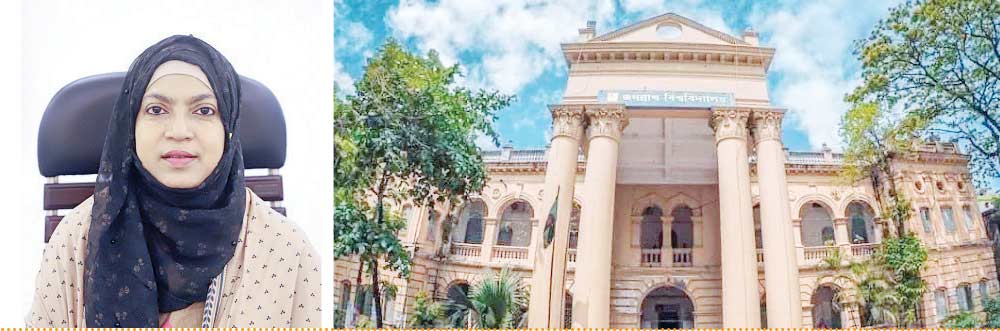 Jagannath University (JnU) continues to face significant infrastructure constraints, with its academic and administrative activities being conducted on just 11 acres of land. Limited space, ageing buildings, budgetary constraints, delays in the second campus project and the university's modest position in international rankings remain major challenges.
In an exclusive interview with Tanvir Raihan of The Daily Observer, Jagannath University Treasurer Professor Dr. Sabina Sharmin said the administration has initiated a series of reforms, including retrofitting dilapidated buildings, reviving the long-delayed second campus project, introducing financial support for research scholars, establishing a dedicated committee to improve international rankings and launching digital monitoring systems to strengthen academic and administrative accountability. The following are excerpts from the interview.
DO: What measures have been taken to address the university's infrastructure crisis?
Treasurer: Infrastructure has always been Jagannath University's greatest weakness. This is not a new problem; rather, it has existed since the university's establishment. Operating on only 11 acres of land with a handful of buildings is far from adequate for our current number of students and faculty members.
Since there is little scope for expanding the existing campus, we are focusing on making the available infrastructure safer and more functional. After I joined as Treasurer on October 24 last year, we found that parts of the administrative building had become structurally vulnerable. In one incident, pieces of brick fell from the ceiling, posing a serious safety risk to employees. We immediately initiated strengthening and renovation work on the heritage administrative building.
Later, similar structural problems emerged in the Science Building. We subsequently launched retrofitting and structural reinforcement there as well. Although the University Grants Commission (UGC) provided only limited funding, we have begun the necessary renovation work with the available allocation.
DO: How challenging is the university's budget situation?
Treasurer: In the last fiscal year, our revised revenue budget stood at around Tk 230 crore. Of that amount, nearly Tk 132 crore was spent on salaries and allowances for teachers, officers and staff. As a result, only a very small portion remains for infrastructure development. It is extremely difficult to undertake major renovation or expansion projects with just Tk 50 to 60 lakh available for development.
DO: What is the current status of the second campus project?
Treasurer: When we assumed office, we found that the first phase of the second campus project was on the verge of being cancelled due to repeated delays. However, the second campus is a dream project for Jagannath University. Under the leadership of the Vice-Chancellor, we worked intensively with the relevant authorities to revive the project.
The project's implementation period has now been extended until December 2026, and the Bangladesh Army is currently overseeing its execution. Our goal is to complete the first phase within the revised deadline.
DO: What new initiatives have been taken to promote research?
Treasurer: Previously, MPhil and PhD researchers did not receive any financial incentives. Beginning last fiscal year, we introduced honoraria for research scholars. Although the amount is modest, it represents an important step toward encouraging research. We hope to increase this support in the future.
DO: What is being done to improve the university's international ranking?
Treasurer: Improving international rankings requires meeting a range of globally recognised indicators. To achieve this, we have formed a dedicated Ranking Development Committee and recently organised a workshop on the issue.
With support from experts from BRAC University's ranking cell, we have analysed the necessary indicators. Our Office of External Affairs has been assigned for coordinating the initiative. Research output, international collaboration, publications and institutional data collection are now being monitored more systematically.
DO: How do you evaluate the semester system?
Treasurer: The semester system is now the global standard, and Jagannath University has followed it since its inception.
It enables students to complete their degrees within a defined timeframe while earning internationally recognised academic credits. This also provides significant advantages when pursuing higher education or employment abroad.
DO: What measures have been introduced to strengthen accountability among teachers and staff?
Treasurer: We have introduced a digital monitoring system through which class representatives report whether scheduled classes are being conducted regularly. We plan to make the system even more advanced in the future.
The Vice-Chancellor also conducts regular visits to university offices to ensure officials and employees maintain discipline and provide timely services. Continuous coordination meetings are also being held to improve accountability and the overall quality of administrative services.
DO: How do you view the absence of a Teachers-Students Centre (TSC) on campus?
Treasurer: Jagannath University was not established as a comprehensive residential campus, so facilities like a Teachers-Students Centre were not included in its original infrastructure. However, once the second campus is fully developed, we plan to create modern facilities, including a TSC, for students.
DO: How do you assess the current generation of students?
Treasurer: Today's students are technologically skilled, confident and globally aware. While there are natural generational differences in attitudes and behaviour, they are adapting to the demands of a rapidly changing world. Our goal is to build a modern, safe and research-oriented university where students can develop their full potential and compete successfully at both national and international levels.
Loading...
Loading...
Also read



Editor : Iqbal Sobhan Chowdhury
Published by the Editor on behalf of the Observer Ltd. from Globe Printers, 24/A, New Eskaton Road, Ramna, Dhaka.
Editorial, News and Commercial Offices : Aziz Bhaban (2nd floor), 93, Motijheel C/A, Dhaka-1000.
Phone: PABX- 41053001-06; Advertisement: 41053012; 01793317829, 01550707291, E-mail: [email protected], [email protected] Online: email: [email protected] 41053014; 01550707297 Advertisement: 01550707296
Published by the Editor on behalf of the Observer Ltd. from Globe Printers, 24/A, New Eskaton Road, Ramna, Dhaka.
Editorial, News and Commercial Offices : Aziz Bhaban (2nd floor), 93, Motijheel C/A, Dhaka-1000.
Phone: PABX- 41053001-06; Advertisement: 41053012; 01793317829, 01550707291, E-mail: [email protected], [email protected] Online: email: [email protected] 41053014; 01550707297 Advertisement: 01550707296


