



| HEADLINE |

|
Why society undervalues teaching profession
Published : Wednesday, 12 August, 2026 at 12:00 AM
Professor Dr. Md. Kudrat-E-Zahan


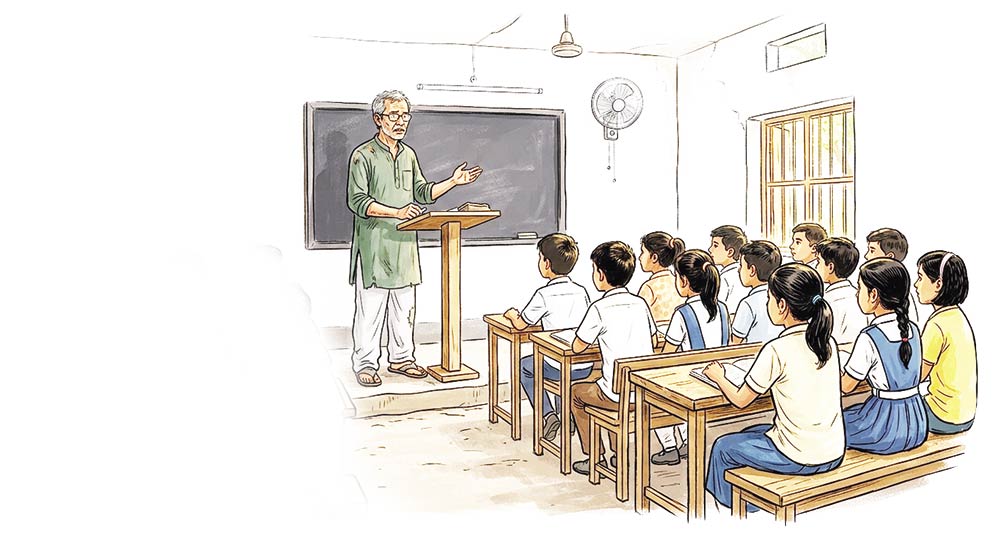 Teachers were once the symbols of knowledge, morality and social leadership in our society. Society respected them, the state accorded them dignity and people considered them guides. However, that status underwent a radical shift during the long period of colonial rule. The professional dignity, financial security and social standing of teachers gradually eroded. Sad as it is, many symptoms of that devaluation persist in our education system today.
To begin with, one might recall a widely known piece of folklore. Although the story's historical authenticity is debated, it presents a symbolic depiction of the life struggles faced by teachers during the British era. It is said that a British officer came to inspect a school and asked about a teacher’s salary. Astonished upon hearing the figure, he asked, "How do you support your family on such a small income?" Without answering directly, the teacher pointed to a nearby three-legged table and said, "Sir, my household also stands on three legs like this table-one leg is my salary, one leg is debt and borrowing and the other leg is reliance on the Almighty."The story might not be strict history, but it reflects a historical reality. During the British regime, the teaching profession gradually reached a state where, despite being the primary architects of society, teachers became financially neglected and institutionally ignored.
From Respect to Devaluation: In ancient and medieval Bengal, scholars, gurus, and maulvis enjoyed a special status in society. Education was a social and moral responsibility aimed at cultivating knowledge, and teachers were the primary bearers of that responsibility. But under British rule, the purpose and character of the education system changed.
The primary goal of the colonial administration was not to build a knowledge-based society, but rather to create an obedient middle class to serve administrative purposes. As a result of policies influenced by Thomas Babington Macaulay's educational philosophy, education was linked to administrative needs instead of humanistic and intellectual development. Consequently, the social and moral significance of the teaching profession steadily declined. During the British period, salaries-especially for primary and secondary school teachers-were extremely low. In many instances, a teacher's salary was comparable to the earnings of a daily wage laborer. Government benefits, pensions, medical allowances, and social security were all far out of reach for the majority of teachers.
On the other hand, a completely different system existed for European teachers. They enjoyed high salaries, housing, and various perks. In contrast, native teachers working in the very same institutions were allocated negligible remuneration and limited facilities. The discriminatory nature of British rule was clearly reflected in the education sector as well. The British government sought to tailor education strictly to suit administrative needs. Through the Universities Act of 1904, strict control was imposed on higher education institutions. Opportunities for teachers to foster independent thought, critical expression, or a nationalist spirit were restricted.
During various phases of the Swadeshi Movement, Non-Cooperation Movement, and the independence struggle, many teachers played active roles. As a result, they became targets of suspicion and surveillance by the British administration. Many teachers lost their jobs, suffered imprisonment, or faced economic repression.
Does the Colonial Legacy Still Persist? Even after more than half a century of independence, a question arises repeatedly: Are we not still carrying the legacy of the devaluation of teachers that began during the British era? The reality is that despite extensive discussions regarding teachers' social dignity and professional importance, the desired changes in their standard of living and financial security are still not fully evident.
Currently, an Assistant Teacher at a government primary school starts employment at Grade 13, with an initial basic salary of 11,000 BDT. Yet at current market prices, the minimum monthly food expense for a family of four alone exceeds several thousand taka. Adding house rent, medical expenses, transportation, clothing, children's education, and other necessary expenses makes the reality of the situation easy to imagine. Consequently, many teachers are forced to seek extra income or rely on loans and debts to meet living expenses.
The most concerning aspect is that this financial and social reality is diminishing the interest of talented youth in the teaching profession. When a nation's brightest minds do not consider teaching a first choice, it is natural that the quality of the education system suffers in the long run. Many university graduates with top academic achievements prioritize careers in administration, banking, the corporate sector, or opportunities abroad. In many cases, teaching is becoming a profession that people join not out of preference, but because they lacked other options. This cannot be a healthy sign for any country's education system.
Beyond financial issues, opportunities for teachers to participate at policy-making levels have also been limited for a long time. Teachers ought to be at the center of the education system; but in reality, their views have not always received the necessary weight in policy formulation, budget allocation, or discussions on educational reform. As a result, many education reform initiatives have failed to align completely with ground realities.
A similar picture is seen in research and innovation. In developed countries, university teachers are considered driving forces behind knowledge creation and policy formulation. Yet in our country, there has long been a lack of adequate funding, infrastructure, and institutional support for research. As a result, many teachers do not get the opportunity to fully realize their potential. Most concerning of all, as the dignity of teachers declines, the culture of intellectual pursuit in society also begins to weaken. In a society where a teacher does not receive due respect and recognition, reverence for education gradually erodes. The effect does not remain confined to classrooms alone; it impacts national development, social values, and human resource building.
However, on a promising note, the current government has announced the prioritization of the education sector. In the proposed national budget for the 2026-27 fiscal year, an allocation of approximately TK122,495 crore has been proposed for the education sector, which is considered the highest allocation in this sector in the country's history. This allocation is equivalent to nearly 2% of the Gross Domestic Product (GDP), up from 1.39% in the previous fiscal year. Simultaneously, the government has announced a long-term goal to raise public expenditure on education to 5% of GDP. Emphasis has also been placed on building a quality, inclusive, technology-driven, and skill-based education system. These initiatives are undoubtedly positive; however, to derive the true benefits of investment in education, teachers must be placed at the center of that investment. Without skilled, inspired, and dignified teachers, no education system can achieve its desired goals.
Qualitative changes in an education system cannot be achieved through infrastructure, technology, or curriculum alone; teachers must remain at its core. Achieving the desired development in education is impossible without ensuring fair salaries and allowances, healthcare, professional training, research support, a safe working environment, and a dignified lifestyle for teachers. The future of a nation is decided inside the classroom, and the living spirit of that classroom is the teacher.
The writer is Vice-Chancellor, University of Bogura
Loading...
Loading...
Also read



Editor : Iqbal Sobhan Chowdhury
Published by the Editor on behalf of the Observer Ltd. from Globe Printers, 24/A, New Eskaton Road, Ramna, Dhaka.
Editorial, News and Commercial Offices : Aziz Bhaban (2nd floor), 93, Motijheel C/A, Dhaka-1000.
Phone: PABX- 41053001-06; Advertisement: 41053012; 01793317829, 01550707291, E-mail: [email protected], [email protected] Online: email: [email protected] 41053014; 01550707297 Advertisement: 01550707296
Published by the Editor on behalf of the Observer Ltd. from Globe Printers, 24/A, New Eskaton Road, Ramna, Dhaka.
Editorial, News and Commercial Offices : Aziz Bhaban (2nd floor), 93, Motijheel C/A, Dhaka-1000.
Phone: PABX- 41053001-06; Advertisement: 41053012; 01793317829, 01550707291, E-mail: [email protected], [email protected] Online: email: [email protected] 41053014; 01550707297 Advertisement: 01550707296


