



| HEADLINE |

|

Bangladesh's Mobile Data Trap
Are Consumers Paying for Connectivity—or Financing a Business Model?
Published : Saturday, 8 August, 2026 at 12:00 AM


 For four years, Sheikh Shajib Alam kept his Bangladeshi mobile number alive while studying in India. It was not for conversations or social media. The SIM card served as a digital lifeline, allowing him to receive one-time passwords (OTPs) for banking and other essential services back home.
When he returned to Bangladesh, however, he was met with an unsettling reality. The money he had painstakingly accumulated in his account had vanished. His international roaming balance had been wiped out. His prepaid credit had disappeared. When he contacted his mobile operator, he was reportedly told that the balances had been "flushed" because he had failed to recharge within a prescribed period.
Standing before the Bangladesh Telecommunication Regulatory Commission (BTRC), Alam posed a question that has since echoed far beyond his personal grievance:
"Can a company simply erase a customer's prepaid money?"
His testimony unlocked a flood of frustration. The Daily Observer focused this crucial issue last week in a report.
One after another, subscribers from across the country stepped forward at the regulator's public hearing with strikingly similar stories�"unused mobile data disappearing overnight, unexplained balance deductions, soaring internet costs, patchy network coverage and bewildering promotional offers that many said had turned buying mobile internet into an exercise in guesswork rather than choice.
Another subscriber, Ashiq Ahmed, argued that the much-publicised Mobile Number Portability (MNP) service had failed to deliver the competition it promised. Others questioned why replacing a SIM card costs Tk345, why even a 20-second phone call can consume more than Tk2, and why consumers repeatedly lose internet they have already paid for.
Taken together, the complaints painted a troubling picture of an industry where public confidence appears to be eroding almost as quickly as prepaid balances.
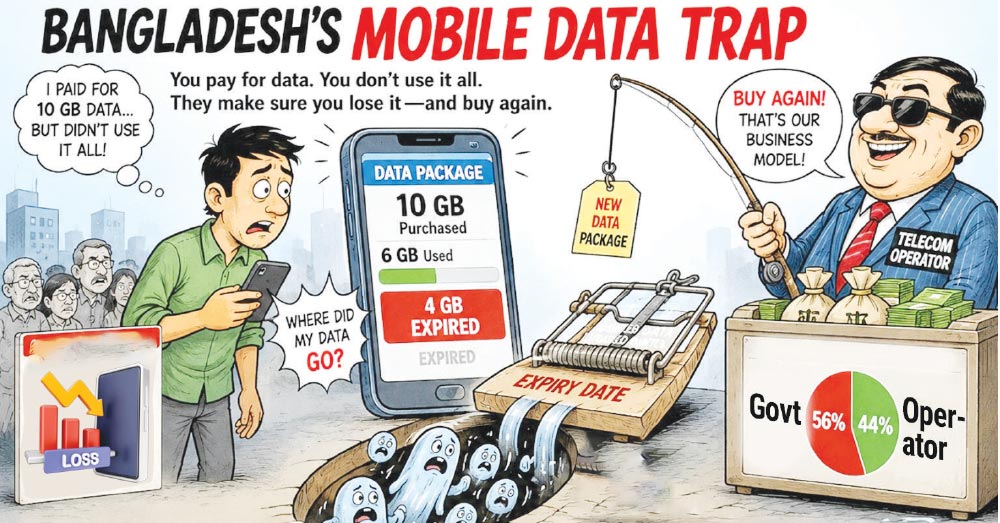
At the centre of the controversy lies a deceptively simple question: who owns prepaid mobile data once it has been paid for? Imagine buying two kilograms of apples. You eat half and keep the rest in your refrigerator. A few days later, the shopkeeper returns, takes away the remaining apples and calmly explains that they have "expired" because you failed to consume them in time.
The proposition is absurd.
Yet millions of Bangladeshi mobile users say they experience the digital equivalent every month. They purchase gigabytes with their own money, but if they fail to consume every megabyte within an arbitrary validity period�"three days, seven days or thirty�"the remaining data simply disappears. No refund. No compensation. No ownership.
In almost any other market, such a practice would trigger consumer outrage. In Bangladesh's telecom sector, it has become an accepted commercial norm.
What began as scattered consumer complaints has now evolved into one of the most significant policy debates confronting Bangladesh's digital economy.
Faced with mounting public anger, the BTRC has instructed mobile operators to submit proposals to reduce internet prices and strengthen consumer protection. The regulator's intervention reflects growing concern that pricing models widely perceived as opaque and unfair could undermine public confidence in the country's digital transformation.
The timing could hardly be more critical.
Bangladesh now has 128.99 million mobile internet subscribers, making mobile connectivity one of the country's most important economic enablers. From digital banking and e-commerce to online education, telemedicine, freelancing and public services, mobile internet has become indispensable to everyday life. It is no longer a lifestyle product; it is essential infrastructure.
Yet critics argue that the industry's commercial model continues to treat internet access as though it were a perishable commodity.
The telecom industry strongly disputes accusations of profiteering. Operators argue that Bangladesh has one of the world's most heavily taxed telecom sectors. According to industry estimates, around Tk56 of every Tk100 earned by mobile operators goes directly to the government through value-added tax, supplementary duties, spectrum charges, licence fees and other regulatory payments.
Executives say that after investing billions of taka in spectrum licences, nationwide 4G expansion, fibre-optic transmission networks and digital infrastructure, profit margins are considerably thinner than many consumers believe. They warn that imposing further tariff reductions without meaningful fiscal reforms could slow investment, weaken network quality and delay the rollout of 5G, artificial intelligence-enabled services and next-generation digital infrastructure.
The pressure is already becoming visible.
BTRC data show Bangladesh's mobile subscriber base declined to 185.8 million in January 2026, while mobile internet subscriptions fell to 128.99 million, extending a downward trend that analysts partly attribute to affordability pressures, persistent inflation and weakening household purchasing power.
At the heart of the industry's argument is Average Revenue Per User (ARPU)�"the benchmark investors use to measure revenue generated from each subscriber. With subscriber growth slowing, operators increasingly rely on higher spending by existing customers to finance network upgrades and future investment.
Consumer organisations, however, contend that the pursuit of higher ARPU has fundamentally altered the way mobile internet is sold. They argue that operators are no longer simply marketing connectivity�"they are monetising time. Short validity periods, segmented internet bundles and restrictive carry-forward rules, they say, encourage repeated purchases while allowing unused prepaid data to expire, transforming data validity into one of the industry's most effective revenue-generating tools.
The controversy therefore extends well beyond internet pricing. It has become a defining contest between consumer rights and commercial sustainability, between protecting subscribers today and financing tomorrow's digital infrastructure.
The challenge facing policymakers is exceptionally delicate. Bangladesh needs financially robust telecom operators capable of investing billions in 5G, cloud computing, artificial intelligence and the next phase of digital transformation. Equally, it needs a regulatory framework that ensures consumers receive fair value for money in an era when internet access is as essential as electricity or clean water.
The question confronting regulators is no longer whether mobile data should be cheaper.It is whether a digital economy can genuinely be called inclusive when millions of consumers continue to lose a service they have already paid for.
How the BTRC answers that question could redefine not only the future of Bangladesh's telecom industry, but also the principles on which the country's digital economy will be built�"consumer trust or corporate convenience.
Loading...
Loading...
Also read



Editor : Iqbal Sobhan Chowdhury
Published by the Editor on behalf of the Observer Ltd. from Globe Printers, 24/A, New Eskaton Road, Ramna, Dhaka.
Editorial, News and Commercial Offices : Aziz Bhaban (2nd floor), 93, Motijheel C/A, Dhaka-1000.
Phone: PABX- 41053001-06; Advertisement: 41053012; 01793317829, 01550707291, E-mail: [email protected], [email protected] Online: email: [email protected] 41053014; 01550707297 Advertisement: 01550707296
Published by the Editor on behalf of the Observer Ltd. from Globe Printers, 24/A, New Eskaton Road, Ramna, Dhaka.
Editorial, News and Commercial Offices : Aziz Bhaban (2nd floor), 93, Motijheel C/A, Dhaka-1000.
Phone: PABX- 41053001-06; Advertisement: 41053012; 01793317829, 01550707291, E-mail: [email protected], [email protected] Online: email: [email protected] 41053014; 01550707297 Advertisement: 01550707296


