



| HEADLINE |

|
The cost, fall-out of battery-run auto boom (Concluding Part)
Published : Sunday, 9 August, 2026 at 12:00 AM
Ahsan Uddin Bhuiyan


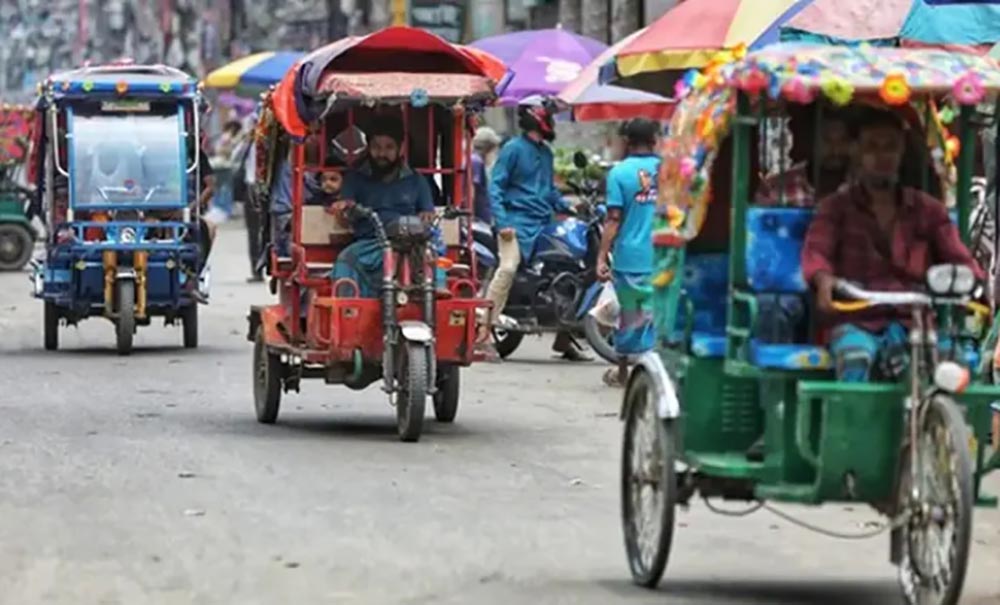 A capital is more than a city; it is a nation's face, conscience and the clearest expression of its identity. Dhaka, the heart of Bangladesh, now bears the scars of mounting disorder. Nothing illustrates this more starkly than the unchecked spread of battery-powered auto-rickshaws, which project a poor image of the country while choking the capital's roads with chronic congestion. Once confined to narrow lanes, these locally assembled vehicles, built from imported motors and heavy batteries, have increasingly occupied Dhaka's main roads over the last two years. Although prohibited under the Road Transport Act, 2018, millions of unregistered battery-powered rickshaws now operate across the country, underscoring the need for the government to enforce the law and restore order on the capital's streets.
The human toll is staggering, yet largely unseen. The Bangladesh Passenger Welfare Association recorded 870 battery-powered auto-rickshaw crashes in 2024, claiming 875 lives and injuring 1,779 people. Its Secretary General Mozammel Haque Chowdhury says only about 10 per cent of such incidents reach the media, as most crashes kill too few people to attract attention. The Road Safety Foundation reported 1,376 deaths in auto-rickshaw crashes in 2025�"18.69 per cent of all road fatalities that year. By June 2026, the Association found that the vehicles were involved in nearly 15pc of the month's 532 recorded road accidents. Beyond these figures lies a hidden toll: an estimated 50�"100 minor crashes occur every day, around 80pc of which are settled on the roadside and leave no official record.
BUET's Accident Research Institute (ARI) identifies battery-powered auto-rickshaws as the riskiest of 18 vehicle categories on Dhaka's roads, citing poor design and the absence of safety standards. Former BUET professor Ijaz Hossain points to a fundamental flaw: the motor does not fully disengage when the brakes are applied-a defect he says is easily fixed but has been ignored. ARI Assistant Professor Kazi Saifun Newaz says the danger is compounded by legal limbo. Without registration or documentation, many drivers disregard traffic signals, weakening the city's AI-based traffic management system and eroding discipline even among those who obey the rules.
For ordinary road users, the crisis is painfully tangible. A biker says the autos "turn left and right at lightning speed without any signal". A bus passenger blames them for "traffic jams and major accidents". Mohammadpur resident Faisal Ahmed says they "respect no lane" and routinely drive against traffic. Sohel, injured while riding with his wife, describes a harsher reality: "If it is their fault, they grab you by the hands and feet. If you are even slightly at fault, they beat you. They can even kill you." Transport expert Dr Md Hadiuzzaman captures the wider disorder in a single image: "These auto-rickshaws are spreading like locusts. There is no control over them."
Researchers trace the danger to the vehicles' very design. Pedal-rickshaw frames were never engineered to carry heavy batteries; adding two or four shifts the centre of gravity, making rollovers more likely on bends. An estimated 70-80% operate without valid registration, hindering investigations and often allowing drivers to disappear after crashes. Reports also point to a growing number of untrained children and teenagers behind the wheel, adding another layer of risk.
The damage extends beyond the crash site. Public health expert Dr Lenin Chowdhury warns that constant vibration strains the spine, particularly endangering pregnant women, though improved suspension could reduce the risk. More troubling is lead pollution from the batteries. An ICDDR,B study found 98% of Dhaka children tested had blood-lead levels above the WHO limit of 3.5 micrograms per decilitre; the median was 6.7, with one child recording 46 micrograms per decilitre. Researcher Dr Mahbubur Rahman estimates that, assuming 20kg of lead per rickshaw, around 80 million kg of lead enter the environment through the country's estimated four million vehicles. "Lead is not destroyed," he warned. "Think about where lead pollution will take us in the next 10 years."
The environmental toll is equally severe. Battery-powered rickshaws, vans and autos generate around 480,000 tonnes of lead, acid and battery waste each year. An estimated 70 per cent of batteries are dismantled in unsafe, unhygienic conditions-often by children in informal rural recycling yards-before the reclaimed lead returns to the market. Meanwhile, fuel wasted in traffic jams further poisons the air. In 2024, Dhaka ranked third among the world's most polluted cities, while in the EIU's 2026 Liveability Index it scored just 42 out of 100, ranking among the world's least liveable cities, ahead of only Tripoli and Damascus.
Government policy has followed a familiar rhythm: announce, protest, retreat. The 2015 ban on Dhaka's main roads and national highways gave way to the ill-fated 2024 ban, withdrawn within five days after driver protests before becoming entangled in conflicting court orders. A draft Electric Three-Wheeler Management Policy, 2025 proposed registration, fitness certificates, tax tokens and BRTA-approved standards, capping speeds at 50km/h for medium-speed and 30km/h for slow-speed vehicles while keeping them off highways except service lanes. A presidential ordinance in August 2025 empowered city corporations to register electric three-wheelers. Most recently, the 2026-27 budget sought to impose advance income tax, estimating that even Tk 1,000 per vehicle across millions of untaxed autos could yield significant revenue. The government later retreated once more, leaving the sector in its familiar legal twilight.
Even now, official voices speak in different tongues. Home Minister Salahuddin Ahmed has proposed moving the vehicles out of metropolitan areas, while Dhaka South City Administrator Abdus Salam insists there will be no ban, only licensing. The DMP Commissioner, meanwhile, concedes that an overnight ban is no longer realistic-the vehicles are now too deeply woven into the city's transport network and livelihoods.
Experts largely agree that neither a blanket ban nor continued inaction will solve the crisis. Dr M Shamsul Haque advocates retraining drivers, setting a clear phase-out timetable, expanding franchised bus services and replicating disciplined traffic management, such as at Hatirjheel. Kazi Saifun Newaz calls for strict caps on vehicle numbers, standardised designs, a shift from lead-acid batteries, a 15km/h speed limit and tighter oversight of workshops.
The Bangladesh Passenger Welfare Association proposes BUET-approved body standards, compulsory one-week driver training, GPS speed monitoring and a ban on importing easy bikes and rickshaw parts. NISA goes further, demanding a ban on the import, manufacture and sale of parts, a nationwide prohibition on highways and main roads, and a phased transition of drivers into skilled public transport-rejecting registration or licensing of the existing fleet altogether.
What unites officials, engineers, drivers and passengers is a simple truth: livelihoods cannot be legislated away, but neither can vehicles with ineffective brakes, no legal status and lead-laden batteries continue multiplying by the hundreds each day.
Professor M Shamsul Haque offered a striking metaphor: "To control floodwater, you first close the floodgate. Likewise, to control auto-rickshaws, we must first stop the import of auto-rickshaws and their batteries."
Whether policymakers finally heed that logic-or retreat once more before the next wave of protest-may determine the future of Dhaka's roads, power grid and air.
Loading...
Loading...
Also read



Editor : Iqbal Sobhan Chowdhury
Published by the Editor on behalf of the Observer Ltd. from Globe Printers, 24/A, New Eskaton Road, Ramna, Dhaka.
Editorial, News and Commercial Offices : Aziz Bhaban (2nd floor), 93, Motijheel C/A, Dhaka-1000.
Phone: PABX- 41053001-06; Advertisement: 41053012; 01793317829, 01550707291, E-mail: [email protected], [email protected] Online: email: [email protected] 41053014; 01550707297 Advertisement: 01550707296
Published by the Editor on behalf of the Observer Ltd. from Globe Printers, 24/A, New Eskaton Road, Ramna, Dhaka.
Editorial, News and Commercial Offices : Aziz Bhaban (2nd floor), 93, Motijheel C/A, Dhaka-1000.
Phone: PABX- 41053001-06; Advertisement: 41053012; 01793317829, 01550707291, E-mail: [email protected], [email protected] Online: email: [email protected] 41053014; 01550707297 Advertisement: 01550707296


