



| HEADLINE |

|
De Facto Power in Rakhine and Repatriation of Rohingyas
Published : Monday, 10 August, 2026 at 12:00 AM
Md Mahiduzzaman


 Myanmar has endured one of the world’s longest-running civil wars, with a dozen ethnic armed organisations (EAOs) fighting against the government. Among the EAOs, the Arakan Army (AA), a de facto sovereign power active in Rakhine State and one of the strongest forces fighting the junta, has been accused of committing war crimes, including killing and wounding hundreds of Rohingya and torching their villages. Survivors of these massacres have reportedly been detained and relocated to makeshift camps by the AA, which has neither provided redress nor held those responsible to account. As a result, the landlessness of the Rohingya continues.
For example, UNHCR reported that at least 1,41,500 Rohingya arrived in Bangladesh from Myanmar between January 2022 and March 2026. In fact, the Rohingya crisis remains a pressing global issue, and world leaders have responded to it in different ways. Case in point, following the influx in 2017, three major international meetings were held on repatriation. However, none of them paved the way for the repatriation of the Rohingya.
The reality is that the Arakan Army has already captured 14 of 17 townships, accounting for around 90 per cent of Rakhine’s territory, with the stated aim of ‘erasing’ the Rohingya from Rakhine. Therefore, Bangladesh must carefully consider with whom it should establish diplomatic relations - whether with the Myanmar junta or the AA, which has gradually transitioned from a battlefield force into a governing entity and has already established local administrations, collected taxes and operated judicial systems in the townships it controls.
The most obvious sign of this evolution is the move to establish its own banking systems, creating a financial infrastructure independent of the junta-controlled kyat. In 2026, the AA launched the Arakan Lottery, known as Laong Pao. In fact, this is not merely a fundraising initiative but a high-stakes state revenue mechanism. By allocating half of the revenue to health, education and social development, the AA is directly funding its welfare system, reducing its reliance on external aid or illicit trade. Born out of an ethnic insurgency seeking autonomy, the AA has evolved into a state-building project with ambitions that could fundamentally reshape Myanmar’s political map.
Having established full control of the Bangladesh border by late 2024, gained access to the sea and developed links with the borders of India and China, the AA now commands around 50,000 well-equipped fighters and has a functional Arakan People’s Revolutionary Government in place. Its military offensives have also extended into Chin and Kachin states and the Magway, Sagaing, Ayeyarwady and Bago regions. The AA is no longer just a rebel group. It has emerged as a significant power that Bangladesh can no longer afford to ignore.
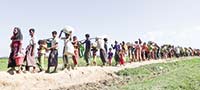
However, ensuring the human rights of the Rohingya in Rakhine requires the Bangladesh government, the US government, development partners, civil society, the private sector and refugee leaders to work together - not only to meet their basic needs but also to help them build resilience and self-reliance while preparing them for a future return to their homeland. But can the junta government ensure a safe return for the Rohingya while retaining control of only key urban centres and losing the countryside, including the border areas of Rakhine State, to the AA?
Perhaps not. Instead, Rakhine State, under AA control, will likely become the most developed and stable of Myanmar’s administrative entities. Moreover, in the near term, the AA is likely to consolidate its control over Rakhine and establish a functioning economy and administration. Therefore, it is time to think differently. Bangladesh could pursue Track II diplomacy with the AA instead of grey-zone diplomacy, without triggering a diplomatic crisis with the Myanmar junta. Such an approach could facilitate regular functional communication with the de facto authorities in pursuit of the ultimate goal of Rohingya repatriation.
Myanmar’s most influential neighbour China remains the AA’s largest supplier of weapons and a critical economic partner, particularly through Belt and Road Initiative projects in Rakhine, while maintaining informal engagement and communication with the AA. China is likely the only neighbour with sufficient influence over both the AA and the junta to potentially push for a solution to the Rohingya crisis. It could warn both sides that ethnic cleansing would destabilise the border and jeopardise its ports. So, the national committee of Bangladesh could consider seeking Chinese support for internationally monitored return areas, humanitarian access, infrastructure reconstruction, civilian guarantees and an information-sharing mechanism.
India’s diplomatic approach is defined by cautious pragmatism. While there is no formal embassy or exchange of ambassadors, New Delhi is reportedly deeply engaged with the AA through back-channel channels. India uses intelligence and diplomatic channels through Mizoram and India’s northeastern states to engage the AA on the security of the Kaladan Multi-Modal Transit Transport Project and informal trade arrangements. Bangladesh could also encourage India to deepen cooperation in addressing the rise in trafficking, human smuggling, maritime migration, illicit economic activities, illegal arms trafficking and transnational organised crime, all of which pose potential threats to regional security.
However, the Bangladesh government has formed an 11-member National Strategy Formulation Committee on Rohingya Affairs, which is a positive step towards building national consensus, determining priorities and coordinating stakeholders to achieve the peaceful and sustainable repatriation of the Rohingya to their homeland. Hopefully, the committee will develop a balanced approach and an effective national policy to safeguard regional security while advancing a sustainable end to the landlessness and displacement of the Rohingya.
The writer is Superintendent of Police
Loading...
Loading...
Also read



Editor : Iqbal Sobhan Chowdhury
Published by the Editor on behalf of the Observer Ltd. from Globe Printers, 24/A, New Eskaton Road, Ramna, Dhaka.
Editorial, News and Commercial Offices : Aziz Bhaban (2nd floor), 93, Motijheel C/A, Dhaka-1000.
Phone: PABX- 41053001-06; Advertisement: 41053012; 01793317829, 01550707291, E-mail: [email protected], [email protected] Online: email: [email protected] 41053014; 01550707297 Advertisement: 01550707296
Published by the Editor on behalf of the Observer Ltd. from Globe Printers, 24/A, New Eskaton Road, Ramna, Dhaka.
Editorial, News and Commercial Offices : Aziz Bhaban (2nd floor), 93, Motijheel C/A, Dhaka-1000.
Phone: PABX- 41053001-06; Advertisement: 41053012; 01793317829, 01550707291, E-mail: [email protected], [email protected] Online: email: [email protected] 41053014; 01550707297 Advertisement: 01550707296


