



| HEADLINE |

|

Stamford University launches symposium series on knowledge, research and impact
Published : Monday, 10 August, 2026 at 5:09 PM
Observer staff correspondent


File Photo
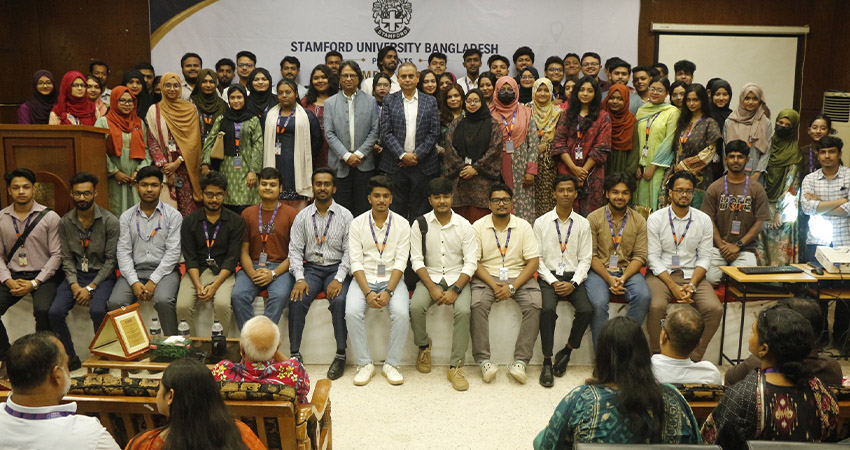
Stamford University Bangladesh has launched a new academic symposium series titled “Looking Ahead by Looking Back”, with the inaugural session focusing on the evolution and future of supply chain management.
Prof. Dr. Sharif Nafe As-Saber, vice chancellor of Stamford University Bangladesh, formally launched the symposium series, while Prof. Dr. Shams Rahman, vice chancellor of East West University, delivered the keynote presentation on supply chain management.
In his presentation, Prof. Rahman traced the development of supply chain management from Adam Smith’s concept of division of labour and specialization to modern supply networks shaped by the Fourth Industrial Revolution. Referring to Smith’s discussion of the pin-making process in "The Wealth of Nations"(1776), he explained how specialization and division of labour contributed to increased productivity and subsequently influenced the evolution of production systems.
He discussed major stages in industrial development, including assembly-line production, mass production, operations management, logistics and modern supply chain systems. He also highlighted the growing role of automation, digital platforms, data analytics, artificial intelligence, the Internet of Things and robotics in transforming supply chain operations.
The keynote also focused on the challenges posed by geopolitical uncertainty, pandemics, climate-related disruptions, changing consumer expectations and rapid technological advancement. Against this backdrop, Prof. Rahman stressed the importance of developing supply chains that are resilient, agile, adaptive and sustainable.
The presentation was followed by a question-and-answer session in which faculty members, students and other participants raised questions about technological transformation, management practices, industrial development, resilience and the future of supply chain management.
The symposium series aims to examine contemporary challenges and emerging trends by connecting them with their historical, theoretical and practical foundations. The university said the initiative will bring scholars and practitioners into discussions on major contemporary issues while encouraging critical inquiry and dialogue between theory and practice.
-HIS
Loading...
Loading...
Also read





Editor : Iqbal Sobhan Chowdhury
Published by the Editor on behalf of the Observer Ltd. from Globe Printers, 24/A, New Eskaton Road, Ramna, Dhaka.
Editorial, News and Commercial Offices : Aziz Bhaban (2nd floor), 93, Motijheel C/A, Dhaka-1000.
Phone: PABX- 41053001-06; Advertisement: 41053012; 01793317829, 01550707291, E-mail: [email protected], [email protected] Online: email: [email protected] 41053014; 01550707297 Advertisement: 01550707296
Published by the Editor on behalf of the Observer Ltd. from Globe Printers, 24/A, New Eskaton Road, Ramna, Dhaka.
Editorial, News and Commercial Offices : Aziz Bhaban (2nd floor), 93, Motijheel C/A, Dhaka-1000.
Phone: PABX- 41053001-06; Advertisement: 41053012; 01793317829, 01550707291, E-mail: [email protected], [email protected] Online: email: [email protected] 41053014; 01550707297 Advertisement: 01550707296


