



| HEADLINE |

|

19-year low SSC pass rate: Why this disaster?
Published : Monday, 10 August, 2026 at 4:56 PM
Observer Special Report


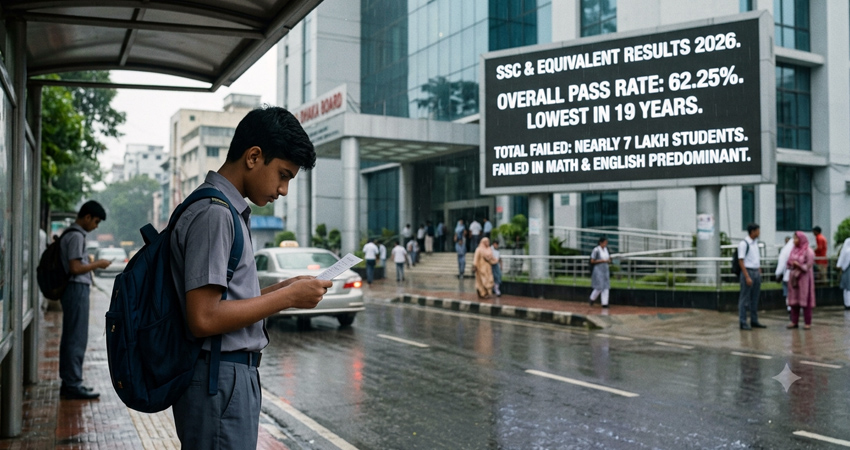
AI image
The secondary education sector has witnessed a massive debacle as the pass rate for the Secondary School Certificate (SSC) and equivalent exams have dropped as low as 62.25 per cent this year - lowest in 19 years.
Out of 18,29,485 examinees under 11 education boards, 11,38,877 passed, while nearly 6.91 lakh (6,90,608) failed. The overall pass rate fell by 6.20 per centage points compared to last year's 68.45 per cent. The number of GPA-5 achievers also dropped by 22,356 to 1,16,676.
Official statistics show this is the worst result since 2007, when the pass rate was 58.36 per cent.
Educationists and board officials attribute the sudden drop to poor performance in Mathematics and English, particularly among Humanities students, alongside strict evaluation of answer scripts and exams conducted on a full syllabus.
The number of institutions with a 100 per cent pass rate plummeted from 2,968 last year to 669. Conversely, the number of zero-pass schools surged to 312.
Board-wise and Demographic Performance
Among the nine general education boards, the average pass rate stood at 64.05 per cent. Girls outperformed boys across all metrics.
A total of 7,41,876 female students appeared under the general boards, with 5,03,796 passing (67.91 per cent pass rate). In contrast, 3,95,814 out of 6,62,663 male students passed (59.73 per cent pass rate). Girls also secured 58,705 GPA-5s, compared to 47,304 achieved by boys.
Dhaka Board topped the general education boards with a 71.63 per cent pass rate, followed by Barishal (66.27pc), Cumilla (65.42pc), Rajshahi (63.67pc), Barishal (60.35pc), Chittagong (59.48pc), Sylhet (58.33pc), and Dinajpur (58.05pc). Mymensingh Board sat at the bottom with 57.39 per cent.
The Madrasa Education Board recorded a pass rate of 55.49 per cent with 6,716 GPA-5 achievers, while the Technical Education Board posted a 58.20 per cent pass rate with 3,951 GPA-5s.
19-Year Historical Trend
The GPA system was introduced in 2001, replacing the division system. The pass rate was 35.22 per cent in 2001, 62.22 per cent in 2006, and dropped to 58.36 per cent in 2007.
Between 2011 and 2017, the pass rate consistently stayed above 80 per cent, peaking at 91.34 per cent in 2014. Following the COVID-19 pandemic, subject mapping pushed the pass rate to a record 93.58 per cent in 2021.
However, with full-syllabus examinations returning post-pandemic, pass rates began sliding - 87.44 per cent in 2022, 80.39 per cent in 2023, 83.04 per cent in 2024, and 68.45 per cent in 2025.
This year's 62.25 per cent marks the lowest point since 2007.
Why Did Students Fail?
Board officials highlighted that Humanities and Business Studies students failed heavily in Mathematics and English.
Ashraf Uddin, a senior mathematics teacher at Viqarunnisa Noon School and College, noted that students are spending excessive time on mobile phones rather than focusing on tough subjects. "Humanities students traditionally fear Math and English. This year, distraction and fear led to a major disaster," he said.
Maruf Billah, a guardian from Motijheel, blamed the lack of qualified teachers in schools. "My son missed GPA-5 due to lower marks in English, Math, and Economics. His school lacked sufficient teachers, forcing him to rely on home study and private coaching," he stated.
Former Director of the Institute of Education and Research (IER) at Dhaka University, Prof. Dr. Siddiqur Rahman Khan, called the high failure rate unacceptable. "Teachers lack proper training to teach according to the curriculum. Furthermore, poor salaries demotivate schoolteachers from delivering quality lessons in classrooms," he said.
Prof. Dr. Mohammad Ali Jinnah, Pro-Vice Chancellor of National University, emphasized that the results reflect long-standing systemic flaws, digital distractions, and post-political transition adjustments. He called for remedial coaching and specialized teacher training to tackle weaknesses in Math and English, alongside a complete restructuring of technical education.
Minister and Board Responses
Refuting claims of a "result debacle," Education Minister Dr. ANM Ehsanul Hoque Milan defended the outcome, stating, "I do not see a bad result; I see a clean and fair outcome. Students received marks based strictly on what they wrote."
Bangladesh Inter-Education Board Coordination Committee President and Dhaka Board Chairman Prof. Dr. Syed Akteruzzaman said the board will investigate the exact reasons behind the mass failure in Math and English. "We will identify weaknesses in Humanities and Madrasa streams and recommend measures against institutions with poor results," he added.
Dissatisfied examinees can apply for answer script re-scrutiny or re-evaluation from August 11 to August 17, 2026.
-SA
Loading...
Loading...
Also read








Editor : Iqbal Sobhan Chowdhury
Published by the Editor on behalf of the Observer Ltd. from Globe Printers, 24/A, New Eskaton Road, Ramna, Dhaka.
Editorial, News and Commercial Offices : Aziz Bhaban (2nd floor), 93, Motijheel C/A, Dhaka-1000.
Phone: PABX- 41053001-06; Advertisement: 41053012; 01793317829, 01550707291, E-mail: [email protected], [email protected] Online: email: [email protected] 41053014; 01550707297 Advertisement: 01550707296
Published by the Editor on behalf of the Observer Ltd. from Globe Printers, 24/A, New Eskaton Road, Ramna, Dhaka.
Editorial, News and Commercial Offices : Aziz Bhaban (2nd floor), 93, Motijheel C/A, Dhaka-1000.
Phone: PABX- 41053001-06; Advertisement: 41053012; 01793317829, 01550707291, E-mail: [email protected], [email protected] Online: email: [email protected] 41053014; 01550707297 Advertisement: 01550707296


