



| HEADLINE |

|

Energy experts demand rational pricing, private participation
Published : Tuesday, 11 August, 2026 at 8:00 PM
Observer Special Correspondent


Collected Photo
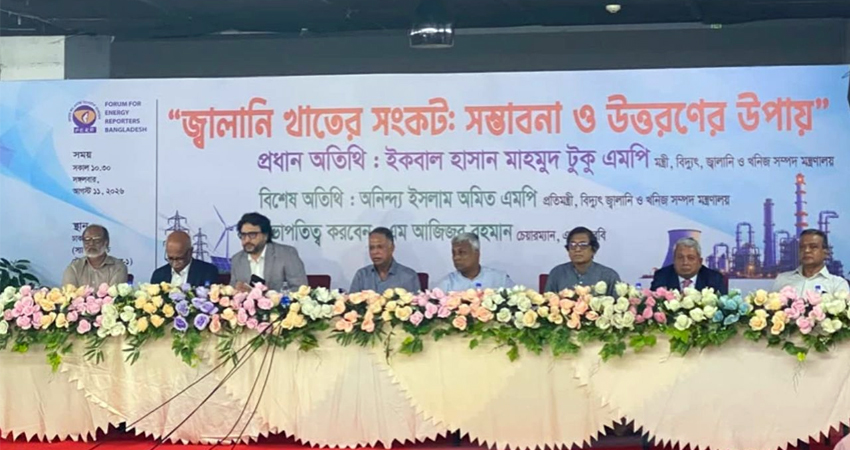
Energy experts-business leaders called at a seminar on Tuesday for a policy consistency, rational energy pricing and greater private-sector participation in the energy sector to ensure long-term energy security and support economic growth of the country.
They also said that Bangladesh needs a coordinated strategy to address its ongoing energy crisis, including increased LNG imports in the short term, accelerated domestic gas exploration and production, expansion of renewable energy and development of energy infrastructure.
The remarks came at a seminar titled “Energy Sector Crisis: Prospects and Ways Forward”, organised by the Forum for Energy Reporters Bangladesh (FERB) at the Samson H Chowdhury Hall of Dhaka Club in the capital. FERB Chairman M Azizur Rahman chaired the seminar, while its Executive Director Serajul Islam Siraj delivered the welcome address.
Speaking as the chief guest, Power, Energy and Mineral Resources Minister Iqbal Hasan Mahmud said the government was moving on plans to allow greater private-sector participation in fuel imports and marketing, adding that the policy was not intended to favour any particular company but to create opportunities for all eligible businesses. State Minister Aninda Islam Amit was present as special guest.
Power, Energy and Mineral Resources Minister rejected allegations on social media that the initiative was intended to benefit specific businesses, describing such claims as "absurd".
Iqbal said under the proposed policy, eligible private companies would be able to import and sell fuel alongside state-owned distributors such as Padma Oil, Jamuna Oil and Meghna Petroleum.
"If there is a private company's pump alongside Padma, Meghna or Jamuna's pump, consumers can buy fuel according to their choice," he said.
Iqbal said the government's plan was partly prompted by the experience of the recent Middle East conflict, when fears of a fuel shortage triggered long queues at petrol stations despite the country having sufficient stocks.
"Even though we had sufficient stock, people stood in long queues at petrol pumps," he said.
He said motorists and motorcyclists rushed to refuel amid fears of shortages, while some areas experienced temporary supply disruptions, alleged hoarding and black-market sales.
The government ultimately managed to maintain fuel supplies, he added.
According to Iqbal, the experience prompted discussions with Prime Minister Tarique Rahman on how greater private-sector participation could strengthen the country's fuel supply chain.
He said private investment should also be encouraged in infrastructure related to primary fuels, including gas, coal and petroleum, as the government alone cannot meet the country's growing energy requirements.
"Private investment is very much needed, especially in the energy sector," he said.
He cited India as an example of a market where state-owned and private companies operate alongside each other in fuel distribution.
Iqbal accused some groups of trying to create confusion over the country's energy situation, saying political opposition was legitimate but attempts to exploit an energy crisis for political gain would not serve the national interest.
“Our target is to generate 10,000MW of solar power,” the minister said, adding that private investment would be encouraged to install rooftop solar systems across the country under cluster-based and OPEX models.
Regarding coal-fired power plants, he said Bangladesh needed to take a cautious approach as international financing for coal-based power projects was declining.
The minister expressed optimism about working with Malaysian state-owned energy company Petronas on the development of gas resources in Bhola.
He said discussions had taken place at the highest levels of the two countries and that he had also spoken with the chairman of Petronas. A Bangladeshi delegation recently visited Malaysia to discuss possible cooperation.
Independent University Bangladesh Vice Chancellor Professor Dr. M. Tamim said the country's domestic gas production is declining while limitations in infrastructure, technology, investment and financing are making it difficult to meet the growing demand for energy.
Bangladesh needs a combination of immediate measures and medium- to long-term strategies to address its worsening energy crisis while ensuring that energy shortages do not hamper economic growth, energy expert Prof M Tamim has said.
"We have limitations in all three of our fossil fuels sources: oil, coal and gas. Yet we have to operate expensive oil- and gas-fired power plants," Tamim said, stressing the need to diversify the energy mix.
He suggested making maximum use of coal-fired power plants, saying they should be operated at around 80-85 per cent capacity where technically feasible, while rapidly expanding solar power.
"If we can quickly add 2,000 to 3,000 MW of solar capacity it would create an opportunity for fuel savings during the daytime by reducing the need to operate oil and gas fired power plants," he said.
The IUB VC said such solar capacity could be developed through rooftop and medium-scale connected projects, including a "plug-and-play" approach where the government provides land and grid connectivity and developers compete to offer electricity at lower prices.
He said the current energy crisis is the result of problems that has accumulated over many years and could not be resolved overnight.
"We need to think about what should be done in the medium and long term. We are constantly engaged in fire-fighting," he said.
Referring to the Speedy Supply of Power and Energy (Special Provisions) Act, he said the emergency legislation has been understandable when Bangladesh was facing severe load shedding and needed electricity quickly.
"But if a project takes five years to implement, why should we award a contract within two months without testing the actual cost and price?" he questioned.
On domestic gas, Tamim said Bangladesh's gas fields are declining and managing declining fields required advanced technology, experience and investment, areas where Bapex had limitations.
He said Bangladesh should consider bringing in international expertise and technology to improve recovery from existing fields, including smaller gas-bearing layers that have not been fully developed.
He also mentioned the possibility of carefully developing Chhatak gas field, saying earlier estimates indicated significant reserves, although the field posed considerable technical risks because of its shallow depth and previous blowouts.
"These initiatives need to be taken so that we can manage the situation over the next three to four years," he said.
Tamim said Bangladesh has become heavily dependent on imported energy, creating a major burden for the economy.
He argued that the country should assess whether its domestic coal resources could be utilised, taking into account technical, economic, environmental and political considerations.
He also stressed the importance of regional energy cooperation, saying Bangladesh could explore greater use of electricity available through regional power exchanges and strengthen grid connectivity with India, Nepal and Bhutan.
He cited the 1,160 MW of electricity being imported through India's power exchange as an example of a potentially useful mechanism for meeting Bangladesh's electricity needs.
Such cross-border connectivity would also become increasingly important if Bangladesh expands renewable energy, he said, as neighbouring countries could provide support when solar or other renewable generation fluctuates.
"Europe has extensive interconnection between countries. When one country has surplus renewable power, it can supply another where generation is lower. We need to think in that direction as well," Tamim said.
State Minister for Power, Energy and Mineral Resources Aninda Islam Amit said the government plans to generate around 10,000MW of electricity from renewable sources within the next four and a half years.
The target is part of the government's plan to generate 20 per cent of the country's total electricity from renewable sources, he said.
"After the mass uprising, the government has to be ambitious to fulfil the aspirations of the people," Amit said.
Around 40-60 per cent of the targeted renewable capacity could come from ground-mounted and rooftop solar projects, he said.
The government is also working to remove bureaucratic obstacles to rooftop solar installations, Iqbal said.
He said city corporations would designate buildings for rooftop solar installations, while private investors could finance the projects and recover their investment through net metering.
"We are very adamant. It does not matter which building it is," he said.
If necessary, the government could also consider holding-tax-related incentives to facilitate rooftop solar installations, he added.
Domestic gas production is declining by around 150mmcfd annually, Amit added.
"Even if you have the money, you cannot increase LNG imports overnight because you do not have the infrastructure," he said.
the government is moving ahead with plans to establish a land-based LNG terminal at Matarbari, which Amit described as the "ultimate solution" for expanding LNG import capacity.
He said the tender for appointing a transaction adviser had closed and land for the proposed terminal had already been identified.
The government is also hopeful that the ongoing offshore oil and gas bidding round will be successful, while preparations for an onshore bidding round are underway, Amit said.
Although the Bangladesh Energy Regulatory Commission (BERC) fixes LPG prices, consumers do not always receive the product at the regulated price, he said.
Only five or six private operators currently import LPG despite the presence of many operators in the market, Amit said.
Asked by a journalist about a new FSRU project, Amit said no project from any particular company had been directly approved.
The government took a policy decision to implement the project through a government-to-government, or G2G, arrangement, he said.
Under this system, the government works directly with the government of another country or a government-backed organisation.
Amit said the eligible entities among those that had initially expressed interest were evaluated under the G2G framework. The process was subsequently advanced based on a shortlist.
He said the G2G approach was chosen because the project needed to be implemented quickly.
The government has floated a new tender for oil and gas exploration in the sea.
The deadline for the tender is November, Amit said.
Presenting the keynote paper, former BUET professor and energy expert Dr Ijaz Hossain said problems that experts had warned about in the past had now turned into serious realities.
He said FSRUs and additional LNG imports were necessary to address the immediate crisis but could not provide a sustainable long-term solution.
Bangladesh is facing both an energy crisis and a shortage of foreign currency, he said, adding that resolving the energy crisis would remain difficult without ensuring broader macroeconomic stability.
He called for an immediate acceleration of domestic gas exploration and said production should be maintained at around 2,000 mmcfd.
At the same time, Bangladesh should expand solar power and battery storage while gradually reducing dependence on furnace oil-based power generation, he said.
Dr Hossain projected that the country's gas demand could reach 4,600 mmcfd by 2030.
CAB energy adviser Shamsul Alam said the new government needed to bring major changes to the power and energy sector rather than simply continuing previous policies.
One of the sector’s major problems is the absence of rational energy pricing, he said.
Bangladesh is buying gas and electricity from foreign companies at high prices without adequately strengthening domestic institutions, Alam said. He called for clear benchmark prices and investment conditions for power generation.
East Coast Group Chairman Azam J Chowdhury said Bangladesh should avoid dependence on any single energy source and utilise all available options, including renewable energy, oil and gas and LNG.
Greater private-sector participation is essential to meet the country’s growing energy demand, he said.
While LNG imports should be increased to meet immediate demand, Bangladesh should also consider developing a large land-based LNG terminal at Matarbari in the long term.
Such a facility could help transform Matarbari into a regional energy hub, he said.
Chowdhury also urged the government to consult stakeholders before introducing new energy policies, warning that policy uncertainty and unilateral decisions discourage private investment.
Artificially keeping energy prices low is not a sustainable way to support economic development, he said, calling for a competitive average energy cost based on a combination of different energy sources.
Bangladesh Independent Power Producers Association (BIPPA) President David Hasnat said around 7,000MW of power generation capacity remains unavailable because of gas shortages.
He called for the third FSRU to be made operational within a maximum of two years and urged the government to develop a land-based LNG terminal as a long-term solution.
He also called for initiatives to utilise Bangladesh’s domestic coal reserves in the interests of industry and investment.
Senior officials from the power and energy sectors, policymakers, private-sector energy entrepreneurs and representatives of business community were also took part in the discussion.
-SB/SA
Loading...
Loading...
Also read







Editor : Iqbal Sobhan Chowdhury
Published by the Editor on behalf of the Observer Ltd. from Globe Printers, 24/A, New Eskaton Road, Ramna, Dhaka.
Editorial, News and Commercial Offices : Aziz Bhaban (2nd floor), 93, Motijheel C/A, Dhaka-1000.
Phone: PABX- 41053001-06; Advertisement: 41053012; 01793317829, 01550707291, E-mail: [email protected], [email protected] Online: email: [email protected] 41053014; 01550707297 Advertisement: 01550707296
Published by the Editor on behalf of the Observer Ltd. from Globe Printers, 24/A, New Eskaton Road, Ramna, Dhaka.
Editorial, News and Commercial Offices : Aziz Bhaban (2nd floor), 93, Motijheel C/A, Dhaka-1000.
Phone: PABX- 41053001-06; Advertisement: 41053012; 01793317829, 01550707291, E-mail: [email protected], [email protected] Online: email: [email protected] 41053014; 01550707297 Advertisement: 01550707296


