



| HEADLINE |

|

Experts bat for energy policy overhaul
Published : Wednesday, 12 August, 2026 at 12:00 AM
Special Correspondent


 Energy experts and business leaders on Tuesday called for policy consistency, rational energy pricing and greater private-sector participation to ensure long-term energy security and support economic growth.
They also urged the government to take coordinated measures to tackle the ongoing crisis, including increasing LNG imports in the short term, accelerating domestic gas exploration and production, expanding renewable energy and developing energy infrastructure.
The recommendations came at a seminar titled “Energy Sector Crisis: Prospects and Ways Forward”, organised by the Forum for Energy Reporters Bangladesh (FERB) at the Samson H Chowdhury Hall of Dhaka Club. FERB Chairman M Azizur Rahman chaired the seminar, while its Executive Director Serajul Islam Siraj delivered the welcome address.
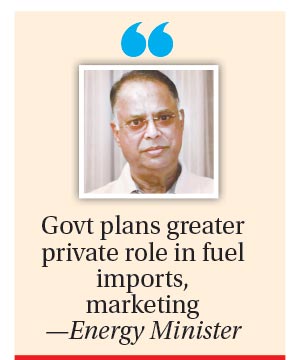
Speaking as the chief guest, Power, Energy and Mineral Resources Minister Iqbal Hasan Mahmud said the government was working to allow greater private-sector participation in fuel imports and marketing.
Under the proposed policy, eligible private companies would be able to import and sell fuel alongside state-owned distributors such as Padma Oil, Jamuna Oil and Meghna Petroleum.
“If there is a private company’s pump alongside Padma, Meghna or Jamuna’s pump, consumers can buy fuel according to their choice,” he said.
Iqbal said the initiative was partly prompted by the recent Middle East conflict, when fears of a fuel shortage led to long queues at petrol stations despite sufficient stocks.
He rejected social media claims that the initiative was intended to benefit specific businesses, calling them “absurd”.
He said private investment was also needed in infrastructure related to gas, coal and petroleum, as the government alone could not meet the country’s growing energy requirements.
Iqbal said Bangladesh would take a cautious approach to coal-fired power plants as international financing for such projects was declining. The government is targeting 10,000MW of solar power generation and will encourage private investment in rooftop solar projects under cluster-based and OPEX models.
He also expressed optimism over cooperation with Malaysian state-owned energy company Petronas in developing gas resources in Bhola.
Independent University Bangladesh Vice Chancellor Professor Dr M Tamim said domestic gas production was declining while infrastructure, technology, investment and financing constraints were making it increasingly difficult to meet growing demand.
He called for maximum use of existing coal-fired power plants, where technically feasible, while rapidly expanding solar power.
“If we can quickly add 2,000 to 3,000MW of solar capacity, it would create an opportunity for fuel savings during the daytime by reducing the need to operate oil- and gas-fired power plants,” he said.
Tamim also called for international expertise and technology to improve recovery from existing gas fields and stressed the need for regional energy cooperation through stronger grid connectivity with India, Nepal and Bhutan.
State Minister for Power, Energy and Mineral Resources Aninda Islam Amit said the government planned to generate around 10,000MW from renewable sources within the next four and a half years, targeting 20 percent of total electricity demand from renewables.
He said 40-60 percent of the targeted renewable capacity could come from ground-mounted and rooftop solar projects.
Amit said domestic gas production was declining by around 150MMcfd annually, while Bangladesh could not increase LNG imports overnight because of infrastructure limitations.
The government is moving ahead with a land-based LNG terminal at Matarbari, which Amit described as the “ultimate solution” for expanding LNG import capacity. The tender for appointing a transaction adviser had closed and land had been identified for the terminal.
He said the government was also hopeful about the ongoing offshore oil and gas bidding round, while preparations for an onshore bidding round were under way.
Presenting the keynote paper, former BUET professor and energy expert Dr Ijaz Hossain said FSRUs and additional LNG imports were necessary to address the immediate crisis but could not provide a sustainable long-term solution.
He called for an immediate acceleration of domestic gas exploration, maintaining production at around 2,000MMcfd, while expanding solar power and battery storage and gradually reducing dependence on furnace oil-based power generation. He projected gas demand could reach 4,600MMcfd by 2030.
CAB energy adviser Shamsul Alam said Bangladesh needed major changes in the power and energy sector, particularly rational energy pricing. He called for clear benchmark prices and investment conditions for power generation.
East Coast Group Chairman Azam J Chowdhury urged Bangladesh to avoid dependence on any single energy source and use all available options, including renewables, oil, gas and LNG.
He stressed the need for greater private-sector participation and stakeholder consultation before introducing new energy policies, warning that policy uncertainty discourages investment.
Bangladesh Independent Power Producers Association (BIPPA) President David Hasnat said around 7,000MW of power generation capacity remained unavailable because of gas shortages. He called for the third FSRU to be made operational within two years and urged development of a land-based LNG terminal as a long-term solution.
Loading...
Loading...
Also read



Editor : Iqbal Sobhan Chowdhury
Published by the Editor on behalf of the Observer Ltd. from Globe Printers, 24/A, New Eskaton Road, Ramna, Dhaka.
Editorial, News and Commercial Offices : Aziz Bhaban (2nd floor), 93, Motijheel C/A, Dhaka-1000.
Phone: PABX- 41053001-06; Advertisement: 41053012; 01793317829, 01550707291, E-mail: [email protected], [email protected] Online: email: [email protected] 41053014; 01550707297 Advertisement: 01550707296
Published by the Editor on behalf of the Observer Ltd. from Globe Printers, 24/A, New Eskaton Road, Ramna, Dhaka.
Editorial, News and Commercial Offices : Aziz Bhaban (2nd floor), 93, Motijheel C/A, Dhaka-1000.
Phone: PABX- 41053001-06; Advertisement: 41053012; 01793317829, 01550707291, E-mail: [email protected], [email protected] Online: email: [email protected] 41053014; 01550707297 Advertisement: 01550707296


