



| HEADLINE |

|

Thousands of buildings on fire-risk list
Published : Thursday, 13 August, 2026 at 12:00 AM
Arifur Rahman Rabbi


 Two deaths in a late-night fire at Al Baraka Tower in Dhaka’s Katabon have once again exposed a wider danger lurking inside buildings across the country: serious fire safety deficiencies that can turn a fire into a deadly disaster.
The fire broke out on the 14th floor of the building late on June 26 and later spread to the 11th and 13th floors. Six units of the Fire Service brought the blaze under control after nearly two hours of efforts, but two people died after suffering burn injuries.
Kazi Nazmuzzaman, assistant director of the Fire Service, said at the time that the building had no firefighting system. Offices had also been rented out in the residential building in violation of regulations.
Al Baraka Tower, however, is far from an isolated case.
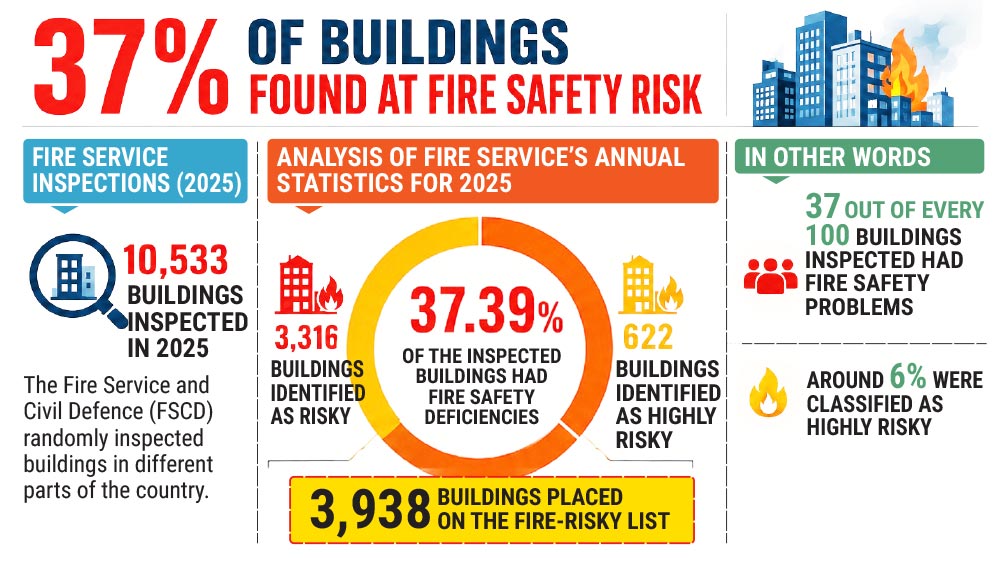
A Fire Service and Civil Defence (FSCD) inspection of 10,533 buildings across the country last year found that nearly 37.39 per cent had fire safety deficiencies. Of these, 3,316 buildings were identified as risky and 622 as highly risky, putting a total of 3,938 buildings on the fire-risk list.
In simple terms, 37 out of every 100 buildings inspected had fire safety problems, while around six in every 100 were classified as highly risky.
The findings are particularly concerning against the backdrop of the country’s overall fire situation. According to Fire Service data, 27,059 fire incidents occurred in 2025, leaving 85 people dead and 267 injured. Property damage from the fires was estimated at around Tk 569.97 crore.
Fire Service officials said the inspections are primarily intended to identify fire hazards and instruct building owners or relevant authorities to take corrective measures.
However, several officials, speaking on condition of anonymity, said urgent action is needed in the case of highly risky buildings. The Fire Service alone cannot address the problem because of its limited manpower, they said, stressing that building owners, users and relevant government agencies must work together to ensure safety.
Dr Adil Muhammad Khan, professor of the Department of Urban and Regional Planning at Jahangirnagar University and executive director of the Institute for Planning and Development (IPD), described the finding that nearly 37 per cent of inspected buildings were at risk as a major warning sign.
“Having fire safety measures in place at the time of construction is not enough. Risks can emerge later due to changes in the use of buildings, overcrowding, excessive storage of goods, blocked emergency stairways and unplanned electrical connections,” he said.
“Regular inspections and re-inspections are therefore essential,” he added.
He said the Fire Service informs building owners about deficiencies identified during inspections, but many fail to take corrective measures because of concerns over costs.
“Alongside public awareness, punitive measures are also necessary,” he said.
Experts also pointed to the important role of the Rajdhani Unnayan Kartripakkha (RAJUK), particularly in Dhaka and its surrounding areas. Ensuring that buildings are being used according to their approved designs and that construction rules are followed is closely linked to fire safety, they said.
RAJUK Chairman Md Riazul Islam said at a discussion meeting at the National Press Club on August 8 that it would not be possible to assess the risks of the capital’s huge number of buildings all at once.
“Therefore, rapid visual, preliminary and detailed engineering assessments will be carried out in phases,” he said.
He said RAJUK, city corporations, disaster management authorities, the Fire Service and other relevant agencies would have to work together to reduce risks. Action is also being taken against construction irregularities and risky structures, he added.
Fire Service and Civil Defence Director (Operations and Maintenance) Lt Col Md Mahmudul Hasan told The Daily Observer that the main objective is to mitigate risks once they have been identified.
Building owners are sent letters instructing them to take necessary measures, while regular monitoring and re-inspections are carried out. Where necessary, action is taken through mobile courts, he said.
Yet the latest inspection figures raise a crucial question: after a building is identified as risky, are the required safety measures actually being put in place?
Loading...
Loading...
Also read



Editor : Iqbal Sobhan Chowdhury
Published by the Editor on behalf of the Observer Ltd. from Globe Printers, 24/A, New Eskaton Road, Ramna, Dhaka.
Editorial, News and Commercial Offices : Aziz Bhaban (2nd floor), 93, Motijheel C/A, Dhaka-1000.
Phone: PABX- 41053001-06; Advertisement: 41053012; 01793317829, 01550707291, E-mail: [email protected], [email protected] Online: email: [email protected] 41053014; 01550707297 Advertisement: 01550707296
Published by the Editor on behalf of the Observer Ltd. from Globe Printers, 24/A, New Eskaton Road, Ramna, Dhaka.
Editorial, News and Commercial Offices : Aziz Bhaban (2nd floor), 93, Motijheel C/A, Dhaka-1000.
Phone: PABX- 41053001-06; Advertisement: 41053012; 01793317829, 01550707291, E-mail: [email protected], [email protected] Online: email: [email protected] 41053014; 01550707297 Advertisement: 01550707296


