



| HEADLINE |

|

Japan hit by ‘Unprecedented’ rainfall, 8 killed and thousands stranded
Published : Friday, 14 August, 2026 at 9:40 PM
Observer Online Report


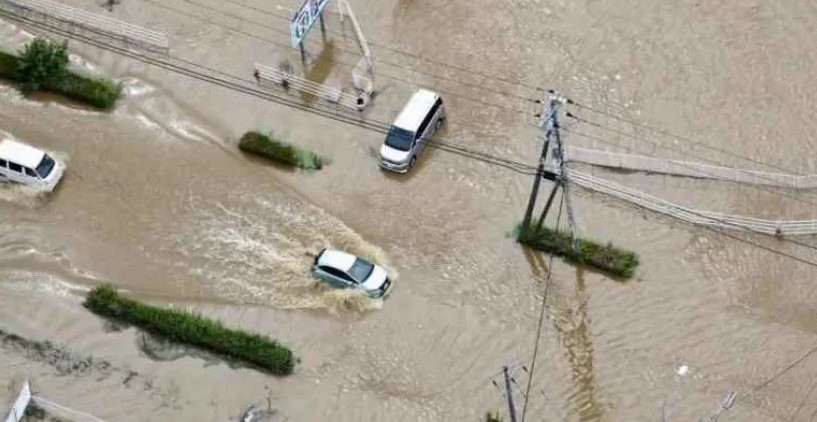
At least eight people have been killed after eastern Japan was hit by record-breaking and what authorities described as “unprecedented” heavy rainfall, triggering floods, landslides, power outages and widespread transport disruptions.
More than 20,000 households in Chiba Prefecture were without electricity, while thousands of passengers were stranded at Tokyo’s Narita International Airport as torrential rain disrupted transport services.
Local authorities issued the highest Level 5 emergency alert on Thursday before lowering it to Level 4 on Friday morning. However, officials warned that the risks of flooding and landslides remained high.
The Japan Meteorological Agency said warm, humid air flowing into eastern Japan had collided with colder air above, creating severe atmospheric instability and causing the intense rainfall. The rain was forecast to continue until late Friday night.
Chiba Governor Toshihito Kumagai told reporters on Friday morning that the situation was highly unusual even by Japan’s standards of severe weather.
“I have dealt with many disasters in the past, but I have never encountered a situation like this,” he said.
More than 100 millimetres of rain per hour was recorded in parts of Chiba, near Tokyo, from Thursday afternoon. The rainfall was nearly three times the average August rainfall and was described as the highest level ever recorded in the country.
According to public broadcaster NHK, Kyodo News and the Asahi Shimbun, at least eight people have died. One woman was killed after becoming trapped inside a vehicle submerged by floodwater, while two others died after being swept or knocked down on roads.
Authorities ordered hundreds of thousands of residents to evacuate their homes and move to safer areas as the rain intensified. Train services and major highways were also suspended, leaving many passengers stranded at railway stations. Around 1,800 people in Chiba spent the night in public buildings.
Narita Airport said flights were expected to operate as scheduled on Friday, although Japan Airlines warned that some services could face delays. No widespread cancellations were expected.
Climate experts said the region was experiencing an unusually active typhoon season. Three storms Dolphin, Chan-hom and Peilou have affected Japan, the Philippines and China this week.
The storms caused extensive power outages and uprooted trees in Japan’s Okinawa islands. In China, more than one million people were evacuated from areas threatened by the storms and flooding, while schools and government offices in much of the northern Philippines were closed again because of worsening flood conditions.
Source: BBC
-HIS
Loading...
Loading...
Also read





Editor : Iqbal Sobhan Chowdhury
Published by the Editor on behalf of the Observer Ltd. from Globe Printers, 24/A, New Eskaton Road, Ramna, Dhaka.
Editorial, News and Commercial Offices : Aziz Bhaban (2nd floor), 93, Motijheel C/A, Dhaka-1000.
Phone: PABX- 41053001-06; Advertisement: 41053012; 01793317829, 01550707291, E-mail: [email protected], [email protected] Online: email: [email protected] 41053014; 01550707297 Advertisement: 01550707296
Published by the Editor on behalf of the Observer Ltd. from Globe Printers, 24/A, New Eskaton Road, Ramna, Dhaka.
Editorial, News and Commercial Offices : Aziz Bhaban (2nd floor), 93, Motijheel C/A, Dhaka-1000.
Phone: PABX- 41053001-06; Advertisement: 41053012; 01793317829, 01550707291, E-mail: [email protected], [email protected] Online: email: [email protected] 41053014; 01550707297 Advertisement: 01550707296


