



| HEADLINE |

|

BEYOND THE MOUNTAINS
Published : Saturday, 15 August, 2026 at 12:00 AM
Lekhak Gupta


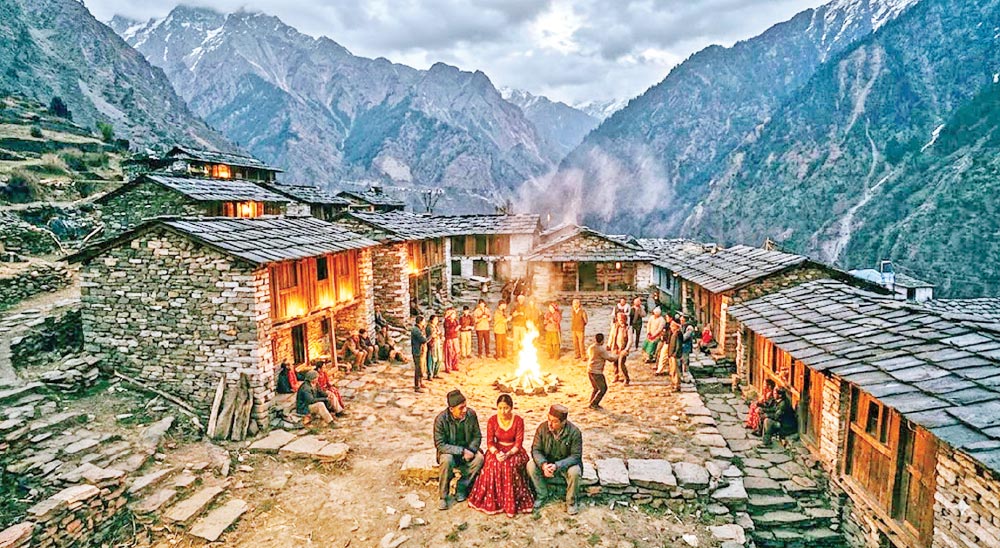 Tuesday had not yet arrived; it was on Monday night that the mountain settlement of Devbhumi outshone the surrounding valleys in a blaze of festivity. A young woman named Krishna was about to be married to two brothers.
Before wrinkling the brow and dismissing it as some bizarre or chaotic social absurdity, one ought perhaps to reproach oneself for having remained ignorant, for so long, of a custom that exists in the world.
It is an ancient institution that claims descent from the Mahabharata�"the Draupadi custom, a living memory of that epic mythological narrative composed by the sage Vyasa, still flowing through the blood of this mountain people. Among the Hatti community of Devbhumi, the belief persists that they are, perhaps more steadfastly than any other polyandrous society in the world, the true heirs of that tradition.
The moment the matchmaker arrived with a proposal from the two sons of the late Narayanswami, Krishna’s mother, Kabita Rani, immersed herself in preparations for the wedding. Krishna herself had been born into such a household: her mother had two husbands, Raghav Chandran and Shashi Chandran, brothers by birth. In that sense, Krishna had two fathers.
Like his four brothers, Narayanswami had inherited from his ancestors a single acre of terraced mountain land and a modest amount of property. Before his death he had left behind a house and two sons of marriageable age. The family was determined that the ancestral estate should not be fragmented still further. Therefore, in accordance with a custom handed down through generations, the two brothers were to marry the same woman.
In this practice, known locally as the Draupadi custom, two or more men accept the same woman as wife. Most often the husbands are brothers, so that paternal property may remain undivided instead of being broken into ever smaller parcels. Even today, in this remote mountain settlement, the tradition survives.
And so our golden-complexioned Krishna was being led toward that same destiny. Yet once she had dreamed of flying like a bird. Gazing at the sky-piercing mountains of Devbhumi, she would imagine that one day she would look upon the world from the heavens. The truth is that the higher human beings learn to climb, the more fiercely the longing to fly takes hold of them.
While the rest of the country had begun to glow with the light of modern education, not a single person in this village had crossed the threshold of a modern school�"because none could name only one father. Krishna too had once wished to enroll in a primary school beyond the mountains. Her two fathers had tried with all their strength. In the end they received nothing but humiliation and failure. After that, it seemed that only two roads remained: wait a few more years, and then give the girl away in marriage.
To present a child before the world carrying the names of two fathers is no easy matter. A school admission form has only one blank space: Father’s Name. Whose name was to be written there? Neither her parents nor the teachers themselves knew the answer.
That day everyone laughed at her�"students and teachers alike. From among the crowd of curious trainee teachers someone exclaimed,
“What a fortunate girl!”
Another curled his lips in mockery and said,
“Some children have no father, and some have two!”
They returned home defeated, yet within that defeat lingered a strange pride. They still believed themselves to be descendants of the Pandavas. To them, the custom was not merely a social arrangement; it was an invisible bond of kinship with their divine ancestors.
The state, of course, had never granted legal recognition to such marriages. Yet it was equally true that this secluded settlement in the lap of the mountains had seldom entered the state’s field of vision. Its customs and way of life had therefore been left largely untouched.
A tailor from the neighbourhood�"who had long watched Krishna out of the corner of his eye as she returned from gathering firewood and mountain fruits�"came a few days before the wedding to take measurements for her bridal clothes. From close quarters he measured every curve of her shy young body. As mountain peaks rose, tier upon tier, to press their lips against the sky, so her beauty extended from the tips of her toes to the ends of her hair. Yet even from such nearness the young man could not hold her gaze. The beauty he yearned to behold had itself become the source of his sorrow:
Beauty scorches the eyes, listen, my heart is full; Each limb of mine weeps for every limb of yours.
Just then the sound of Kabita Rani’s footsteps came from outside. The tailor seemed to awaken from a trance. Muttering a few measurements to himself, he asked for some old pieces of cloth and slipped away in silence.
On the very night of the wedding, Krishna left home, taking the narrow mountain path under cover of darkness. Before departing she heard again the voice that had long echoed within her:
If a bird wishes to fly, it must leave the nest.
She descended from the mountain heights with the stillness of an eagle gliding through the air, and in time she came to the Bengali settlement on Teresa Island.
“How could that be possible?”
Possible in this way: before the bridegrooms arrived, the Krishna who longed to fly, the Krishna who wished to trample the ancient custom underfoot, the Krishna who thirsted to see the outer world and to know it, slipped quietly out of the house. As she walked the mountain trails, an old familiar melody kept sounding through the silence:
Beyond the boundary of my village, Beyond the mountains, I hear the echoes of the midnight night�" Echoes, only echoes, endlessly I hear them.
Barefoot, frightened, and alone, she was walking toward the hermitage near the village, where a monk had once told her, “If a bird wishes to fly, it must leave the nest.”
But fate had already written a different story for her.
Before she could reach the hermitage, a middle-aged woman from the roadside market at the foot of the hills saw the radiance of her youthful face and gathered her into a maternal embrace. From that moment Krishna could not escape the snare of that apparent affection. And when she finally did escape, she was covered in blood�"her clothes stained with dark, warm patches of it.
The bus in which she was being carried toward some unknown destination of human predators collided head-on with an overloaded truck on a rain-soaked highway, only a few steps from my own house. The accident was catastrophic. Rescuers found that most of the passengers had died on the spot. Amid the twisted metal and the shards of blood-smeared glass sat a little girl in utter silence, drenched not in her own blood but in the blood of others.
She had survived.
For several days she did not speak a word. Whenever someone asked her name, she lowered her head. Raised within a deeply patriarchal world, Krishna would answer any question about her father by giving the names of both fathers.
Just as you would not have believed it, neither did anyone else. The police assumed that the trauma of the accident had confused her mind. Newspapers reported her merely as an unidentified adolescent girl. The news never reached Hatti with any certainty, and after a time she was forgotten.
Your mother and I happened to be in Kolkata on our autumn vacation then. When the holidays ended, we brought Krishna back with us to the Bengali village on Teresa Island. She entered your mother’s loneliness like the shattering of a hidden spring. This was many years before you were born, when I was a mathematics teacher at a government senior secondary school. Teresa Island, in the Nicobars, is a lovely crescent-shaped land, so rich in sweeping grass-covered meadows that people sometimes call it a hidden New Zealand. Here, no one worries about land being divided into ever-smaller fragments; a single spouse is the natural course of life. The Bengali settlement is said to have been founded by descendants of those Bengalis who, after Independence, were freed from the dreaded penal colonies and journeyed southward. Among their children, Krishna, the guileless mountain girl, soon became one of their own.
When we heard the story of that hill-country girl�"her two fathers, the humiliation of school admission, and her broken dream�"we felt ashamed. A civilisation capable of reaching the moon had failed to make room on a school admissions form for a child like her. That truth embarrassed us deeply.
Your mother said quietly,
“If society cannot accept the truth of her life, let us at least preserve her dignity.”
The following academic year I enrolled her in my school. Under Name, I wrote Ami (stands for "I"). Under Father’s Name I wrote Father. Under Mother’s Name I wrote Mother. Because, after all:
When someone truly desires something from the depths of their heart, the entire universe conspires to help them attain it.
Years later, when someone asks her, “Where do you come from?” she smiles gently and replies:
“I am everyone, and I am no one. I belong to those who chose to love me.”

Loading...
Loading...



Editor : Iqbal Sobhan Chowdhury
Published by the Editor on behalf of the Observer Ltd. from Globe Printers, 24/A, New Eskaton Road, Ramna, Dhaka.
Editorial, News and Commercial Offices : Aziz Bhaban (2nd floor), 93, Motijheel C/A, Dhaka-1000.
Phone: PABX- 41053001-06; Advertisement: 41053012; 01793317829, 01550707291, E-mail: [email protected], [email protected] Online: email: [email protected] 41053014; 01550707297 Advertisement: 01550707296
Published by the Editor on behalf of the Observer Ltd. from Globe Printers, 24/A, New Eskaton Road, Ramna, Dhaka.
Editorial, News and Commercial Offices : Aziz Bhaban (2nd floor), 93, Motijheel C/A, Dhaka-1000.
Phone: PABX- 41053001-06; Advertisement: 41053012; 01793317829, 01550707291, E-mail: [email protected], [email protected] Online: email: [email protected] 41053014; 01550707297 Advertisement: 01550707296


