



| HEADLINE |

|
200 lime kilns burn 1,400 tonnes of wood every month in Sunamganj
Published : Sunday, 16 August, 2026 at 3:45 PM
Observer Correspondent


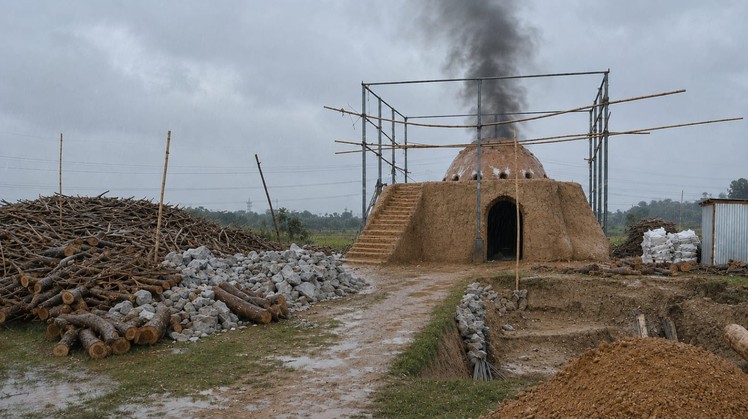
Around 200 wood-fired pajus used to produce lime, have been set up in Chhatak of Sunamganj without environmental clearance from the Department of Environment. Around 1,400 tonnes of wood are burned in these kilns every month.
This has not only created a shortage of firewood in the area, but also put forests and the environment at risk. The black smoke, lime dust and foul odour emitted from the kilns are also increasing public health risks.
Although these kilns have been set up at various locations across the upazila, including residential areas, both banks of the Surma River and areas around the Chhatak-Gobindaganj road, their number is reportedly increasing day by day due to a lack of effective action. Locals allege that such environmentally destructive activities are continuing unchecked due to the negligence of the Department of Environment, Forest Department and local administration.
Firewood prices rise, concerns over deforestation
Black smoke and lime dust pose health risks
The burning of limestone with wood in the kilns produces black smoke. Lime dust and foul odours are also released into the air. As a result, local public health is at risk alongside the environment.
Locals allege that the risks are even greater for children, elderly people and those suffering from respiratory problems because the kilns have been set up close to residential areas and populated settlements. At the same time, the lack of adequate safety measures for workers and owners of the kilns raises concerns about possible accidents and loss of life.
This has not only created a shortage of firewood in the area, but also put forests and the environment at risk. The black smoke, lime dust and foul odour emitted from the kilns are also increasing public health risks.
Although these kilns have been set up at various locations across the upazila, including residential areas, both banks of the Surma River and areas around the Chhatak-Gobindaganj road, their number is reportedly increasing day by day due to a lack of effective action. Locals allege that such environmentally destructive activities are continuing unchecked due to the negligence of the Department of Environment, Forest Department and local administration.
According to local sources, Chhatak was once known for its limestone and lime industry. Over the past few months, these wood-fired kilns have sprung up rapidly along both banks of the Surma River, on both sides of the Chhatak-Gobindaganj road, and in various areas including Boula and Tatikona. The facilities used to burn limestone to produce lime are locally known as pajus. In the past, limestone was burned using straw or thatch, but such activities were discontinued for environmental reasons. The lime-making business later shifted to Narayanganj, where limestone was burned using gas. However, the operations there were recently suspended amid complaints of environmental damage and a gas shortage.
As a result, the price of lime suddenly almost doubled. Taking advantage of the situation, temporary kilns began springing up overnight in different parts of Chhatak. According to people familiar with the business, each paju burns limestone twice a month. Each kiln requires around seven tonnes of firewood per month. Accordingly, around 1,400 tonnes of wood are being burned every month in nearly 200 kilns across the upazila.
Firewood prices rise, concerns over deforestation
The heavy use of wood as fuel has created a firewood shortage in the area. Locally, firewood that previously cost Tk 120 is now reportedly being sold for as much as Tk 300. The surge in demand has also raised concerns that firewood could be collected indiscriminately from forests.
Firewood is now being brought to the kilns from different upazilas across Sylhet division. According to locals, 20 to 30 trucks and pickup vans carrying firewood are seen entering Chhatak every day. Relevant authorities fear that continued use of such large quantities of wood could have long-term adverse effects on forests.
Black smoke and lime dust pose health risks
The burning of limestone with wood in the kilns produces black smoke. Lime dust and foul odours are also released into the air. As a result, local public health is at risk alongside the environment.
Locals allege that the risks are even greater for children, elderly people and those suffering from respiratory problems because the kilns have been set up close to residential areas and populated settlements. At the same time, the lack of adequate safety measures for workers and owners of the kilns raises concerns about possible accidents and loss of life.
Locals allege that the kilns have been operating without environmental clearance for around six months. They have expressed frustration that such environmentally destructive activities are continuing in plain sight of the administration without effective action.
Relevant people said that environment-related illnesses are also increasing due to the constant emission of dense smoke and the spread of lime dust from the kilns. The extensive use of wood as fuel has also raised concerns about deforestation. As a result, demands have grown across the upazila for the closure of the illegal kilns.
Doctor warns of growing health risks
Chhatak Upazila Health and Family Planning Officer Dr Nusrat Jahan said, “As Chhatak has industrial facilities, the number of patients suffering from environment-related illnesses has already been high in the upazila. It has increased further over the past few months.”
Business owners seek legal recognition
Paju Business Association President Salek Mia and General Secretary Ashraful Alam acknowledged that the kilns cause some environmental damage but said it is an old business in Chhatak. They said many people would be left helpless without this business.
They demanded that the businesses be granted environmental clearance and brought under the tax system, arguing that this would benefit both the government and the business owners.
Forest Department cites staff shortage
KBM Ferdous, a beat officer of the Chhatak Forest Department, said, “We are facing a shortage of manpower. It is difficult to conduct raids with only two people. We are trying to take legal action in consultation with the upazila nirbahi officer.”
No environmental clearance; Department says notices and fines issued
Sunamganj Department of Environment Director Mohammad Mohaiminul Haque said, “These establishments do not have any environmental clearance from the Department of Environment. We have served them notices and also fined them. We have written to the Forest Department to stop the supply of fuel. We have also spoken to the local administration. We will sit with them and decide what can be done. Since these are harmful to the environment, we have not granted them clearance. We are working to shut them down.”
UNO says meeting will be held soon
Chhatak Upazila Nirbahi Officer (UNO) Mohammad Mahi Uddin said, “We will sit with the Department of Environment and the paju owners soon. We will find out how these are operating without approval and take necessary action.”
Locals expect that, rather than merely serving notices or imposing fines, the relevant departments will take coordinated and effective measures to protect the environment, forests and public health and reach a swift decision on these kilns operating without environmental clearance.
MT
Loading...
Loading...
Also read







Editor : Iqbal Sobhan Chowdhury
Published by the Editor on behalf of the Observer Ltd. from Globe Printers, 24/A, New Eskaton Road, Ramna, Dhaka.
Editorial, News and Commercial Offices : Aziz Bhaban (2nd floor), 93, Motijheel C/A, Dhaka-1000.
Phone: PABX- 41053001-06; Advertisement: 41053012; 01793317829, 01550707291, E-mail: [email protected], [email protected] Online: email: [email protected] 41053014; 01550707297 Advertisement: 01550707296
Published by the Editor on behalf of the Observer Ltd. from Globe Printers, 24/A, New Eskaton Road, Ramna, Dhaka.
Editorial, News and Commercial Offices : Aziz Bhaban (2nd floor), 93, Motijheel C/A, Dhaka-1000.
Phone: PABX- 41053001-06; Advertisement: 41053012; 01793317829, 01550707291, E-mail: [email protected], [email protected] Online: email: [email protected] 41053014; 01550707297 Advertisement: 01550707296


