



| HEADLINE |

|

RMG exports to EU decline sharply despite June recovery
Published : Monday, 17 August, 2026 at 12:00 AM
Mizanur Rahman


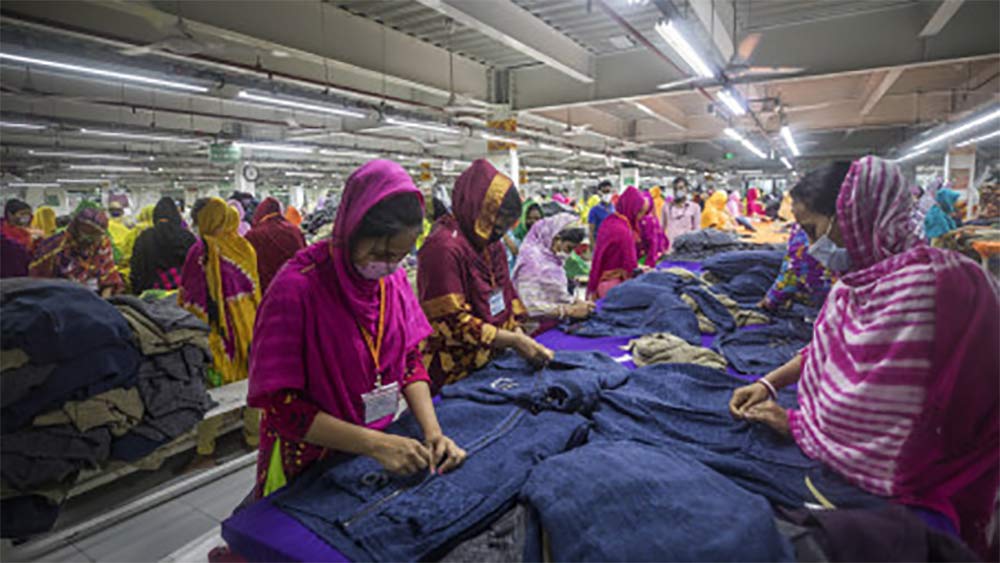 Bangladesh’s apparel exports to the European Union (EU) fell sharply in the first half of 2026 despite a modest recovery in June, as weaker shipment volumes and falling prices continued to erode competitiveness in its largest export market.
According to Eurostat data compiled by Bangladesh Apparel Voice (BAV), the EU’s apparel imports from the world fell 9.70 per cent year-on-year to €41.10 billion in January-June. Import volume declined 6.40 per cent, while the average price fell 3.53 per cent.
Bangladesh fared worse, with apparel exports to the bloc dropping 16.43 per cent to €8.64 billion. Export volume fell 8.22 per cent and the average price 8.94 per cent.
June, however, brought a modest improvement.

Bangladesh's apparel exports to the EU rose 0.87 percent year-on-year to €1.37 billion. Shipment volume increased 6.53 per cent, although the average price declined 5.31 percent.
The data indicate that Bangladesh is facing a dual challenge in the European market-weak demand and growing price pressure.
Exports of most major competing suppliers also declined. China's shipments to the EU fell 8.88 per cent, Turkey's 14.60 percent, India's 12.49 per cent, Pakistan's 12.53 per cent, Sri Lanka's 11.21 percent and Cambodia's 8.84 per cent.
Vietnam was the only major supplier to record growth, with exports increasing 0.36 per cent. Its shipment volume fell 11.52 per cent, but its average export price rose 13.43 per cent.
Competitiveness a major concern
Bangladesh Garment Manufacturers and Exporters Association (BGMEA) President Mahmud Hasan Khan has previously attributed the decline in EU-bound exports to weak global demand and rising competitiveness pressures.
He said volatile global conditions, US reciprocal tariffs, high bank interest rates, poor port operations and uncertainty over LDC graduation were affecting Bangladesh's apparel exports.
"Tariffs, wars and geopolitics have eaten up global demand, causing a decline in work orders," he said, adding that the key issue for Bangladesh was competitiveness in a squeezed global market.
The latest data reinforce his concern, as Bangladesh's 16.43 per cent decline was significantly higher than the 9.70 per cent fall in the EU's overall apparel imports.
Mahmud Hasan Khan has also highlighted growing competition from India, saying Indian exporters are benefiting from integrated supply chains, cost advantages and stronger capabilities in home textiles, technical textiles and synthetic fibres.
Product diversification needed
Industry leaders say Bangladesh must reduce its dependence on basic cotton-based garments and move into higher-value and non-cotton products.
They have stressed the need to improve productivity, reduce production costs and diversify products to remain competitive, particularly as Bangladesh prepares for tougher competition following its LDC graduation.
The BGMEA has also been focusing on sustainability and traceability. In May, the association signed an MoU with AWARE to strengthen digital product passport and supply-chain traceability capabilities in preparation for evolving EU requirements.
Former BGMEA director and Bangladesh Apparel Voice founder and CEO Md Mohiuddin Rubel has warned that Bangladesh's heavy dependence on the EU market creates a structural risk as the country approaches LDC graduation.
He said losing preferential access could expose Bangladeshi apparel exports to higher tariffs, while competitors such as China and Vietnam could gain market share.
BGMEA leaders have particularly emphasised securing GSP+ benefits and maintaining favourable access to the European market.
Industry insiders said Bangladesh now needs to focus simultaneously on retaining existing European buyers and securing new orders through product diversification, improved productivity, competitive pricing and stronger compliance with emerging EU requirements.
They also called for lower financing costs, improved port and logistics services and reliable energy supplies to reduce production costs.
The June recovery offers some hope, particularly as shipment volume increased 6.53 per cent. However, the 8.22 per cent decline in volume during January-June suggests fewer orders, while the 8.94 per cent fall in average prices is putting additional pressure on exporters' margins.
With the EU remaining a crucial market for Bangladesh's garment industry, exporters say a sustained recovery will depend on the country's ability to regain competitiveness in an increasingly challenging European market.
Loading...
Loading...
Also read



Editor : Iqbal Sobhan Chowdhury
Published by the Editor on behalf of the Observer Ltd. from Globe Printers, 24/A, New Eskaton Road, Ramna, Dhaka.
Editorial, News and Commercial Offices : Aziz Bhaban (2nd floor), 93, Motijheel C/A, Dhaka-1000.
Phone: PABX- 41053001-06; Advertisement: 41053012; 01793317829, 01550707291, E-mail: [email protected], [email protected] Online: email: [email protected] 41053014; 01550707297 Advertisement: 01550707296
Published by the Editor on behalf of the Observer Ltd. from Globe Printers, 24/A, New Eskaton Road, Ramna, Dhaka.
Editorial, News and Commercial Offices : Aziz Bhaban (2nd floor), 93, Motijheel C/A, Dhaka-1000.
Phone: PABX- 41053001-06; Advertisement: 41053012; 01793317829, 01550707291, E-mail: [email protected], [email protected] Online: email: [email protected] 41053014; 01550707297 Advertisement: 01550707296


