



| HEADLINE |

|
Gas crisis halts production at over 300 factories in Narsingdi
Published : Saturday, 22 August, 2026 at 7:53 PM
Observer Online Report


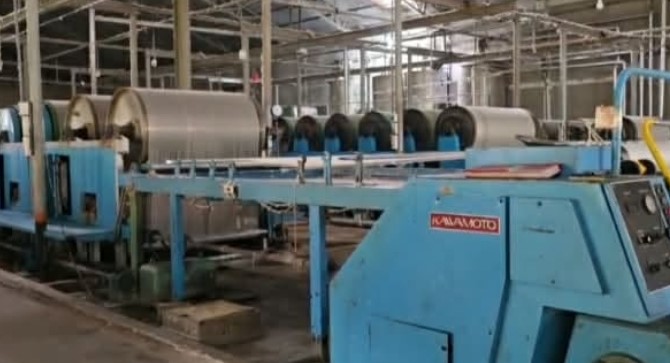
Collected Photo
Production has come to a halt at more than 300 small and large factories in Narsingdi due to an acute gas shortage, while many industrial units in Narayanganj and Gazipur have also been forced to suspend or scale back operations amid critically low gas pressure.
The gas crisis has continued across industrial areas in and around Dhaka, including Narsingdi, Narayanganj and Gazipur. Bangladesh’s daily gas demand stands at around 3.8 billion cubic feet (bcf), while supply is normally maintained at around 2.7 bcf through rationing. However, supply fell from 2.42 bcf on Saturday morning to 2.40 bcf on Sunday, 2.28 bcf on Monday and 2.26 bcf at 6pm on Tuesday.
In Narsingdi, hundreds of factories have been unable to operate, leaving workers idle. Household cooking has also been disrupted in some areas, while long queues have formed at CNG filling stations.
Factory owners said gas pressure has remained at its lowest level for about a week and has occasionally dropped to zero. Although some factories had managed to maintain around 10 percent production through alternative arrangements, several have now been forced to shut down completely. Narsingdi’s textile sector supplies nearly 70 percent of the country’s demand for locally produced fabrics. The district has more than 3,000 textile, dyeing and spinning mills.
Rashidul Hasan, president of the Narsingdi Chamber of Commerce and Industries, said more than 300 industrial units had been forced to suspend production due to the lack of gas.
Among the factories that have suspended operations in Narsingdi town and surrounding areas are Chishtia Sizing Mill, Yamin Sizing Mill, Momin Sizing Mill, Hossain Dyeing and Calendaring Mill, Abed Textile Mills, Shilpi Dyeing, Nadi-Bangla Sizing Mill and Bhuiyan Textile and Calendar Mills. Several factories under Amanat Shah Group and Pakiza Group in Madhabdi, as well as MMK Dyeing, Muktadin Dyeing and Madhabdi Dyeing, are also closed.
Nizam Uddin Bhuiyan, president of the Narsingdi Textile, Dyeing and Printing Association and owner of Madhabdi Dyeing Finishing Mills, warned that prolonged disruption could leave factory owners unable to pay workers’ wages or gas bills.
Anisur Rahman Bhuiyan, director of Bhuiyan Textile and Calendar Mills Ltd, urged the government to resolve the crisis quickly. He called for a clear announcement on when the gas shortage would end and what industrialists should do until then.
Abdullah Al Mamun, managing director of Abed Textile Mills in Narsingdi, said the factory had been completely shut for 20 days. To prevent worker dissatisfaction, the company is assigning employees maintenance and cleaning duties, he said.
Maksudur Rahman, manager of the regional marketing office of Titas Gas in Narsingdi, said gas pressure in the district was “almost nonexistent.” He said whatever gas was available was being supplied on a priority basis to the Ghorashal-Palash urea fertiliser plants.
Production disrupted in Narayanganj
Production has also been disrupted in Narayanganj. MS Dyeing and Printing at the Panchabati BSCIC Industrial Estate in Fatullah has suspended operations due to a lack of gas pressure, said its general manager, Babul Hossain.
Fakir Knitwear in Kayempur, Fatullah, has been using generators to keep production running, increasing its operating costs, said General Manager Rajib Ahmed.
Production at City Group’s factory in Rupsi, Rupganj, one of the country’s major consumer-goods manufacturing facilities, was completely halted from Tuesday afternoon. Syed Rafiqul Rahman, technical director of City Group, said the factory requires around 120 PSI of gas pressure to operate, but the pressure had fallen to 20-25 PSI.
Gas shortage hits Gazipur factories
Many factories in Gazipur are also operating at reduced capacity due to inadequate gas supply. Production has been particularly affected in dyeing and other gas-dependent sections of garment factories. Some factories have had to temporarily shut their dyeing units, industry insiders said.
Abdur Rahman, a manager at a factory in Konabari, said irregular and inadequate gas supplies were disrupting production and creating uncertainty over timely delivery of finished products.
Saifuzzaman Sani, manager of Titas Gas in Gazipur, acknowledged that gas pressure had declined and expressed hope that the situation would improve soon.
The crisis has been linked to disruptions in LNG supply. Bangladesh has two floating LNG terminals in Maheshkhali one operated by US-based Excelerate Energy and the other by local company Summit. Excelerate’s terminal was shut down following a fire incident on July 21.
After 25 days of severe gas shortages, Summit’s terminal resumed full operations and Excelerate’s terminal resumed partial operations on Saturday, increasing gas supply. However, supplies from Excelerate’s terminal have been declining for the past three days because it does not have a new LNG cargo.
A new LNG cargo was expected to arrive on August 20 and could be delivered to Summit’s terminal, while another cargo for Excelerate’s terminal could arrive on August 23-24, according to a source.
-HIS
Loading...
Loading...
Also read









Editor : Iqbal Sobhan Chowdhury
Published by the Editor on behalf of the Observer Ltd. from Globe Printers, 24/A, New Eskaton Road, Ramna, Dhaka.
Editorial, News and Commercial Offices : Aziz Bhaban (2nd floor), 93, Motijheel C/A, Dhaka-1000.
Phone: PABX- 41053001-06; Advertisement: 41053012; 01793317829, 01550707291, E-mail: [email protected], [email protected] Online: email: [email protected] 41053014; 01550707297 Advertisement: 01550707296
Published by the Editor on behalf of the Observer Ltd. from Globe Printers, 24/A, New Eskaton Road, Ramna, Dhaka.
Editorial, News and Commercial Offices : Aziz Bhaban (2nd floor), 93, Motijheel C/A, Dhaka-1000.
Phone: PABX- 41053001-06; Advertisement: 41053012; 01793317829, 01550707291, E-mail: [email protected], [email protected] Online: email: [email protected] 41053014; 01550707297 Advertisement: 01550707296


