



| HEADLINE |

|
The Rohingya Crisis Nears a Decade: A Roadmap for Repatriation Is Urgently Needed
Published : Tuesday, 25 August, 2026 at 12:00 AM
M A Halim


 After Rohingyas displaced from Myanmar (then Burma) in 1978 were repatriated within two years, a new influx began arriving in Cox’s Bazar during November-December 1991. On 9 March 1992, I joined the Rohingya humanitarian assistance programme of the Bangladesh Red Crescent Society as an officer at the Domdomia Camp in Teknaf. At that time, the camp was not yet fully established, and Rohingyas continued to arrive in large numbers. It was through relentless efforts to set up the camp in a highly disorganized environment and to deliver humanitarian assistance to the refugees that I first came to understand their suffering and began my work with the Rohingya population.
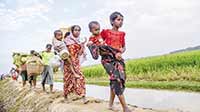
In both phases of displacement, in 1978 and in 1991-92, the reasons behind the Rohingyas' displacementto Bangladesh were essentially the same: seeking protection from persecution, repression, and killings by Myanmar’s military and paramilitary forces in Rakhine State. The same circumstances led to another influx in 2016-2017, culminating in a massive exodus on 25 August 2017. More than 700,000 Rohingyas entered Bangladesh during that period. According to the Inter Sector Coordination Group (ISCG), there are currently 1,250,209 Rohingyas living in 33 camps in Ukhiya and Teknaf, as well as on Bhasan Char. Of these, around 178,000 have arrived during the past year alone. During the same period, 34,301 children were born, equivalent to nearly 100 births per day. It is noteworthy that the Government of Bangladesh refers to them not as refugees but as Forcibly Displaced Myanmar Nationals (FDMNs).
As reports of mass killings and large-scale displacement intensified in September 2016, international criticism prompted the establishment of the Advisory Commission on Rakhine State, chaired by former UN Secretary-General Kofi Annan and consisting of nine members. While the commission was carrying out its mandate, Myanmar intensified its persecution of the Rohingyas, culminating in the atrocities of 25 August 2017. The Commission submitted its report on 23 August 2017, highlighting, among other issues, restrictions on freedom of movement, denial of access to public services, and the discriminatory nature of the 1982 Citizenship Law. It recommended reforms, including amendments to the citizenship law.
Following the massive influx of Rohingyas in 2017, Bangladesh and Myanmar signed a Memorandum of Understanding (MoU) on repatriation on 23 November. To the best of my knowledge, neither the United Nations nor any influential third party, such as ASEAN, was directly involved in this process. Consequently, the MoU was never translated into a comprehensive agreement, nor were effective mechanisms established to ensure implementation or encourage Myanmar to take meaningful steps toward repatriation. Although intermittent initiatives have been undertaken, questions remain regarding their sincerity. In December 2023, a pilot repatriation programme involving 1,176 Rohingyas was proposed. To build confidence among the Rohingya community, a 27-member delegation, including 20 Rohingyas, visited Maungdaw in Rakhine State on 5 May 2023 and toured villages and transit centres. However, renewed fighting between the Myanmar military and the Arakan Army in November that year halted the initiative.
A major obstacle to repatriation remains Myanmar’s reluctance to recognize most Rohingyas as its citizens, a stance reflected in recent official statements. After a prolonged period of silence on the issue, reports emerged on 30 July, citing the Prime Minister of Malaysia, that Myanmar was willing to take back 300,000 Rohingyas. More recently, Myanmar acknowledged 308,975 individuals from a list of over 800,000 names submitted by Bangladesh as residents of Rakhine State. However, it stated that repatriation would only take place “when the security situation in Rakhine improves.” The remainder were labelled as “Bengalis,” effectively denying them recognition as Myanmar citizens. The Government of Bangladesh has formally protested this position.
Moreover, media reports have highlighted the construction of permanent housing for Rohingyas through hill-cutting operations. According to one report, 888 permanent shelters are planned inKutupalong Camp 4 Extension. Waste generated by more than 250,000 families, contaminated wastewater, and daily sanitation outputs have made the surrounding environment increasingly unsustainable. Drains, open spaces, agricultural lands, and water bodies have become dumping grounds for waste and polluted water. The widespread use of plastic and polythene poses additional threats to soil fertility and agricultural productivity.
Perhaps the most alarming yet less visible challenge is the excessive dependence on groundwater. The unplanned installation of deep and shallow tube wells has reportedly lowered the water table to depths of 700-750 feet. Security concerns are also persistent, with violent clashes occurring both within camps and between Rohingyas and host communities, sometimes resulting in fatalities. Many Rohingyas have entered local labour markets, increasing competition for livelihoods and fuelling tensions. At the same time, the involvement of both Rohingyas and local residents in smuggling activities has contributed to rising social instability.
In addition, the camps frequently experience various secondary disasters, including flash floods, landslides, cyclones, and fires. The devastating fire of 2021 destroyed more than 10,000 shelters, while landslides on 4 and 8 July of this year claimed the lives of 14 Rohingyas. Addressing these recurring crises requires considerable additional resources, coordination, and effort.
Having worked in Rohingya humanitarian operations during 1992-93 and again from 2020-22, I have had conversations with Rohingyas. Many expressed exhaustions with the difficult living conditions, monotony, dependence on aid, and uncertainty surrounding their children's future. One individual remarked: “How long can we continue living in another country? Back home we had land, livelihoods, and a decent life.” Their concerns about their children are understandable, as many young people are growing up without access to formal education and with little certainty about their future.
In reality, Bangladesh cannot be expected to provide indefinite shelter to the Rohingyas solely on humanitarian grounds. Growing global conflicts and crises, shrinking humanitarian funding, and the protracted nature of the crisis have all contributed to declining international attention. Although the 2026 Joint Response Plan (JRP) seeks to mobilize USD 710 million to support 1.5 million people, including 1.25 million Rohingyas and vulnerable host communities, there is uncertainty regarding the availability of adequate funding. In 2025, only 40 percent of the USD 934 million requested under the JRP was funded. As a result of funding shortages, food assistance has been reduced to a maximum value of USD 12 per person, posing significant nutritional risks.Human Rights Watch has also reported that declining donor support is negatively affecting education in the camps. Due to financial constraints, UNICEF reportedly had to close many learning centres in the camps last year.
Since the beginning of the crisis, Bangladesh has consistently raised the Rohingya issue at the United Nations General Assembly and supported resolutions calling for an end to violence and ethnic persecution, recognition of Rohingya citizenship rights, provision of security guarantees, establishment of UN-supervised safe zones within Myanmar, sustainable repatriation and reintegration of displaced Rohingyas, and implementation of the recommendations of the Kofi Annan Commission. However, such initiatives have had limited impact because no meaningful decision can be taken unless the issue is incorporated into the formal agenda of the General Assembly.Therefore, efforts should be made to place the Rohingya issue formally on the agenda of the upcoming UN General Assembly to facilitate substantive discussions and concrete decisions. Bangladesh currently holds the Presidency of the General Assembly, creating a valuable opportunity that should be seized.
At the same time, lessons from efforts to address conflicts and crises around the world demonstrate the importance of regional and multilateral engagement beyond the UN system. Bangladesh should continue bilateral dialogue with ASEAN, particularly with influential member states such as Malaysia and Indonesia, while maintaining diplomatic engagement with China, which enjoys close relations with both Bangladesh and Myanmar.
It is also worth noting that the outcomes of several important initiatives remain unclear, including the stakeholder conference held in Cox’s Bazar on 25 August last year, the high-level international conference at UN Headquarters on 30 September, and the Qatar International Conference on 6 December. Likewise, numerous visits by the UN Secretary-General, the UNHCR High Commissioner, the UN High Commissioner for Human Rights, and other international leaders have produced expressions of solidarity but little tangible progress. Discussions on repatriation often stress that it must be “voluntary, safe, and dignified,” as though responsibility for ensuring these conditions rests solely with Bangladesh.
At present, the prospects for Rohingya repatriation remain highly uncertain. On the one hand, there is a lack of strong international and multilateral initiatives. On the other, Myanmar remains unwilling to recognize most Rohingyas as its citizens. Consequently, even if repatriation begins, establishing citizenship claims for more than 1.2 million Rohingyas will be an enormous challenge, particularly since many fled under circumstances that prevented them from bringing documentation proving their citizenship.
Bangladesh must therefore develop a clear and practical roadmap for repatriation and continue to advocate for its implementation through the United Nations, regional organizations, and international forums. Without a defined roadmap, sustained dialogue, and strong advocacy, the crisis, now ending its first decade after nine years of displacement, is likely to remain unresolved for long.
The writer is a Disaster and Humanitarian Affairs analyst
Loading...
Loading...
Also read



Editor : Iqbal Sobhan Chowdhury
Published by the Editor on behalf of the Observer Ltd. from Globe Printers, 24/A, New Eskaton Road, Ramna, Dhaka.
Editorial, News and Commercial Offices : Aziz Bhaban (2nd floor), 93, Motijheel C/A, Dhaka-1000.
Phone: PABX- 41053001-06; Advertisement: 41053012; 01793317829, 01550707291, E-mail: [email protected], [email protected] Online: email: [email protected] 41053014; 01550707297 Advertisement: 01550707296
Published by the Editor on behalf of the Observer Ltd. from Globe Printers, 24/A, New Eskaton Road, Ramna, Dhaka.
Editorial, News and Commercial Offices : Aziz Bhaban (2nd floor), 93, Motijheel C/A, Dhaka-1000.
Phone: PABX- 41053001-06; Advertisement: 41053012; 01793317829, 01550707291, E-mail: [email protected], [email protected] Online: email: [email protected] 41053014; 01550707297 Advertisement: 01550707296


