



| HEADLINE |

|

Fresh flood risk recedes in Nepal, rescue operations resume
Published : Friday, 28 August, 2026 at 4:30 PM
Observer Online Report


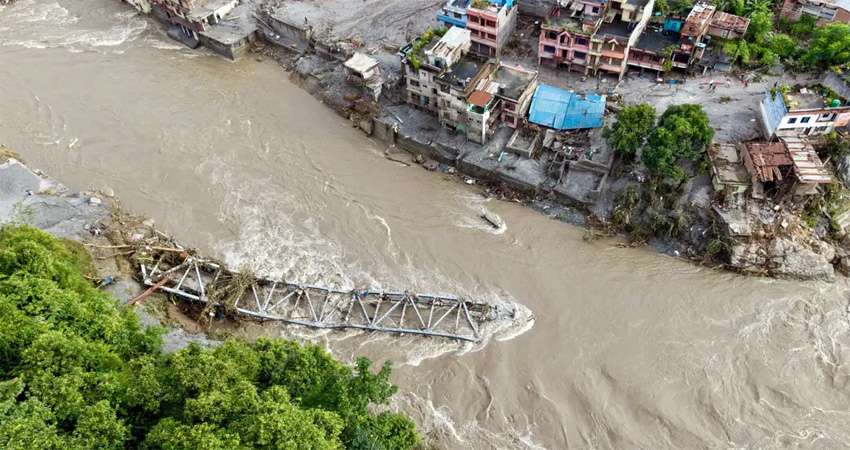
Collected Photo
The threat of a secondary flash flood following Wednesday's devastating deluge in Nepal has receded, prompting rescue teams to resume operations in affected regions.
Authorities had temporarily suspended search efforts in Nepal and Tibet earlier on Friday due to safety concerns.
The immediate risk subsided as water levels in the newly formed artificial barrier lake upstream began to drop naturally without breaching its banks.
China's Ministry of Water Resources stated on Thursday that the barrier lake formed near the confluence of the Chochhen Khola and Purepu Sangpo rivers in Tibet. These rivers merge before entering Nepal, where the watercourse is known as the Bhote Koshi River - a major upper tributary of the Trishuli River.
On Wednesday, the Bhote Koshi River overflowed violently, inundating surrounding low-lying areas with water and mud. The surge destroyed infrastructure along its path.
Officials from both China and Nepal confirmed on Friday that water from the lake is discharging gradually.
Zhou Zhidong, an official from the Third Engineering Bureau of China Aneng Group, said water levels began receding on Friday morning. He added that the lake's depth had decreased by 10 metres compared to Thursday's levels, significantly reducing the threat of a sudden outburst flood.
Meanwhile, death toll in Nepal's flash flood reached nearly 500 as search teams recovered more bodies. Chinese authorities have yet to release official casualty figures for Tibet.
-SA
Loading...
Loading...
Also read







Editor : Iqbal Sobhan Chowdhury
Published by the Editor on behalf of the Observer Ltd. from Globe Printers, 24/A, New Eskaton Road, Ramna, Dhaka.
Editorial, News and Commercial Offices : Aziz Bhaban (2nd floor), 93, Motijheel C/A, Dhaka-1000.
Phone: PABX- 41053001-06; Advertisement: 41053012; 01793317829, 01550707291, E-mail: [email protected], [email protected] Online: email: [email protected] 41053014; 01550707297 Advertisement: 01550707296
Published by the Editor on behalf of the Observer Ltd. from Globe Printers, 24/A, New Eskaton Road, Ramna, Dhaka.
Editorial, News and Commercial Offices : Aziz Bhaban (2nd floor), 93, Motijheel C/A, Dhaka-1000.
Phone: PABX- 41053001-06; Advertisement: 41053012; 01793317829, 01550707291, E-mail: [email protected], [email protected] Online: email: [email protected] 41053014; 01550707297 Advertisement: 01550707296


