



| HEADLINE |

|

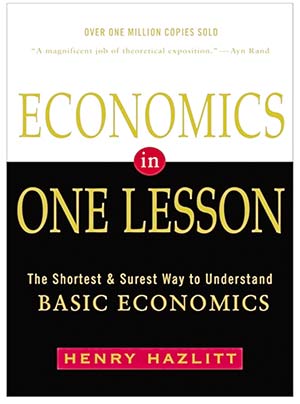
ECONOMICS IN ONE LESSON
Published : Saturday, 26 September, 2026 at 12:00 AM
Henry Hazlitt


 Reviewed by Lubabah Bint Mahtab
In contrast to many books concerned with economics, Economics in One Lesson is composed of multiple fundamental economic themes and topics, merged into a single, highly informative book. The author, Henry Hazlitt, has done an amazing job of making these introductory concepts a fascinating read.
Initially, the book may seem a little intimidating, given that it has 23 chapters on multiple different topics. In reality, each chapter is closely linked with the others, which in itself is amazing, as you can clearly see how one action can have such a drastic effect - much like the butterfly effect, where the idea that a flap of a butterfly's wing can cause a tornado far away. This can be seen in this book when talking about price fixing or inflation. This is actually one of the core concepts; though the book lacks a central theme, the main idea is the importance of looking for the benefits of all groups involved, in not just in the short run, but in the long run too. Economics In One Lesson can clearly emphasise the importance of looking beyond the immediate effects of any policy.
To start with, we are introduced to the ‘broken window fallacy’, which is one of my favourite part of the book. The author goes on to explain why this is a common misconception. A broken window will not create more employment and spending by means of paying to have the window fixed, as the money spent on the window could have been used elsewhere; therefore, there is no net gain. Personally, this was an amazing opening to the book, as it immediately had me hooked and curious to know what other misconceptions this book could clear for me.
Furthermore, besides the interesting topics themselves, Henry Hazlitt uses very simple language to express what he understands. This means that the book will be easily comprehensible for readers of any level, whether beginner or proficient. This is a huge plus for me, as simple language means not only that the author has a deep understanding of what he is saying, as he can explain it without complex jargon that sounds smart, but also that it gives readers the scope to understand better and do their own thinking regarding the topic. When reading a book, it is essential to take away knowledge and understanding from the said book; Economics In One Lesson allows for both, which ensures that the book is worthwhile.
Additionally, certain people may find that this book matches their ideology. This book will certainly resonate with those who are in favour of the free market, as the author goes on to explain the unintended consequences of government intervention in the economy in great detail, with multiple examples, which makes it much easier to understand the arguments. The author stresses the importance of avoiding minimum wage, price fixing or even tariffs. While it may seem counterintuitive, reasonable arguments are proposed against them, which can give the reader enough information to think about both sides and what they support.
However, while this may be an amazing book, there are certain aspects that draw attention in a negative manner. To start off, while this is not a big shortcoming, since this book speaks of fundamental economic themes, it is hardly original. Both Economics In One Lesson and That Which Is Seen and Which Is Not Seen contemplate the importance of looking beyond immediate effects, only that the latter had been published first, back in1850. Though Economics In One Lesson still does an amazing job at elaborating the explanations.
Moreover, while the book does attempt to be equal in its opinions, the beliefs are very strongly one-sided, that being, against any form of government intervention. While the book does offer strong arguments against price fixing, minimum wage, and other forms of intervention, it ignores the opposing sides arguments and fails to shed light on the good that can come from intervention as well, thereby being in support of the free market entirely. While the usefulness of government intervention is debatable, it is not difficult to see why public goods can most certainly be beneficial. In that case, it could be argued that the book is a little rigid, but still, this isn't a major issue.
Overall, Economics In One Lesson was definitely an engaging introductory book, which has remained timeless over the years.
The reviewer is an A-level student

Loading...
Loading...
Also read



Editor : Iqbal Sobhan Chowdhury
Published by the Editor on behalf of the Observer Ltd. from Globe Printers, 24/A, New Eskaton Road, Ramna, Dhaka.
Editorial, News and Commercial Offices : Aziz Bhaban (2nd floor), 93, Motijheel C/A, Dhaka-1000.
Phone: PABX- 41053001-06; Advertisement: 41053012; 01793317829, 01550707291, E-mail: [email protected], [email protected] Online: email: [email protected] 41053014; 01550707297 Advertisement: 01550707296
Published by the Editor on behalf of the Observer Ltd. from Globe Printers, 24/A, New Eskaton Road, Ramna, Dhaka.
Editorial, News and Commercial Offices : Aziz Bhaban (2nd floor), 93, Motijheel C/A, Dhaka-1000.
Phone: PABX- 41053001-06; Advertisement: 41053012; 01793317829, 01550707291, E-mail: [email protected], [email protected] Online: email: [email protected] 41053014; 01550707297 Advertisement: 01550707296


