



| HEADLINE |

|

Climate Promises Must Translate into Action: Ainun Nishat
Published : Monday, 31 August, 2026 at 12:00 AM


 In an exclusive and wide-ranging interview, a veteran voice on Bangladesh’s environmental challenges laid bare the nation’s struggle to translate climate commitments into concrete action. A leading policymaker and project veteran Professor Dr Ainun Nishat offered a candid, often blunt, assessment of the government’s performance, the pitfalls of mega-projects, and the urgent need for a paradigm shift in how the country approaches sustainability. A respected watchdog and analyst of Bangladesh’s development and environmental sectors, his unvarnished views offer a critical perspective on the nation’s journey towards a sustainable future. His exclusive and wide-ranging interview was taken by Shahnaj Begum, Special Correspondent of The Daily Observer. Following is the excerpt of the interview:
Daily Observer: Nowadays how do you define the environment and climate issue in Bangladesh…what positive change you can calculate in your life term work?
Dr Ainun Nishat: We have been having these discussions for 100 years, right? A “100-Year” Debate without any solution.
When I was in school, I used to see that every two years there is a ‘Bikkhari Pondi Varsha’�"seminars, workshops, and rallies. But my question is: how do we truly sustain this? In my student life I saw Hilsha fish in the Buriganga River…it means it came up close to the Dhaka City as the water was liveable one, there was oxygen-a system that support the life of Hilsha, later it could be available at Dholeshhori point, okay no issue, we are accepting the issue, but now….there is no question of water quality, even we cannot drink it after purification, when we raised the issue people think it’s an old one, definitely it would be an old one as life and livelihood is nothing new, flora and fauna are the same, we are losing everything in everyday in step by step.
Observer: What we need to do? We need energy and environment; it never goes hand in hand what we can do to ensure the both?
Dr Ainun Nishat: He raised a red flag regarding the planned 10,000-megawatt solar panel project. He questioned the wisdom of importing “cheap solar technology” from China, calling for a special committee to determine what is suitable for Bangladesh’s specific context.
There is a need for careful selection of "appropriate" technology and stronger regulation of polluting industries like brick-making and polythene production, he said.
On the topic of green technology, he said, “Which technology has been picked up is the crucial question... The cheap solar technology that is picked up from China is not right. The question here is which technology has been picked up. The industry is very good. But the cheap solar technology that is picked up from China is not right.
“A special committee has to be formed on this. Which technology will be suitable for us?” he said expressing frustration with the endless cycle of seminars and workshops was palpable.
Addressing the Polythene issue, he said, he advocated for stricter regulation, even closure, of producers making “very thin” polythene, questioning if it was being used properly despite western practices.
A special committee has to be formed on this. Which technology will be suitable for us? In agriculture and irrigation, solar technology is very popular. But this is not happening.
Thirdly, there is a lot of discussion about polythene. But those who produce polythene. The polythene is very thin. These have to be closed. In the west, it is not closed. But we have to see if it is being used properly no issue but if not we should go for action.
The next point is that Bangladesh has a lot of interethnic rights. How do we co-operate with the world? We need to understand this. The climate change is getting worse day by day. We need to be active in this area. We need to work on adaptation and transfer of technology.
Observer: There is a call for accountability in This sector, question raised about the Mega-Projects and Environmental Impact Assessment (EIA) issue, what is your observation over it?
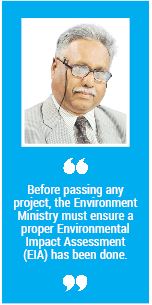
Dr Ainun Nishat: “Before passing any project, the Environment Ministry must ensure a proper Environmental Impact Assessment (EIA) has been done. The monitoring mechanism has to be strong,” he made it clear.
The government is failing in its regulatory role. Mega-projects must undergo rigorous environmental impact assessments with strong monitoring. The interview took a sharp turn towards accountability, particularly regarding the country’s mega-project culture. He admitted to being involved in large projects himself, warned of "irreversible damage" if proper planning is ignored.
He cited a recent tragic accident at the Ship breaking factory in Chattogram as a stark example of where environmental protection was “definitely not done.” His solution was clear and direct.
Observer: How do you see the Carbon Credit Conundrum and Development Finance in this arena?
Dr Ainun Nishat: On carbon trading, he saw potential but urged caution. He highlighted methane from urban garbage and the brick-making industry as major sources for potential carbon credits. However, he warned against allowing carbon trading to mask the need for fundamental change in the brick-making sector, which relies on destroying topsoil.
He criticized the terms of international funding, pointing out that “the world is not giving interest-free” loans. He highlighted the issue of Bangladesh’s “rent” economy, questioning the true benefit of funds from development partners. “Is this money being spent by the government? Are there any stakeholders involved? None,” he stated bluntly, criticizing the lack of transparency and stakeholder engagement.
Finance and Carbon Trading: Climate finance terms are often unfavourable, and carbon trading must not be a "rent" or an excuse to avoid systemic change.
Observer: How do you describe the gap between Policy and Practice here?
Dr Ainun Nishat: “In our constitution, there is a very beautiful guideline. The responsibility of the state is to protect the environment, the environment, the water, etc. According to this, we have not created an action plan... All beautiful things are said in their manifesto. But there is a gap between our words and deeds. These gaps have to be removed.”
He stressed that the state’s primary role is monitoring and regulation, not production, arguing that the private sector is better suited for the latter. He lamented the state's failure in this regulatory role, pointing to the pollution of rivers and the decline of natural resources.
Observer: Is Bangladesh’s population a challenge to address the climate issue?
Dr Ainun Nishat: Acknowledging population growth as a “big factor,” he warned of declining food production and water shortages. He argued that the “population dividend” is becoming a burden due to mechanization and a failure to create employment in other sectors.
He accused the government of being “short-sighted” and focused on immediate profit, at the expense of the environment. “We are destroying everything. We don’t understand how the production capacity will increase in the future,” he added.
Observer: What will be the Bangladesh’s Role on the Global Stage especially at CoOP31?
Dr Ainun Nishat: Expressing uncertainty about Bangladesh’s position and preparation. He lamented the lack of a clear strategy, particularly regarding the country’s role in negotiating blocks like the G77 and China. He advocated for joining the “like-minded developing countries” (LNDC) group, which includes major powers like China and India, to have a stronger voice.
“If you add zero to zero, it will be zero,” he said, dismissing the idea of a smaller group led by Nepal and Bhutan. “The LNDC group has a lot of countries. There is Nisar, there is Saudi Arabia. So, there is a group, a strong group, which is challenging the developed world.”
Observer: How Bangladesh can improve or minimise the losses in this regard?
Dr Ainun Nishat: I see there is a significant gap between the government's beautiful promises in its manifesto and its actions on the ground. This is not for this government, I am talking about all government’s role, I call for “Political Will” type of document where all the political parties put their signatures and abide by it for the betterment of livelihood of this country’s human being and environment.
Loading...
Loading...
Also read



Editor : Iqbal Sobhan Chowdhury
Published by the Editor on behalf of the Observer Ltd. from Globe Printers, 24/A, New Eskaton Road, Ramna, Dhaka.
Editorial, News and Commercial Offices : Aziz Bhaban (2nd floor), 93, Motijheel C/A, Dhaka-1000.
Phone: PABX- 41053001-06; Advertisement: 41053012; 01793317829, 01550707291, E-mail: [email protected], [email protected] Online: email: [email protected] 41053014; 01550707297 Advertisement: 01550707296
Published by the Editor on behalf of the Observer Ltd. from Globe Printers, 24/A, New Eskaton Road, Ramna, Dhaka.
Editorial, News and Commercial Offices : Aziz Bhaban (2nd floor), 93, Motijheel C/A, Dhaka-1000.
Phone: PABX- 41053001-06; Advertisement: 41053012; 01793317829, 01550707291, E-mail: [email protected], [email protected] Online: email: [email protected] 41053014; 01550707297 Advertisement: 01550707296


