



| HEADLINE |

|

Nepal Disaster: A Warning from the Himalayas
Published : Monday, 31 August, 2026 at 12:00 AM
Dr Mahtab Hossain Mazed



The Himalayas are often described as the roof of the world-a landscape of snow-capped peaks, deep valleys, rushing rivers and breathtaking natural beauty. For generations, Nepal has drawn mountaineers, pilgrims and travellers from across the globe to this extraordinary mountain realm.
But on August 26, 2026, the Himalayas revealed a far more frightening face.
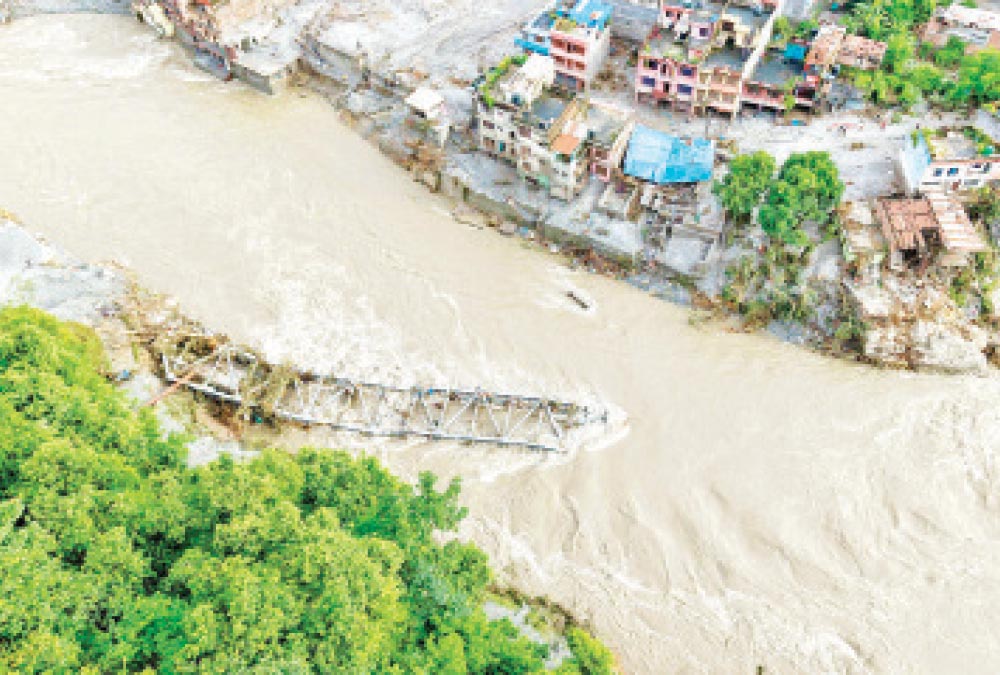
In a matter of minutes, enormous quantities of ice, rock, mud and water swept through vulnerable mountain communities. Roads and bridges disappeared. Power infrastructure was damaged. Settlements were devastated. Border areas were cut off. What unfolded was not merely a flood, but a cascading disaster in which one natural hazard triggered another.
 When the Mountain Collapses
The disaster began in the Himalayan region along the Nepal-China border when a massive section of ice and rock suddenly collapsed.
At first, the event was thought to have been an earthquake. Subsequent geological assessments, however, suggested that the powerful tremor-like effects were associated with a major glacial and rock collapse. Satellite observations pointed to the collapse of ice and rock as a possible trigger for the destructive flow that followed.
The initial flow entered the Lhende Khola before affecting the Bhote Koshi and eventually the Trishuli River. Reports indicated that the water level of the Trishuli rose by nearly nine metres in just 30 minutes. That is the terrifying reality of a mountain flash flood: there may be little time between warning and destruction.
A Flood That Was More Than Water
A conventional flood may develop gradually, giving communities time to evacuate. A Himalayan flash flood, however, can arrive suddenly, carrying boulders, mud, ice and debris like a moving wall of destruction.
Roads, bridges, vehicles, houses and riverbank infrastructure can all be swept away. For rescuers, this creates another challenge: the very roads and bridges needed to reach affected communities may be destroyed, while debris, unstable slopes and disrupted communications make rescue operations extremely dangerous.
When Tourism Becomes a Humanitarian Concern
Nepal’s disaster has also highlighted the vulnerability of international tourism and pilgrimage in mountain regions.
According to Nepal’s Department of Tourism, contact had been lost with 668 tourists from 34 countries as of August 27, including 177 Indian nationals, 90 Americans, 34 Australians, 33 British citizens and 25 Canadians. In Tibet’s Gyirong area, another 558 people were reported missing, including 260 foreign nationals.
These figures show that the Himalayan crisis is not simply a local emergency. Nepal’s mountains are part of a global tourism and pilgrimage network, meaning a disaster in a remote valley can quickly become an international humanitarian concern.
The Hidden Economic Cost
The destruction caused by such a disaster cannot be measured by the death toll alone. When roads collapse, bridges disappear and power plants are damaged, local economies can be severely disrupted. Tourism suffers, trade routes are interrupted, electricity generation falls, and communities lose access to markets, schools and essential services.
Nepal’s National Planning Commission and National Statistics Office have begun separate damage assessments. Preliminary estimates indicated that 15 hydropower projects had been affected, taking around 431 megawatts of generation capacity offline. Damage at projects including Rasuwagadhi, Chilime and Sanjen illustrates how exposed critical infrastructure can be in high-altitude and river-valley environments. The immediate disaster may last hours or days, but its economic consequences can last for months or years.
Why Rescue Efforts Are So Difficult
Nepal’s geography is both its natural treasure and one of its greatest challenges. Mountain roads are limited. Settlements can be isolated. River crossings are critical. Once bridges and roads are swept away, even relatively short distances can become extremely difficult to cover.
Thousands of personnel from the Nepal Army, police and other emergency agencies have been involved in search and rescue operations. Yet the danger does not end when the flood recedes. Landslides can continue. River channels can change. Temporary dams can form. And behind those natural barriers, enormous quantities of water may accumulate.
Reports that a barrier lake near the Nepal-Tibet border had accumulated more than 2.5 million cubic metres of water raised fears of another downstream flood. In such circumstances, rescuers must balance the urgency of saving lives against the possibility of a second disaster.
Is Climate Change to Blame?
This is where scientific caution matters. It would be simplistic�"and scientifically inappropriate�"to declare that one specific glacier collapse was caused solely by climate change. But it would be equally dangerous to ignore the climate connection.
Global warming is transforming the Himalayan cryosphere�"the interconnected system of glaciers, snow, ice and frozen ground that regulates mountain ecosystems and downstream water supplies. Rising temperatures can accelerate glacier melt, while changes in ice and permafrost can weaken mountain slopes. These processes can increase instability and the risks of landslides, avalanches, glacier collapses and glacial lake outburst floods.
According to a Reuters analysis, Nepal has lost roughly one-third of its glacier ice over the past three decades. This does not prove that climate change directly caused this particular disaster, but it is a powerful warning that the Himalayan environment is changing rapidly.
The Danger Does Not End with the First Wave
One of the most frightening features of cascading disasters is that one event can trigger another. A landslide or glacier collapse can block a river, forming a temporary lake. If the barrier fails, the water can burst downstream, causing another devastating flood.
Therefore, disaster management cannot end with the first flood. Authorities must continue monitoring rivers, unstable slopes, glaciers and temporary lakes. The question is not only, “How do we respond to the flood?” but also, “What disaster might the flood have created?”
A Warning for South Asia
The significance of Nepal’s Himalayan disaster extends far beyond its borders. Rivers flowing from the Himalayas form interconnected systems that affect India and Bangladesh. The Trishuli joins the Narayani, which enters India as the Gandak, meaning changes in upstream flows can have downstream consequences.
Precautionary evacuations in parts of Bihar, Uttar Pradesh and Uttarakhand underline the regional dimension of the crisis. The lesson for South Asia is clear: Himalayan disasters cannot always be treated as isolated national events. Water does not recognise political borders. Neither does climate change.
What Bangladesh Should Learn
For Bangladesh, the Himalayan crisis carries particular significance. As a river-dependent country, Bangladesh is closely connected to upstream rainfall, mountain runoff and transboundary river systems. We cannot control what happens in the Himalayas, but we can prepare better for its downstream impacts.
That means strengthening river monitoring, improving flood forecasting, investing in early-warning systems and deepening regional cooperation. Preparedness must begin before the water arrives.
From Reaction to Prevention
The central lesson of Nepal’s disaster is simple: rescue capacity alone is not enough. Modern disaster management must focus on anticipation. Glaciers, glacial lakes, mountain slopes and vulnerable rivers should be continuously monitored through satellites, drones and ground-based systems. Authorities must identify emerging risks before they become disasters.
But technology alone cannot save lives. Early warnings must reach people in time through mobile alerts, sirens, local volunteers, shelters and clear evacuation routes.
Development Must Respect the Mountains
The disaster also raises a broader question about development. We cannot eliminate natural hazards, but we can reduce our vulnerability to them. Roads, settlements and infrastructure built without considering geological and environmental risks can turn natural hazards into humanitarian disasters.
Rivers need space to flow, mountain slopes need stability, and high-risk areas require responsible land-use planning.
The Himalayas Are a Shared Responsibility
The Himalayas are far more than a spectacular mountain range. They are a living environmental system connected to the rivers, agriculture, ecosystems, economies and communities of South Asia. What happens in the high mountains can affect people hundreds or even thousands of kilometres away.
Nepal’s disaster should therefore be seen not only as a tragedy, but also as a warning. It does not mean every glacier will collapse or every flood is directly caused by climate change. The deeper warning is that the environmental systems millions depend on are changing�"and our preparedness must change with them.
The Warning from the Roof of the World
Nepal’s devastating Himalayan disaster should not be dismissed as an isolated natural calamity. It exposes a convergence of vulnerabilities�"changing glaciers, fragile mountain terrain, extreme weather, exposed infrastructure, vulnerable communities and difficult access to remote areas. Climate change may not explain every event, but it is altering the conditions in which such hazards unfold.
For South Asia, the message is clear: we need science-based preparedness, responsible development, effective early-warning systems and stronger regional cooperation. Glacier monitoring, glacial-lake surveillance, resilient infrastructure, ecosystem protection and responsible settlement planning are no longer optional. They are necessities.
The writer is a public health analyst
Loading...
Loading...
Also read



Editor : Iqbal Sobhan Chowdhury
Published by the Editor on behalf of the Observer Ltd. from Globe Printers, 24/A, New Eskaton Road, Ramna, Dhaka.
Editorial, News and Commercial Offices : Aziz Bhaban (2nd floor), 93, Motijheel C/A, Dhaka-1000.
Phone: PABX- 41053001-06; Advertisement: 41053012; 01793317829, 01550707291, E-mail: [email protected], [email protected] Online: email: [email protected] 41053014; 01550707297 Advertisement: 01550707296
Published by the Editor on behalf of the Observer Ltd. from Globe Printers, 24/A, New Eskaton Road, Ramna, Dhaka.
Editorial, News and Commercial Offices : Aziz Bhaban (2nd floor), 93, Motijheel C/A, Dhaka-1000.
Phone: PABX- 41053001-06; Advertisement: 41053012; 01793317829, 01550707291, E-mail: [email protected], [email protected] Online: email: [email protected] 41053014; 01550707297 Advertisement: 01550707296


