



| HEADLINE |

|
Fahrenheit 451: A tale of burning books and the modern ‘Fireman’
Published : Friday, 4 September, 2026 at 5:07 PM
Shahman Abir


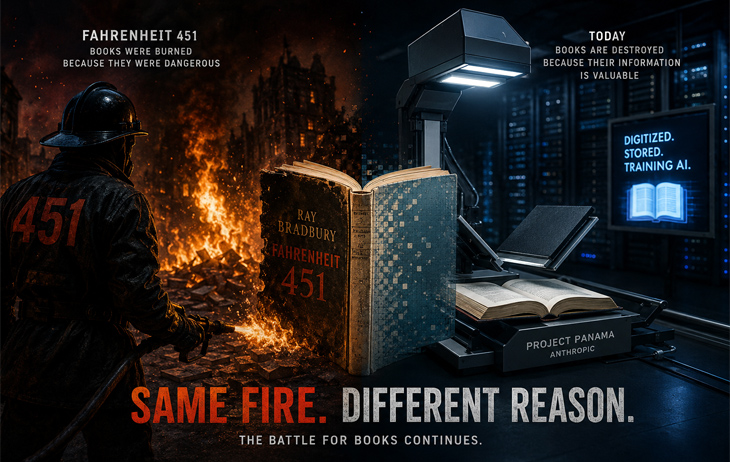
AI image
Book enthusiasts have everlasting affection for Ray Bradbury’s Fahrenheit 451, a novel that was originally published in 1953. This dystopian novel showcased a futuristic society, where ‘firemen’ burn books en masse - as books are banned.
Astonishingly, more than seven decades later, the novel’s premise has resurfaced as many major AI companies have started ‘destructive scanning’ of books, after facing multiple lawsuits as they were trying to train their models through pirated copies.
Court documents indicated that Anthropic had downloaded approximately 7.5 million books from online pirated sources for its AI training efforts, leading to copyright litigation from authors.
Recent controversy revealed concerning details about Anthropic, the company behind Claude AI. In July 2026, a US federal judge granted final approval to a $1.5bn class-action settlement between Anthropic and authors who accused the company of using their copyrighted works, including books obtained from pirated sources. Consequently, OpenAI, the company that owns ChatGPT, has been sued by The New York Times, Encyclopedia Britannica and many others.
According to a report by The Guardian, officials from Anthropic confirmed they labeled their destruction project as ‘Project Panama.’ When asked what intentions they had while hiding the nature of the project under a codename, they stated, “We don’t want it to be known that we are working on this.”
As books are being ripped off from their covers and incorporated into a digital server, questions form regarding information authenticity and disposal procedure of those physical books.
Nevertheless, as reported in Forbes, The First Sale Doctrine of Copyright Act allows the buyer of a physical book to destroy it as they please. Thus, Anthropic is purchasing antique, rare and pre-owned books; scanning them in high speed machines and training their LLM to make it smarter and avoid lawsuits.
Today’s internet has been flooded with AI-generated content across websites, video-sharing platforms - anywhere and everywhere. For this reason, Anthropic specifically targeted pre-2022 publications as they are deprived from the exposure of AI generated write-ups.
In this modern AI-driven digitized era, books are not merely a collection of words. Rare or antique editions may possess cultural significance beyond the information which is stored withinthem.
Unfortunately, once a book has been split open for scanning, its physical history may not be preserved the way it should have been.
How Fahrenheit 451 Fits in?
The uncanny resemblance of the ‘Fireman’ with the ongoing AI ‘destruction’ sparked fresh debate. In the novel, the protagonist, Guy Montag, is a fireman. He is assigned to burn books as it initiates conflict in society.
He meets a neighbor named Clarisse. She incites a discourse of happiness in Montag’s mind. After witnessing an older woman burning herself with her library, Montag steals a book and starts questioning his entire life and career.
Later, Montag flees the city and encounters a camp of book lovers who pledged to save the humanity and rebuild societyand preserve human knowledge through memorizing books.
How Current Scenario Reverberates
As portrayed in the novel, Guy Montag had to leave the society to rebuild it through memorizing literature as a way of preserving it. The current scenario, however, may not be as dire as the one portrayed in the novel.
In Fahrenheit 451, book is something that must disappear.
In the age of AI, the physical book can become something that is valuable only until its information has been extracted. Yes, books are indeed being destroyed. At the same time, information is being retained through digital servers as well.
Yet, questions arise, what would be the aftermath of burning books? The high speed machines may make mistakes as millions of pages are being scanned. No doubt, Large Language Models (LLMs) are getting sharper. Still, what safety measures were taken to withstand information alteration?
Are we going to face a future where firemen approach us with heating devices charged with 451 degrees Fahrenheit? What will happen to human knowledge when we only care for the information and not the physical entity behind it?
Perhaps these are the barrage of questions which may remain unanswered.
Loading...
Loading...
Also read








Editor : Iqbal Sobhan Chowdhury
Published by the Editor on behalf of the Observer Ltd. from Globe Printers, 24/A, New Eskaton Road, Ramna, Dhaka.
Editorial, News and Commercial Offices : Aziz Bhaban (2nd floor), 93, Motijheel C/A, Dhaka-1000.
Phone: PABX- 41053001-06; Advertisement: 41053012; 01793317829, 01550707291, E-mail: [email protected], [email protected] Online: email: [email protected] 41053014; 01550707297 Advertisement: 01550707296
Published by the Editor on behalf of the Observer Ltd. from Globe Printers, 24/A, New Eskaton Road, Ramna, Dhaka.
Editorial, News and Commercial Offices : Aziz Bhaban (2nd floor), 93, Motijheel C/A, Dhaka-1000.
Phone: PABX- 41053001-06; Advertisement: 41053012; 01793317829, 01550707291, E-mail: [email protected], [email protected] Online: email: [email protected] 41053014; 01550707297 Advertisement: 01550707296


