



| HEADLINE |

|

wealth versus dignity social inequality conceptual artwork
Published : Tuesday, 22 September, 2026 at 4:40 PM
A. U. Dowla


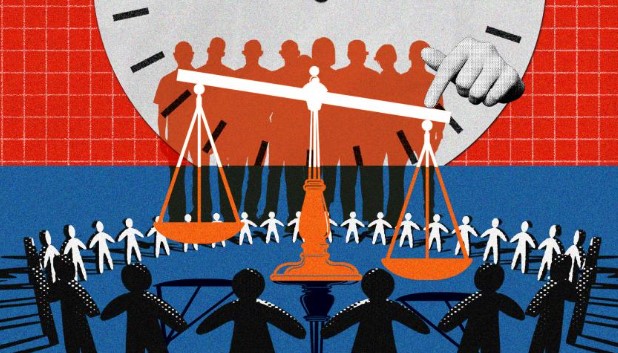
Since time immemorial, humanity has been divided into groups, factions, classes, communities, lineages, and geographical identities. Yet, amidst all divisions, the most profound and devastating one that has controlled human society for ages is the division between the rich and the poor.
But how did this divide originate? The Creator did not make us unequal. Regarding our capacity to breathe oxygen, there is no difference between one human and another. So, how did humanity become shackled to this massive disparity? When a baby is born into a rich family, he or she is rich from the first day; when a baby is born in a slum, he or she is poor from the first day of its breath. Is this inequality merely the hand of fate, or is there a deeper engineering behind it?
British philosopher John Locke stated that humans were absolutely free in the state of nature. They lived off wild fruits, milk, and meat; the concept of private property did not exist, much like it does not among animals in the wild today.
However, the moment humanity learned agriculture and someone claimed a piece of land as their own, the concept of private property was born. Whoever controlled the most land became the rich.
But Karl Marx felt this divide through the lens of class relations. The foundation of his philosophy lay in the internal flaws of capitalism. He demonstrated that in a capitalist system, ownership of production is controlled in the hands of a few, in that the worker becomes alienated from the true value of their labor and the products they create.
Marx explained how the primary goal of capitalism is to minimize labor costs and maximize profit by selling products at higher prices. As such, the system builds mountains of wealth for the rich class while leaving the majority deprived.
Marx observed that even if a businessman or capitalist is personally kind or benevolent, the structures of the capitalist system prevent him from not exploiting labor. He found out that the divide between rich and poor is not a personal failure, but the inevitable result of an improper system.
Marx called for movements for fair wages for laborers. He dreamed of a society based on equality and justice. Massive political shifts, like the French, Russian, and Chinese Revolutions, occurred by the inspiration of his philosophy. At the cost of millions of lives, socialist governance was established in many nations.
But the question remains: was the original sin of inequality removed? No, it was not. Reality shows that the same patterns persisted in socialist states, where the ruling class became rich while the general masses remained trapped in the same cycles of deprivation and inequality.
So, where was Marx right? He argued that inequality stems from the fact that the capitalist owner does not pay the fair value of labor. But consider this: by 2050, if global production becomes entirely dependent on machines and artificial intelligence, and there is no longer a need for human laborers in factories, will the accusation of labor theft remain relevant? Or suppose, through a successful global project by international aid agencies, the per capita income of every poor person in the world reaches over $1000 per day by 2030; will the burning sensation of inequality vanish?
Imagine if clothing, housing, and food are guaranteed for everyone, yet people who have billions purchase expensive, artificial organs like hearts, kidneys, livers, or lungs to extend their lives to 150 years. Will people without such means not feel deprived? Will that inequality not spark new movements?
Looking deeper, it is evident that what Marx identified was not the root problem. The issue is not essentially capitalism or socialism; the seed lies elsewhere. While he clearly identified economic exploitation, he missed the deepest layer of exploitation: the crisis of dignity that resides in the human heart.
Humans naturally crave honor and dignity; it is a primary biological instinct for survival. But where does that desired dignity reside? It is buried in our social conditioning. Does our dignity depend on what others think of us? Does dignity dwell in the outside world? No, true dignity resides deep within the human spirit. Our dignity, sense of respect, and idea of honor are our sense of internal values, and they are submerged in our social education.
Since ancient times, society has become accustomed to treating material wealth and dignity as synonyms. Just as we are taught our mother tongue, we are taught that wealth is the only benchmark of prestige. Because of the false belief that human honor is embedded in material possessions, all the inequality, injustice, and crime in the world have been born.
The practice of equating wealth with power, and power with dignity, is the source of all competition and conflict. As a result, humans have been conditioned to see fellow humans as commodities; thus, the strategies of exploitation have gained more social acceptance than honesty and empathy. Power and influence have become the only path to respect. Consequently, we are trapped in a social system where moral balance has vanished.
Today, we are stuck in a system where most are anxious about their food, employment, and healthcare. But the rich few, standing on mountains of wealth, cannot claim to be happy either. Most of the rich spend their nights sleepless, worrying about the security and expansion of their wealth. Those in power are terrified that opposing forces might remove them at any moment. In this game, we are all anxious, terrified, and worried. Some may live in palaces and wear expensive clothes, but at the end of the day, no one is actually at peace.
So, for the emancipation of humanity, and to build a world free from inequality and exploitation, we must break free from these false notions of status. We need to redefine dignity. We need a global engineering of social consciousness that proclaims: A mountain of wealth is not dignity; rather, the one who acts with the greatest responsibility is the most dignified. True human dignity lies not in a bank balance, but in one sense of self respect, founded on responsibility, integrity, and empathy.
Responsibility creates a commitment to oneself and to society. The deeper one sense of responsibility, the more dignified they are. Empathy standing by others in their time of need and fostering mutual cooperation is the benchmark of social excellence. The more empathetic one is, the more dignified they are. Integrity not achieving success through shortcuts, but through a life of pure honesty is the source of true glory.
Only if we can build these behavioral habits as the new social benchmarks of dignity, respect, and honor will society transform from conflict toward peace.

Loading...
Loading...
Also read









Editor : Iqbal Sobhan Chowdhury
Published by the Editor on behalf of the Observer Ltd. from Globe Printers, 24/A, New Eskaton Road, Ramna, Dhaka.
Editorial, News and Commercial Offices : Aziz Bhaban (2nd floor), 93, Motijheel C/A, Dhaka-1000.
Phone: PABX- 41053001-06; Advertisement: 41053012; 01793317829, 01550707291, E-mail: [email protected], [email protected] Online: email: [email protected] 41053014; 01550707297 Advertisement: 01550707296
Published by the Editor on behalf of the Observer Ltd. from Globe Printers, 24/A, New Eskaton Road, Ramna, Dhaka.
Editorial, News and Commercial Offices : Aziz Bhaban (2nd floor), 93, Motijheel C/A, Dhaka-1000.
Phone: PABX- 41053001-06; Advertisement: 41053012; 01793317829, 01550707291, E-mail: [email protected], [email protected] Online: email: [email protected] 41053014; 01550707297 Advertisement: 01550707296


