



| HEADLINE |

|

Two Straits, One Shock: Bangladesh Caught in Global Trade Squeeze
Published : Thursday, 17 September, 2026 at 12:00 AM
Faruk Ahmed


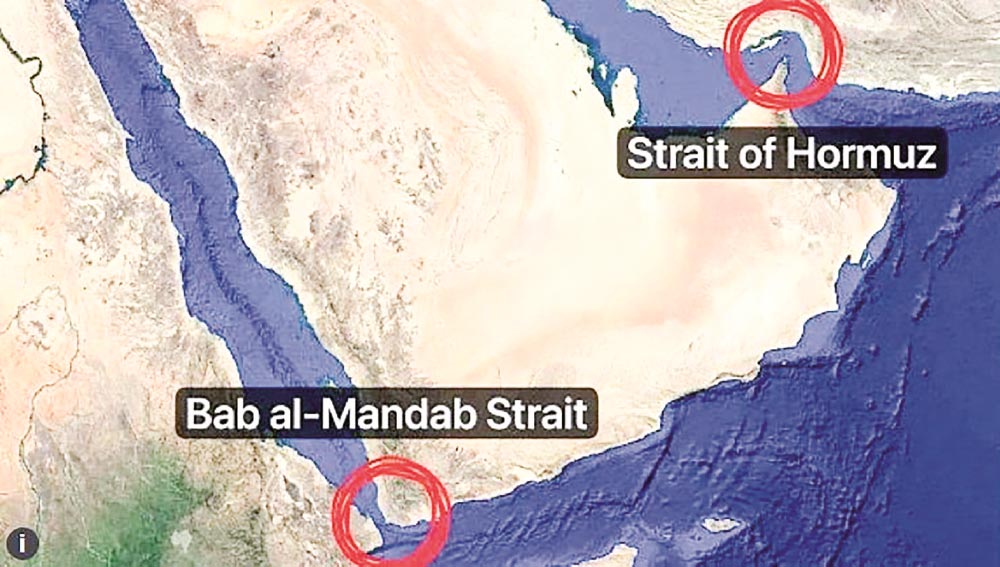 Bangladesh is facing a fresh economic threat as the Houthis tighten their grip over the Bab el-Mandeb Strait, threatening to sever one of the country's most important maritime lifelines just as the Strait of Hormuz remains severely disrupted.
The latest Houthi seizure of Greater and Lesser Hanish islands, following the capture of Mokha port and Perim Island, has dramatically strengthened the group's strategic position around the southern Red Sea and the approaches to Bab el-Mandeb. The Hanish islands lie about 160 kilometres north of the strait.
The development has transformed the Red Sea crisis into a potentially wider global trade shock.
The Houthis have not physically closed Bab el-Mandeb to every commercial vessel, but their expanding territorial control and attacks on Saudi-linked shipping have sharply increased the risks of passage. Vessel traffic through the strait has already fallen, while shipping companies face the prospect of renewed diversions around Africa.
For Bangladesh, that is a particularly dangerous prospect.
The country is already dealing with severe disruption in Hormuz, a critical route for Gulf energy supplies. Bab el-Mandeb had consequently become an increasingly important alternative route for bringing fuel and other essential commodities from the Middle East. With both gateways under pressure, Dhaka's room for manoeuvre is shrinking rapidly.
The stakes extend far beyond oil.
Bangladesh's trade with Europe depends heavily on the Red Sea-Suez corridor. If shipping lines increasingly avoid Bab el-Mandeb, Europe-bound vessels could be forced to make a detour of about 7,500 kilometres around the Cape of Good Hope, adding an estimated 15�"30 days to transit times and potentially pushing freight rates up by 40�"50 per cent.
For the country's garment industry, that could become a competitive crisis.
Bangladesh's apparel exporters operate on tight delivery schedules and narrow margins. An additional two to four weeks at sea means higher fuel, insurance and financing costs and a greater risk of missing delivery deadlines.
International buyers facing uncertainty can shift orders to competing suppliers.
The immediate impact is already visible in Bangladesh's fuel trade.
A Bangladesh Shipping Corporation tanker carrying around 100,000 tonnes of Saudi crude recently avoided Bab el-Mandeb and sailed around the Cape of Good Hope. The voyage took roughly 50 days instead of 13�"15 days, adding an estimated Tk66.63 crore to the cost.
That single shipment illustrates the danger facing the wider economy: the longer route does not merely cost more�"it locks up vessels and capital for weeks longer.
Bangladesh's exposure is particularly serious because crude oil imports are concentrated on Saudi Arabia and the UAE. Saudi Arabia is also a major source of fertiliser, with Bangladesh importing substantial quantities of urea and DAP from the kingdom. A prolonged disruption could therefore hit both energy security and agricultural input supplies.
The shock is already feeding into global oil markets. Brent crude has moved above $100 a barrel, with recent reports putting it around $107, while Saudi oil production and export infrastructure are facing additional pressure from attacks on critical facilities.
For Bangladesh, higher crude prices would come on top of higher freight and insurance costs, creating a potentially vicious cycle: more expensive oil raises transport and production costs; higher freight raises import prices; and both feed domestic inflation.
The threat to fertiliser supplies could be even more consequential.
Any prolonged disruption around Bab el-Mandeb could delay Saudi fertiliser shipments and raise their landed cost. That would place additional pressure on farmers and food prices at a time when Bangladesh is already battling persistent inflation.
The latest crisis therefore exposes a fundamental vulnerability in Bangladesh's economic model.
The country has diversified its export markets and built substantial foreign-exchange buffers, but it remains heavily dependent on a handful of maritime chokepoints that it cannot control.
And the present crisis is different from previous Red Sea disruptions because Hormuz and Bab el-Mandeb are being threatened simultaneously.
Hormuz normally carries around one-fifth of global oil consumption, while Bab el-Mandeb is the critical gateway between the Indian Ocean and the Red Sea-Suez route. With traffic through Hormuz collapsing and Bab el-Mandeb increasingly threatened, global shipping is being forced to reconsider routes that have underpinned international commerce for decades.
Yet Bangladesh still has some breathing space.
Domestic fuel stocks and diversified refined-fuel suppliers provide a short-term buffer, while the country's foreign-exchange reserves offer some capacity to absorb higher import bills. But those buffers cannot indefinitely compensate for a prolonged breakdown in maritime trade.
Dhaka must therefore treat the crisis as an economic-security emergency, not simply a foreign-policy issue.
Strategic fuel and fertiliser reserves need strengthening. Alternative suppliers and shipping routes must be secured. Exporters need support to withstand prolonged freight disruptions, while Bangladesh should intensify diplomatic efforts to keep commercial shipping lanes open.
The Houthi seizure of the Hanish islands is a warning that the geography of global trade is changing by the day.
For Bangladesh, Hormuz threatens the energy supply line; Bab el-Mandeb threatens the trade artery. If both remain under fire, the shock will not stay in the Middle East. It will arrive at Bangladesh's ports, factories, farms and eventually the household kitchen.
The country's economic resilience is now being tested�"not on its own soil, but on two narrow waterways thousands of kilometres away.

Loading...
Loading...
Also read



Editor : Iqbal Sobhan Chowdhury
Published by the Editor on behalf of the Observer Ltd. from Globe Printers, 24/A, New Eskaton Road, Ramna, Dhaka.
Editorial, News and Commercial Offices : Aziz Bhaban (2nd floor), 93, Motijheel C/A, Dhaka-1000.
Phone: PABX- 41053001-06; Advertisement: 41053012; 01793317829, 01550707291, 01550707296
E-mail: [email protected], [email protected]. [email protected], [email protected], [email protected], [email protected], Online-email: [email protected]
Published by the Editor on behalf of the Observer Ltd. from Globe Printers, 24/A, New Eskaton Road, Ramna, Dhaka.
Editorial, News and Commercial Offices : Aziz Bhaban (2nd floor), 93, Motijheel C/A, Dhaka-1000.
Phone: PABX- 41053001-06; Advertisement: 41053012; 01793317829, 01550707291, 01550707296
E-mail: [email protected], [email protected]. [email protected], [email protected], [email protected], [email protected], Online-email: [email protected]


