



| HEADLINE |

|

The Case for a Bangladesh-South Korea Defence Partnership
Published : Friday, 18 September, 2026 at 12:00 AM
Muhammad Muzahidul Islam


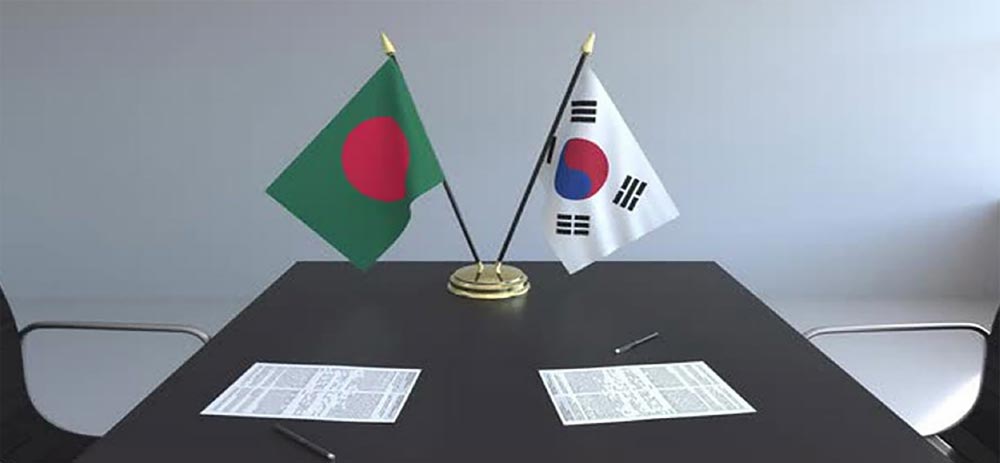
 The government of Bangladesh pursues a foreign policy heavily prioritising strategic balancing, regional economic integration, and a “Look East” orientation. Grounded in the constitutional policy of “Friendship towards all, malice towards none,” Dhaka maintains independent bilateral ties to maximise trade, secure development funding, and upgrade infrastructure without aligning strictly with any single global power. By avoiding excessive alignment, Bangladesh safeguards its strategic autonomy while navigating complex regional and global geopolitical dynamics.
Dhaka’s diplomatic balance involves maintaining critical relationships across multiple partners, including key bilateral ties with:
* China: Serves as a vital source of raw materials for export industries (such as ready-made garments), major economic development loans, Belt and Road Initiative (BRI) infrastructure projects, and historical defence supplies.
* India: Represents a key neighbour tied by geography, essential security links, transit trade, cross-border energy connectivity, and shared natural resources.
* United States: Acts as Bangladesh’s largest single-country export market and a key partner in international trade, regional maritime security, and international development.
While major international partners engage regularly with Bangladesh on economic development, Washington and other Western partners closely monitor Dhaka’s defence procurement trends, given that Chinese-made systems currently account for a significant portion of Bangladesh’s inventory.
 Bangladesh’s Military Modernisation and Defence Options
Under its “Forces Goal 2030” modernisation plan, Bangladesh seeks a pragmatic strategy to upgrade its armed forces through strategic diversification. While China remains its primary historic arms supplier (providing frigates, main battle tanks, fighter jets, and submarines), heavy reliance on a single supplier limits long-term operational autonomy and creates potential diplomatic friction with alternative global partners.
Additionally, concerns regarding supply-chain sustainability, long-term maintenance cycles, and operational flexibility have prompted Dhaka to consider a wider variety of global options. Procuring advanced platforms like the Chinese J-10CE multi-role fighter presents geopolitical and logistic considerations, while direct procurement of U.S.-made platforms (such as the F-16V) or Western European systems carries significant hurdles regarding cost, stringent end-user monitoring, long delivery timelines, and production backlog.
To preserve its foreign policy independence while advancing its defence capabilities, Bangladesh is incentivized to identify reliable, high-capability alternative defence suppliers.
South Korea: The Optimal Strategic Alternative
Among prospective defence partners�"including Turkey, Japan, and Western European nations�"South Korea emerges as a highly viable defence partner for Bangladesh. As an established defence exporter, South Korea produces advanced, NATO-compliant weapons systems at competitive price points and rapid delivery schedules, all while remaining outside the direct superpower rivalry in South Asia.
South Korea offers Bangladesh a bridge to military modernization while strengthening its strategic autonomy through key advantages:
1. Pragmatic Geopolitical Alignment Without Strings: Purchasing from South Korea�"a major US treaty ally with strong global trade links�"satisfies international standard requirements while avoiding the heavy strategic baggage associated with direct single-power reliance.
2. Advanced, Proven Defence Hardware: Seoul offers direct, high-capability alternatives across all branches, including the FA-50 multi-role fighter Jet, the KF-21 advanced fighter Jet, advanced submarines (such as the KSS-I / Jang Bogo class), 105mm artillery, and Offshore Patrol Vessels (OPVs).
3. Deepening Bilateral Security Cooperation: Defence ties between Seoul and Dhaka continue to mature through regular high-level diplomatic visits, bilateral defence dialogues, and naval staff talks.
4. Industrial & Technological Transfer: Unlike traditional defence exporters, South Korea routinely incorporates local subsystem assembly, technology transfers, and joint maintenance training into its procurement agreements �"directly supporting Bangladesh’s long-term defence-industrial goals.
By shifting its procurement focus toward South Korea, Bangladesh can modernise its armed forces with NATO-standard hardware, ease geopolitical friction with Western partners, and achieve a balanced, diversified defence supply chain �"effectively operationalising its core strategic principles in an era of global power competition.
The writer is a barrister-at-law, human rights activist and an advocate at the Supreme Court of Bangladesh

Loading...
Loading...
Also read



Editor : Iqbal Sobhan Chowdhury
Published by the Editor on behalf of the Observer Ltd. from Globe Printers, 24/A, New Eskaton Road, Ramna, Dhaka.
Editorial, News and Commercial Offices : Aziz Bhaban (2nd floor), 93, Motijheel C/A, Dhaka-1000.
Phone: PABX- 41053001-06; Advertisement: 41053012; 01793317829, 01550707291, E-mail: [email protected], [email protected] Online: email: [email protected] 41053014; 01550707297 Advertisement: 01550707296
Published by the Editor on behalf of the Observer Ltd. from Globe Printers, 24/A, New Eskaton Road, Ramna, Dhaka.
Editorial, News and Commercial Offices : Aziz Bhaban (2nd floor), 93, Motijheel C/A, Dhaka-1000.
Phone: PABX- 41053001-06; Advertisement: 41053012; 01793317829, 01550707291, E-mail: [email protected], [email protected] Online: email: [email protected] 41053014; 01550707297 Advertisement: 01550707296


