



| HEADLINE |

|

European states fortify borders, expand military reserves against Russia
Published : Sunday, 20 September, 2026 at 1:19 PM
Shahman Abir


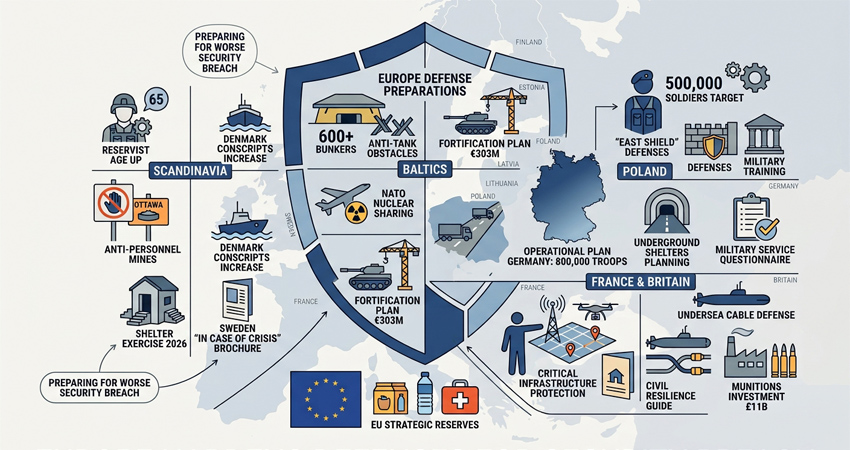
AI Illustration
European governments are hardening defenses, expanding conscription and reserves, and preparing their populations for a worse security breach.
The defensive measures follow a series of sabotage incidents, drone incursions, and cyber attacks that Western officials link directly to Russia. The Associated Press has counted roughly 200 incidents across Europe since the full-scale invasion of Ukraine that officials or investigators have connected to Russian operations.

NATO military drills: Getty Images
Most recently, a bomb squad discovered drones carrying military-grade explosives at Leipzig airport in Germany, with a Ukrainian cargo plane identified as the suspected target.
French President Emmanuel Macron stated that the operation was attributed to Russia's military intelligence service and failed, though it could have caused heavy casualties.
Governments are not, however, declaring that war is imminent. They are planning for a more dangerous environment rather than stating a major war with Russia is expected.
Germany's interior minister emphasized that Germany is not at war but remains a daily target of hybrid attacks. Many of the defense measures being implemented predate the latest incidents.
Finland: The maximum reservist age rises from 60 to 65 starting January 1, 2026. Finland's withdrawal from the Ottawa landmine convention took effect on January 10, 2026, allowing the country to plan the reintroduction of anti-personnel mines.
Though Helsinki states it does not plan to station nuclear weapons on its territory, however, the president signed an amendments on July 1, effectively lifting ban on the import, transit, transport, and deployment of nuclear weapons on Finnish territory.
Finland already maintains about 50,500 civil defense shelters with space for 4.8 million people. In early September, it conducted "Shelter 2026," a two-day civil defense exercise in Kuopio.
Estonia: The defense ministers of Estonia, Latvia, and Lithuania approved the Baltic Defense Line concept on January 19, 2024. Estonia's section includes up to 600 bunkers for military and Defense League units, along with anti-tank obstacles. Estonia has left the Ottawa Convention, though it currently has no anti-personnel mines.
Its defense minister stated that Estonia is ready to host allied nuclear-capable jets, referring specifically to aircraft rather than stored warheads.
Latvia: Latvia approved a five-year, €303 million fortification and counter-mobility plan in 2024, beginning first-phase work on expropriated land in March 2026. It has withdrawn from the Ottawa Convention alongside the other Baltic States and Poland.

Border fortifications: Getty Images
Lithuania: Lithuania has established 27 engineering equipment parks. A revised plan approved on August 12 raises the total target to 50 parks by the end of 2028, with the government allocating approximately €1.1 billion for counter-mobility over ten years. Work includes physical obstacles, anti-tank ditches, and bridges prepared for demolition along the borders with Russia and Belarus. Lithuania has also withdrawn from the Ottawa Convention.
Poland: Poland is constructing its "East Shield" defenses and joined the Baltic Defense Line effort in late 2024. Prime Minister Donald Tusk stated that Poland needs 500,000 soldiers, including reservists, and aims to train 100,000 volunteers annually starting in 2027. He added that his government is working on a plan for military training for all Polish men.
In late August, a deputy defense minister stated Poland wants to join NATO nuclear sharing without hosting warheads, whereas the defense minister stated Poland seeks full participation in nuclear sharing. President Karol Nawrocki's camp favors stationing US weapons directly on Polish soil.
Germany: A classified wartime plan, "Operation Plan Germany," outlines how approximately 800,000 German, US, and other NATO troops would move across Germany to the eastern flank if Russia attacked the alliance.
Regarding shelters, the civil protection chief has called for tunnels, subway stations, garages, and basements to be converted to create space for one million people. This remains a target, as Germany currently possesses only 579 public shelters with room for roughly half a million people.
Under a military service law in force since January 1, 2026, young men must complete a questionnaire and later undergo a medical exam, while active military service remains voluntary. Medical exams begin on July 1, 2027, for men born in 2008 or later.
Sweden: Distribution of the updated "In Case of Crisis or War" brochure to every household began on November 18, 2024, reaching more than five million households.
Denmark: Conscription service was extended from four to 11 months. On August 3, 2026, approximately 1,600 conscripts began service, including women drafted on the same terms as men for the first time.
France: The government published its "Tous Responsables" civil resilience guide on November 20, 2025, detailing ways to join reserve forces and approved associations. On September 18, President Emmanuel Macron ordered preparations for a comprehensive plan to protect critical infrastructure and sensitive defense and technology sites from drone and cyber attacks.
Britain: The government committed to rewriting its "War Books"—the operational plans for transitioning from peace to war—by the end of this year.
A large home defense exercise, "Albiston Shadow," is scheduled for 2027. The age limit for recalling former personnel in the Strategic Reserve is being raised from 55 to 65, with reforms expected from spring 2027. The June 2026 Defense Investment Plan includes £11 billion for munitions and weapons, as well as at least six new energetics factories by 2030. The government also launched the "Atlantic Bastion" program to counter Russian submarines and protect undersea cables and pipelines.
European Union: In March 2025, the European Union urged citizens to stockpile food, water, and other essential supplies for at least 72 hours. The EU announced plans to build strategic reserves, including protections against chemical, biological, radiological, and nuclear threats.
Notably, in November 2021, then-CIA director William Burns showed up in Moscow to warn Kremlin against a planned invasion of Ukraine.
Russia, however, invaded Ukraine after three months.
Similarly, on August 25, 2026, current CIA director John Ratcliffe made a surprising visit to Moscow. Multiple media outlets cited anonymous sources, reported he warned Russia against attacking NATO territory.
Uneasiness prevails due to uncanny resemblance.

Loading...
Loading...
Also read




Editor : Iqbal Sobhan Chowdhury
Published by the Editor on behalf of the Observer Ltd. from Globe Printers, 24/A, New Eskaton Road, Ramna, Dhaka.
Editorial, News and Commercial Offices : Aziz Bhaban (2nd floor), 93, Motijheel C/A, Dhaka-1000.
Phone: PABX- 41053001-06; Advertisement: 41053012; 01793317829, 01550707291, E-mail: [email protected], [email protected] Online: email: [email protected] 41053014; 01550707297 Advertisement: 01550707296
Published by the Editor on behalf of the Observer Ltd. from Globe Printers, 24/A, New Eskaton Road, Ramna, Dhaka.
Editorial, News and Commercial Offices : Aziz Bhaban (2nd floor), 93, Motijheel C/A, Dhaka-1000.
Phone: PABX- 41053001-06; Advertisement: 41053012; 01793317829, 01550707291, E-mail: [email protected], [email protected] Online: email: [email protected] 41053014; 01550707297 Advertisement: 01550707296


