



| HEADLINE |

|

The long raid ahead
Israil Howlader's mission to reforge Bangladesh Kabaddi


 For Bangladesh Kabaddi, the 2026 Japan Asian Games in Aichi-Nagoya offered both promise and a painful reminder of the distance still to travel.
 There, the men began with two stirring victories, edging the Republic of Korea 39-35 and Chinese Taipei 48-47, before a 40-37 defeat by hosts Japan ended their hopes of reaching the semi-finals. A 48-25 loss to India in the final group match brought the campaign to a close. The women, meanwhile, lost to India and Iran before recovering to beat Japan 42-22.
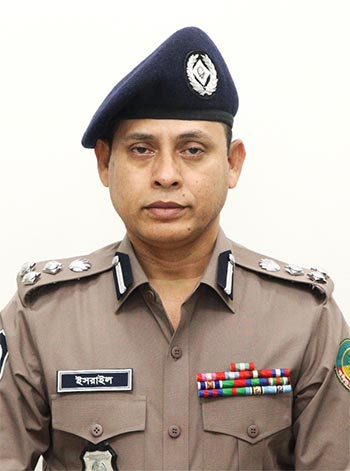
For newly appointed Bangladesh Kabaddi Federation (BKF) general secretary Md Israil Howlader, however, the 2026 Asian Games was not merely an unsuccessful campaign. It was a diagnostic exercise, a chance to identify where Bangladesh are being outmuscled, outmanoeuvred and, perhaps most importantly, out-planned.
Blueprint for renewal is already taking shape
Md Israil Howlader assumed the federation's general secretaryship when the newly constituted ad hoc committee took charge on 18 July 2026, barely nine weeks before the Asian Games began in Japan on 19 September. The former DIG, who serves as Commissioner of Gazipur Metropolitan Police, was promoted to Additional Inspector General of Police (Additional IGP), Grade-2, on 23 August. Yet, amid the demands of a senior police posting and his new sporting responsibility, his attention has increasingly turned towards the Kabbadi mat. And what he sees there is a sport in need of structural repair.
Building specialists, not just squads
"We are planning to appoint separate coaches for each category or position alongside the head coach, such as raiders and defenders, as well as fitness trainers and physiotherapists," Mr Howlader told The Daily Observer.
The idea goes beyond assembling a team for the next tournament. He wants a specialised three-month training programme, with two months conducted online and one month involving practical training in India.
It is a distinctly different approach from preparing a squad only when a major tournament looms. In Kabaddi, where a raid can turn on a heartbeat and a defensive chain can either hold firm or unravel in an instant, technical detail is often the difference between survival and surrender.
A painful Asian Games lesson
The Asian Games exposed precisely a fault line in Bangladesh Kabaddi.
"Our biggest obstacle in missing out on the medal race at these Asian Games was the lack of good defence," Israil Howlader says.
Bangladesh had entered the tournament with genuine medal prospects after their opening victories, but Japan's 40-37 victory brought the campaign crashing back to earth. The defeat was particularly telling because Bangladesh had led the hosts at points during the contest but could not sustain the pressure.
The Police High Official believes the timing of his committee's appointment must also be taken into account.
He says, "When we took responsibility, we really did not have much time in hand. We had to complete the final preparations within just a few weeks. During that period, the coaches worked on our defensive weaknesses as much as possible."
Training of the Trainers (ToT)
But he is unwilling to regard the shortage of preparation time as the whole story. Another, deeper problem concerns the quality and availability of coaches.
As he says, "There is a serious shortage of quality coaches. If the coach himself does not possess advanced knowledge, how can he provide advanced training to his students?"
That question has led the federation towards another potentially important initiative, developing the developers. The BKF general secretary says the federation is considering advanced training programmes for local coaches, effectively a Training of the Trainers (ToT) model, so that Bangladesh can gradually build a stronger domestic coaching base rather than continually depending on limited expertise.
The rebuilding plan also extends into recruitment.
Looking beyond the next tournament
The federation has held discussions with officials responsible for Kabaddi in the country's various service institutions, urging them to consider height when recruiting male and female Kabaddi players.
"We have seen that internationally our opponents have been gaining an advantage against us because of their height," Mr Howlader says.
He adds, "So we have suggested that, for service Kabaddi, around six feet could be considered as a benchmark for men and five feet six inches for women."
The rationale is straightforward: Bangladesh are not merely short of established stars; they are short of alternatives.
He says the national teams lack sufficient back-up players in several positions, while the development pipeline does not currently contain enough high-quality replacements. The concern, therefore, is both immediate and generational, keeping the present side competitive while ensuring that tomorrow's Bangladesh do not inherit today's shortages.
A long way ahead
His vision is consequently wider than one Asian Games cycle. It is about creating specialists rather than simply selecting squads; building coaches rather than merely appointing them; strengthening the pipeline rather than repeatedly searching for emergency replacements; and, ultimately, giving Bangladesh's traditional mat game a modern competitive spine.
There is no overnight raid that can win such a contest. The rebuilding of Kabaddi, like the sport itself, will require patience, timing, teamwork and the courage to stay on the mat when the pressure is fiercest.
For Israil Howlader, the next battle has already begun.

Loading...
Loading...
Also read



Editor : Iqbal Sobhan Chowdhury
Published by the Editor on behalf of the Observer Ltd. from Globe Printers, 24/A, New Eskaton Road, Ramna, Dhaka.
Editorial, News and Commercial Offices : Aziz Bhaban (2nd floor), 93, Motijheel C/A, Dhaka-1000.
Phone: PABX- 41053001-06; Advertisement: 41053012; 01793317829, 01550707291, E-mail: [email protected], [email protected] Online: email: [email protected] 41053014; 01550707297 Advertisement: 01550707296
Published by the Editor on behalf of the Observer Ltd. from Globe Printers, 24/A, New Eskaton Road, Ramna, Dhaka.
Editorial, News and Commercial Offices : Aziz Bhaban (2nd floor), 93, Motijheel C/A, Dhaka-1000.
Phone: PABX- 41053001-06; Advertisement: 41053012; 01793317829, 01550707291, E-mail: [email protected], [email protected] Online: email: [email protected] 41053014; 01550707297 Advertisement: 01550707296


