



| HEADLINE |

|

Don’t Turn Hawkers into ‘Neo-Hijackers’
Published : Saturday, 3 October, 2026 at 12:00 AM
Shaon Arafat


 Look at what went down in Mirpur-10 on Wednesday and tell me you didn’t see the explosion coming. What the state blithely branded a routine administrative exercise ended in burning garbage trucks, a smashed police vehicle, tear gas flooding the avenues, and workers dragged away into custody. At least nine policemen were injured, media personnel were caught in the fray, and a major transit artery ground to a complete halt. By Thursday morning, the state’s enforcement machinery swung into full force, filing four sweeping criminal cases naming hundreds of individuals and executing swift night raids to lock up 25 desperate hawkers. When municipal authorities destroy a vendor’s livelihood overnight without warning or alternative, they don’t solve an urban problem. Instead, they ignite an existential crisis. If the ruling class continues down this path of ruthless suppression, we must beware of hawkers turning into neo-hijackers simply because they have to feed their families.
And how did officials respond? Predictably, city corporation leaders ran straight to the news cameras, declared the entire clash a pre-planned political conspiracy, and vowed to double down with more bulldozers. Meanwhile, workers were left standing beside the smashed wreckage of their wooden carts, weeping over the ruined inventory that represented their entire world.
While this violent clash erupted in Mirpur, the policy driving it is far from unique. Across Dhaka, from Farmgate and Motijheel to New Market and Gulshan, routine eviction drives follow the exact same predatory script. Time after time, the authorities roll in with heavy machinery, frame the operation as a sanitised cleanup for elite shoppers, and then act shocked when human beings facing forced starvation react with righteous fury. Under this capital-driven framework, modernising our streets means nothing more than scrubbing the working poor out of sight. Public walkways are commodified as prime commercial real estate, ignoring the reality that street vending remains the sole lifeline for thousands of displaced rural migrants and impoverished families in a system where formal employment is virtually nonexistent.
That disconnect exposes a basic truth our administrators refuse to face: hawkers are human beings who deserve food, dignity and a real means of survival. The state apparatus has a duty to protect working people from extreme deprivation. Yet, as systemic inflation erodes real wages, food prices skyrocket and factory closures multiply, the working class is left to sink or swim. When a government fails to provide adequate employment or social safety nets during severe macroeconomic distress, destroying an informal worker’s only source of income at such short notice is definitely not urban planning, but rather a form of a state-sanctioned economic violence.
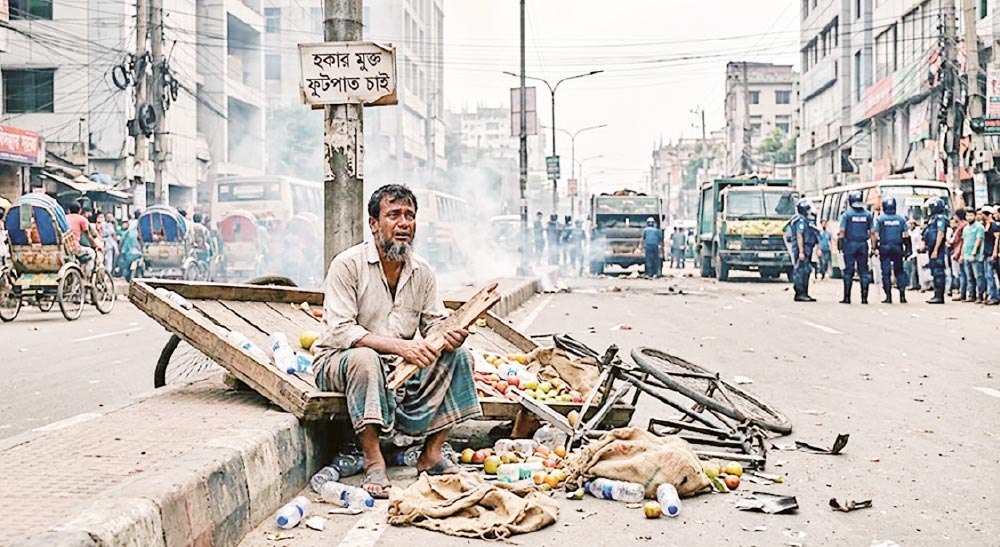 The central failure of these sudden eviction drives lies precisely in their utter disregard for human survival. When authorities crush a vendor’s cart, they corner working families into absolute destitution. A parent unable to bring home a few hundred taka for basic cooking oil and rice at the end of the day will not lie down and starve in silence. Strip away a worker’s legal means of living, and you leave them with nothing left to lose.
This short-sighted brutality carries terrifying consequences for a nation already reeling under a deteriorating law and order situation. Muggings, street crime and desperation are escalating across major cities, and pushing thousands of hardworking vendors off the pavement actively fuels that fire. If the state continues to smash their tools of labour overnight and criminalise their poverty, these displaced workers will be backed into crime merely to survive, becoming neo-hijackers tomorrow. By systematically destroying informal livelihoods, the state is actively transforming the capital into a breeding ground for crime.
To understand why these drives repeatedly turn into street battles, one must examine how the informal economy actually operates through parasitic extraction. Hawkers are perpetually squeezed from both sides. On one hand, local political leaders, corrupt municipal handlers and criminal syndicates extract daily surplus value by forcing vendors to pay illegal rents just to stand on public ground. On the other hand, city authorities launch periodic eviction drives, smashing carts while leaving those exact same extortion networks untouched. The state tolerates extortion when convenient, only to criminalise the victims whenever it needs to display administrative strength.
At the same time, allowing unchecked occupation under syndicate control surrenders public space to private gain and forces pedestrians onto risky roads. The violence and destruction of public property during the Mirpur clash must be condemned, but mass arrests and brute force will never solve underlying economic desperation.
To resolve this crisis, urban space must be restructured to guarantee the material rights of working people over public land. First, law enforcement must stop punishing labour and instead dismantle the corrupt political and municipal syndicates that extract daily rents from vulnerable vendors. Then, the city must establish democratic worker collectives that conduct transparent digital censuses and manage vending permits directly, completely eliminating middleman leverage. Planners must also maintain clear primary arteries while transforming secondary streets, public grounds and commercial quarters into socialised, regulated vending zones equipped with municipal infrastructure, timed vending windows, night markets and weekend bazaars. Moreover, the state must eliminate arbitrary property destruction and guarantee advance written notice, structured consultation and proper compensation or alternative trading placement for any displaced worker.
Reclaiming Dhaka’s footpaths is a governance responsibility, but that responsibility cannot be measured by how many workers authorities sweep away in a single morning. It should be measured by whether pedestrians can safely walk those streets without pushing the working class into crime and destitution. Working people need both a safe city and a legitimate, collective means of earning a living. If the state wants clear footpaths, it must organise urban space around human need rather than elite convenience, providing workable alternatives rather than leaving thousands with nowhere to go. Otherwise, a policy intended to clean up the streets will only turn them into a battleground for survival.
The writer is Editorial Assistant at The Daily Observer
Loading...
Loading...
Also read



Editor : Iqbal Sobhan Chowdhury
Published by the Editor on behalf of the Observer Ltd. from Globe Printers, 24/A, New Eskaton Road, Ramna, Dhaka.
Editorial, News and Commercial Offices : Aziz Bhaban (2nd floor), 93, Motijheel C/A, Dhaka-1000.
Phone: PABX- 41053001-06; Advertisement: 41053012; 01793317829, 01550707291, E-mail: [email protected], [email protected] Online: email: [email protected] 41053014; 01550707297 Advertisement: 01550707296
Published by the Editor on behalf of the Observer Ltd. from Globe Printers, 24/A, New Eskaton Road, Ramna, Dhaka.
Editorial, News and Commercial Offices : Aziz Bhaban (2nd floor), 93, Motijheel C/A, Dhaka-1000.
Phone: PABX- 41053001-06; Advertisement: 41053012; 01793317829, 01550707291, E-mail: [email protected], [email protected] Online: email: [email protected] 41053014; 01550707297 Advertisement: 01550707296


