



| HEADLINE |

|

Dhaka Circular Waterway
Revival bid underway after Tk 1.22b wasted
Published : Sunday, 4 October, 2026 at 12:00 AM
Staff Correspondent


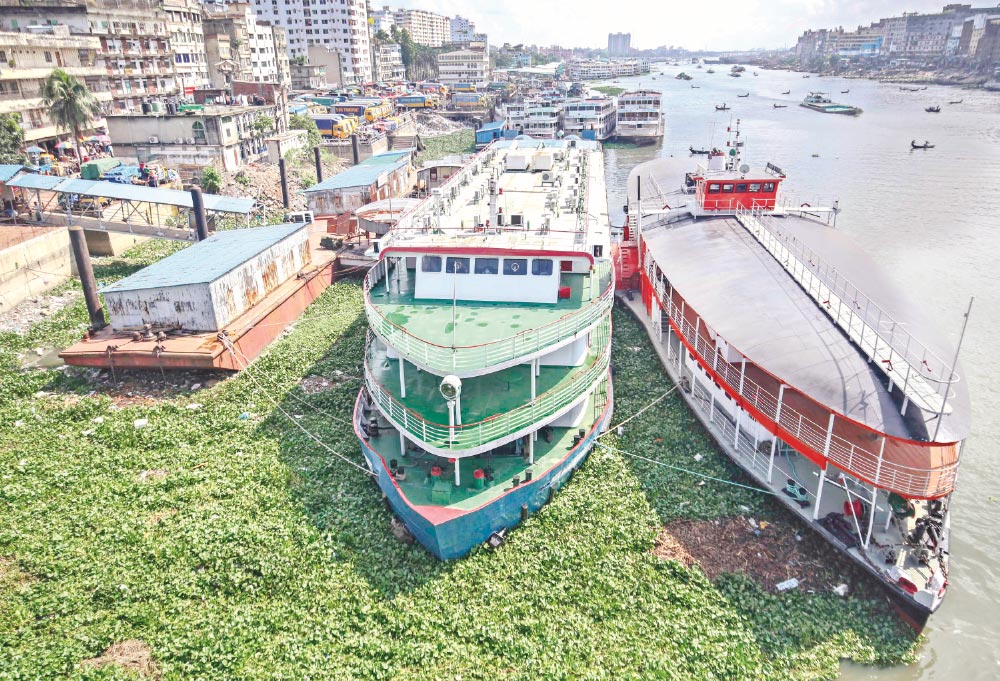 The government has spent around Tk 1.22 billion over the past two decades to develop Dhaka’s circular waterway and introduce waterbus services, but the initiative has generated only Tk 25.2 million in revenue.
Of the total expenditure, around Tk 835 million was spent on waterway development and related infrastructure, while another Tk 380 million was spent on purchasing and operating waterbuses.
Despite the investment, regular passenger services were never established across the planned 110-kilometre circular waterway. Low bridges, river pollution, foul odours, navigational obstacles and operational problems repeatedly disrupted the service.
The government is now preparing to revive the water transport system, initially focusing on the Gabtoli-Sadarghat route. Unlike previous attempts, the Bangladesh Inland Water Transport Corporation (BIWTC) is not expected to operate the service. Instead, interested private companies will be invited to run the waterbuses, while the Bangladesh Inland Water Transport Authority (BIWTA) will coordinate the programme.
The plan to establish a circular water transport system around Dhaka was initiated in 2000, with the proposed network covering the Turag, Buriganga, Shitalakkhya, Balu and other rivers surrounding the capital.
The first phase was completed in 2005 at a cost of around Tk 360 million. It included dredging approximately 29.5 kilometres of the Ashulia-Sadarghat waterway, along with the construction of 10 landing stations, seven terminal buildings and other infrastructure.
The second phase, implemented between 2007 and 2010, cost around Tk 475 million and involved developing approximately 40 kilometres of waterway from Ashulia through Tongi to Kanchpur.
Together, the two phases cost about Tk 835 million. A further Tk 380 million was spent on waterbuses, bringing total expenditure to around Tk 1.22 billion.
In contrast, revenue from the service amounted to only Tk 25.2 million�"roughly 2.1% of the total expenditure.
Low-clearance bridges have been one of the major obstacles to operating the planned circular route.
According to BIWTA data, around 25 road bridges and three railway bridges�"28 in total�"are located along the circular waterway. Around 20 reportedly have insufficient clearance for the planned waterbus operations.
As a result, waterbuses could not operate across the entire 110-kilometre network as originally envisioned.
BIWTA officials have previously identified the bridges as a major constraint, saying structural modification or removal of some bridges would be necessary to ensure uninterrupted navigation for larger vessels.
The government has made several attempts to establish passenger services on the route.
In 2004, two small launches were introduced on the Ashulia-Sadarghat route but were withdrawn after a short period.
In 2010, two waterbuses, MV Buriganga and MV Turag, were introduced. Another 10 were added in 2014, bringing the fleet to 12.
The service, however, failed to become financially sustainable.
BIWTC officials attributed the poor performance largely to low passenger demand, while citing river pollution and foul odours as factors discouraging commuters.
Passengers and terminal workers, however, have also blamed irregular operations and weak management.
Touhid Hossain, a fruit trader who regularly travelled from Gabtoli, said he initially used the waterbus to save time but often had to wait at the terminal even after the vessel was full.
“ We used the waterbus to save time, but a lot of time was spent waiting at the terminal,” he said.
Mohammad Babul who has worked at the Gabtoli terminal for around two decades, said passenger demand was not necessarily the main problem.
“There was no shortage of passengers. When people were called through the microphone, they would come. But passengers often had to wait because the drivers could not be found,” he said.
The government previously attempted to involve private operators.
In 2016, a private company named Buriganga was given responsibility for operating waterbuses, but the initiative did not continue.
In 2020, eight waterbuses were leased for six months to the Keraniganj-Buriganga Boatmen Workers Labour Cooperative Society. The organisation later returned the vessels after incurring losses.
Of the 12 waterbuses introduced for the circular route, nine are now being prepared for auction as scrap. The remaining three are operating on the Aricha-Kazirhat route.
BIWTC public relations officer Mohammad Nazrul Islam said the nine vessels had been abandoned because they no longer had valid fitness certificates.
A special meeting on August 2 discussed plans to revive Dhaka’s circular waterways, with emphasis on controlling river pollution, improving drainage and sewerage systems, maintaining navigability and ensuring normal water flow.
Under the proposed model, private companies will operate the waterbuses, while BIWTA will oversee coordination. The initial service is planned for the Gabtoli-Sadarghat route.
BIWTA Joint Director Mobarak Hossain Majumder said the initiative could succeed if the key environmental and operational problems were addressed.
Urban planning expert Adil Mohammad Khan, a professor at Jahangirnagar University, has called for a longer-term approach. He said a 15- to 20-year master plan should be prepared instead of rushing to restart individual routes.
The proposed revival therefore faces challenges beyond putting new operators and vessels on the river. Pollution control, navigational clearance, reliable schedules, terminal connectivity and coordination among government agencies will be critical to establishing the waterway as a dependable component of Dhaka’s public transport system.

Loading...
Loading...
Also read



Editor : Iqbal Sobhan Chowdhury
Published by the Editor on behalf of the Observer Ltd. from Globe Printers, 24/A, New Eskaton Road, Ramna, Dhaka.
Editorial, News and Commercial Offices : Aziz Bhaban (2nd floor), 93, Motijheel C/A, Dhaka-1000.
Phone: PABX- 41053001-06; Advertisement: 41053012; 01793317829, 01550707291, E-mail: [email protected], [email protected] Online: email: [email protected] 41053014; 01550707297 Advertisement: 01550707296
Published by the Editor on behalf of the Observer Ltd. from Globe Printers, 24/A, New Eskaton Road, Ramna, Dhaka.
Editorial, News and Commercial Offices : Aziz Bhaban (2nd floor), 93, Motijheel C/A, Dhaka-1000.
Phone: PABX- 41053001-06; Advertisement: 41053012; 01793317829, 01550707291, E-mail: [email protected], [email protected] Online: email: [email protected] 41053014; 01550707297 Advertisement: 01550707296


