



| HEADLINE |

|

Bangladeshi fisherman saved after live eel enters body
Published : Sunday, 4 October, 2026 at 12:00 AM
Observer Desk


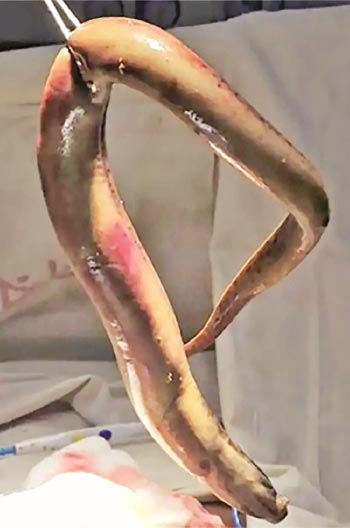 A 55-year-old Bangladeshi fisherman underwent emergency surgery after a live eel entered his body during a fishing trip and tore a hole in his large intestine, according to a medical case report.
The unusual incident was reported in the International Journal of Surgery Case Reports by doctors from Bangladesh and Nepal.
The fisherman was taken to hospital with severe abdominal pain and signs of peritonitis, a potentially life-threatening infection that can occur when the lining of the abdomen becomes inflamed.
During medical questioning, he told doctors that an eel had entered his clothing and then gone into his rectum while he was fishing the previous day. He had initially been reluctant to seek medical help, hoping the fish would eventually pass out on its own.
Medical tests and scans showed that his intestine had been perforated, with air trapped inside the abdomen �" a sign of a serious internal injury and possible infection.
Doctors performed emergency surgery and found a 5cm hole in the sigmoid colon, the lower part of the large intestine. They also removed the eel, which was still alive and moving. It measured about 65cm in length.
According to the case report, such an injury caused by a live animal is extremely rare. The doctors said they found only one previously documented case involving an eel entering the intestine through the rectum. That incident was reported in Hong Kong in 2004 and involved a man who had deliberately inserted an eel in an attempt to relieve constipation.
The Bangladeshi patient later underwent a colostomy and recovered well. He was discharged from hospital four days after admission without further pain or complications.
The doctors said the case highlights the importance of considering unusual causes when patients arrive with severe abdominal pain.
They also stressed the importance of taking a detailed medical history, particularly when patients may feel embarrassed about explaining how an injury occurred.
“Prompt and thorough history-taking is essential to elicit relevant information,” the doctors wrote, noting that patients may hesitate to disclose unusual circumstances surrounding their symptoms.
They also said a combination of medical tests and scans can help doctors identify unusual injuries quickly and allow treatment before serious complications develop.

Loading...
Loading...
Also read



Editor : Iqbal Sobhan Chowdhury
Published by the Editor on behalf of the Observer Ltd. from Globe Printers, 24/A, New Eskaton Road, Ramna, Dhaka.
Editorial, News and Commercial Offices : Aziz Bhaban (2nd floor), 93, Motijheel C/A, Dhaka-1000.
Phone: PABX- 41053001-06; Advertisement: 41053012; 01793317829, 01550707291, E-mail: [email protected], [email protected] Online: email: [email protected] 41053014; 01550707297 Advertisement: 01550707296
Published by the Editor on behalf of the Observer Ltd. from Globe Printers, 24/A, New Eskaton Road, Ramna, Dhaka.
Editorial, News and Commercial Offices : Aziz Bhaban (2nd floor), 93, Motijheel C/A, Dhaka-1000.
Phone: PABX- 41053001-06; Advertisement: 41053012; 01793317829, 01550707291, E-mail: [email protected], [email protected] Online: email: [email protected] 41053014; 01550707297 Advertisement: 01550707296


