



| HEADLINE |

|

Japan, India deepen strategic ties amid China rivalry
Published : Monday, 5 October, 2026 at 6:38 PM
Observer Online Report


Collected Photo
Japan and India are deepening their strategic partnership across defence, economic security, technology and energy as both countries seek to strengthen their position in the Indo-Pacific amid intensifying competition with China.
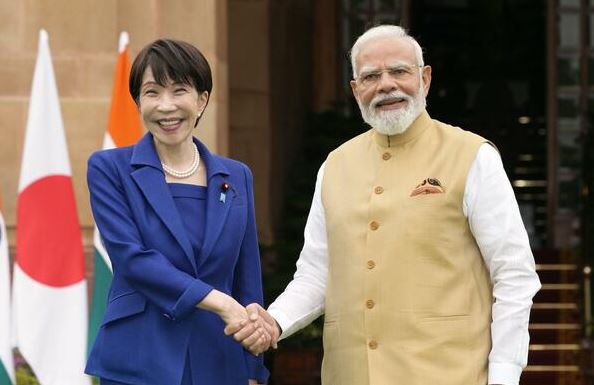
The partnership gained fresh momentum at the 16th India-Japan Annual Summit in New Delhi in July, where Japanese Prime Minister Sanae Takaichi and Indian Prime Minister Narendra Modi agreed to expand cooperation in economic security, artificial intelligence, critical minerals, clean energy and defence.
Tokyo and New Delhi have identified semiconductors, critical minerals, ICT, AI, clean energy and pharmaceuticals as key areas for building resilient supply chains. They also agreed to strengthen energy security and cooperation in emerging technologies.
Defence and maritime security are becoming increasingly important to the relationship. Japan and India are expanding security cooperation as members of the Quad alongside the United States and Australia, while promoting a free and open Indo-Pacific.
Economic ties are also expanding. Around 1,400 Japanese companies operate in India, with bilateral trade reaching $27.5 billion in the 2025-26 fiscal year. Japan has also backed major Indian infrastructure projects, including the Mumbai-Ahmedabad high-speed rail corridor.
The growing alignment comes as Japan seeks greater supply-chain resilience and India works to strengthen its manufacturing base and reduce strategic dependence on China. At the same time, India and China have recently moved to improve their strained economic and diplomatic ties, showing that New Delhi continues to balance competing relationships in Asia.
The partnership gained fresh momentum at the 16th India-Japan Annual Summit in New Delhi in July, where Japanese Prime Minister Sanae Takaichi and Indian Prime Minister Narendra Modi agreed to expand cooperation in economic security, artificial intelligence, critical minerals, clean energy and defence.
Tokyo and New Delhi have identified semiconductors, critical minerals, ICT, AI, clean energy and pharmaceuticals as key areas for building resilient supply chains. They also agreed to strengthen energy security and cooperation in emerging technologies.
Defence and maritime security are becoming increasingly important to the relationship. Japan and India are expanding security cooperation as members of the Quad alongside the United States and Australia, while promoting a free and open Indo-Pacific.
Economic ties are also expanding. Around 1,400 Japanese companies operate in India, with bilateral trade reaching $27.5 billion in the 2025-26 fiscal year. Japan has also backed major Indian infrastructure projects, including the Mumbai-Ahmedabad high-speed rail corridor.
The growing alignment comes as Japan seeks greater supply-chain resilience and India works to strengthen its manufacturing base and reduce strategic dependence on China. At the same time, India and China have recently moved to improve their strained economic and diplomatic ties, showing that New Delhi continues to balance competing relationships in Asia.
The expanding Japan-India partnership therefore reflects a broader shift in Indo-Pacific geopolitics, with economic security, maritime cooperation, critical technologies and resilient supply chains becoming central to their strategic relationship.
-AH

Loading...
Loading...
Also read







Editor : Iqbal Sobhan Chowdhury
Published by the Editor on behalf of the Observer Ltd. from Globe Printers, 24/A, New Eskaton Road, Ramna, Dhaka.
Editorial, News and Commercial Offices : Aziz Bhaban (2nd floor), 93, Motijheel C/A, Dhaka-1000.
Phone: PABX- 41053001-06; Advertisement: 41053012; 01793317829, 01550707291, E-mail: [email protected], [email protected] Online: email: [email protected] 41053014; 01550707297 Advertisement: 01550707296
Published by the Editor on behalf of the Observer Ltd. from Globe Printers, 24/A, New Eskaton Road, Ramna, Dhaka.
Editorial, News and Commercial Offices : Aziz Bhaban (2nd floor), 93, Motijheel C/A, Dhaka-1000.
Phone: PABX- 41053001-06; Advertisement: 41053012; 01793317829, 01550707291, E-mail: [email protected], [email protected] Online: email: [email protected] 41053014; 01550707297 Advertisement: 01550707296


