



| HEADLINE |

|

Francis Halzen Wins Nobel Prize in Physics
Published : Tuesday, 6 October, 2026 at 4:05 PM
Observer Online Report


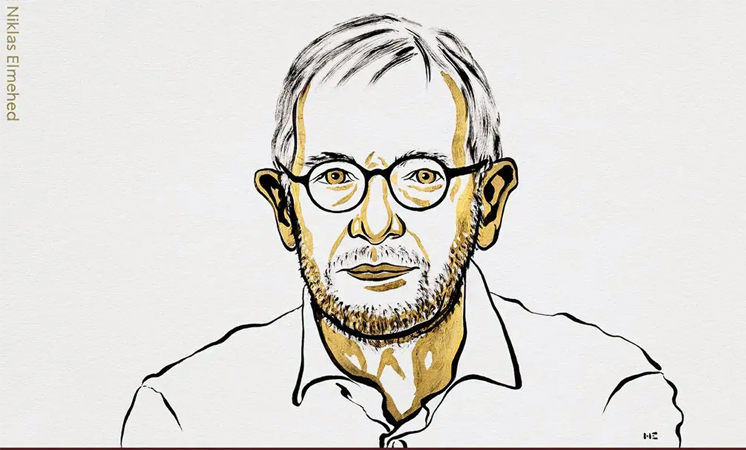
Collected Photo
Francis Halzen has won the Nobel Prize in Physics for his ground-breaking contributions to the IceCube Neutrino Observatory and the discovery of high-energy cosmic neutrinos.
The Royal Swedish Academy of Sciences announced the winner from Stockholm, Sweden around 3:45 PM Bangladesh Time.
Halzen received the prestigious award for his outstanding contributions to the IceCube Neutrino Observatory and the detection of high-energy cosmic neutrinos originating from distant space.
He was the first to propose that Antarctic ice could serve as a medium to detect ghost-like neutrino particles. His concept laid the foundation for building the IceCube Neutrino Observatory, a massive one-cubic-kilometer research facility embedded in ice and equipped with thousands of light-sensitive sensors.
Researchers use IceCube to track high-energy neutrinos travelling from the most powerful cosmic phenomena in the universe.
Neutrinos exist everywhere and pass through the Earth and the human body undetected. Extremely rarely, a single neutrino interacts with an atomic nucleus, allowing scientists to detect it using specialized instrumentation.
Unlike other cosmic particles, high-energy neutrinos do not change direction or lose energy as they travel through space. This characteristic enables them to deliver unique cosmic information that remains impossible to obtain through other scientific means.
Last year, John Clarke, Michel H Devoret, and John M Martinis of the University of California won the Nobel Prize in Physics for discovering macroscopic quantum mechanical tunneling and energy quantization in electrical circuits.
The Nobel Prize in Physics has been awarded 119 times since its inception in 1901. Lawrence Bragg was the youngest recipient at age 25, while Arthur Ashkin became the oldest laureate at 96 when he received the award in 2018.
-SA

Loading...
Loading...
Also read









Editor : Iqbal Sobhan Chowdhury
Published by the Editor on behalf of the Observer Ltd. from Globe Printers, 24/A, New Eskaton Road, Ramna, Dhaka.
Editorial, News and Commercial Offices : Aziz Bhaban (2nd floor), 93, Motijheel C/A, Dhaka-1000.
Phone: PABX- 41053001-06; Advertisement: 41053012; 01793317829, 01550707291, E-mail: [email protected], [email protected] Online: email: [email protected] 41053014; 01550707297 Advertisement: 01550707296
Published by the Editor on behalf of the Observer Ltd. from Globe Printers, 24/A, New Eskaton Road, Ramna, Dhaka.
Editorial, News and Commercial Offices : Aziz Bhaban (2nd floor), 93, Motijheel C/A, Dhaka-1000.
Phone: PABX- 41053001-06; Advertisement: 41053012; 01793317829, 01550707291, E-mail: [email protected], [email protected] Online: email: [email protected] 41053014; 01550707297 Advertisement: 01550707296


