



| HEADLINE |

|

Delhi Protests: Beyond the Barricades, Police Crackdown
Published : Monday, 12 October, 2026 at 12:00 AM
Shaon Arafat


 Protests do not erupt without a reason, and clearing the streets does not make that reason disappear. The recent demonstrations in New Delhi are a case in point. What began as a dispute over electoral rolls has grown into a wider confrontation involving young activists, ruling party, opposition groups, the police and the Election Commission. Protesters are demanding the resignation of Chief Election Commissioner Gyanesh Kumar, while the authorities have defended their actions on security grounds. And the result is a dispute that now goes well beyond the voter lists themselves. With another opposition-led demonstration planned for Monday, the immediate concern is whether the dispute will move towards a solution or deepen the confrontation.
At the centre of the dispute is the Special Intensive Revision (SIR) of electoral rolls, during which around 130 million voter entries were reportedly removed. The Election Commission says the exercise is necessary to keep voter lists accurate by removing duplicate entries and identifying people who have died or moved elsewhere. Opposition parties, however, worry that some eligible voters may also have lost their names from the lists. They have questioned how the revision was carried out and whether those affected have had a fair chance to challenge the deletions. The number of removed entries does not, by itself, prove that voters were deliberately excluded. But that should not end the discussion, either. The Commission needs to explain how the deletions were made and make it easier for people to check their status and correct mistakes. After all, a name missing from a voter list can mean a person loses the chance to vote. That is why the issue deserves a clear answer, not simply an assurance that everything has been done properly.
The campaign has also brought an unlikely group into the spotlight: the Cockroach Janta Party (CJP). It began as an online satire in response to a remark about unemployed young people but has since drawn attention through campaigns over public grievances. Also, its earlier protests over examination paper leaks helped build pressure before the education minister resigned in July. Now, the group has joined opposition parties in challenging the voter-roll revision and demanding Gyanesh Kumar’s resignation. The alliance brings together groups that may not agree on every political issue but share concerns about how public institutions operate. Online networks can help young activists spread their message quickly, while established parties can bring more people into the streets. Whether that combination can sustain the campaign remains to be seen. Much will depend on whether the groups can move beyond anger and set out demands that can be addressed.
The police response has added another layer to the controversy. On Saturday, Delhi Police detained protesters and political figures at several locations, including the airport and routes leading towards Jantar Mantar. Police said permission for the demonstration had been denied because the organisers had not given sufficient notice and because of security concerns. Reports on the number of people detained varied. Media reported around 4,000, while The Indian Express described thousands caught up in the operation. The full scale of the detentions needs to be established, but the larger question is why such extensive action was considered essential. Police must protect public safety and prevent violence. At the same time, denying permission for a gathering and detaining people before it can take place raises questions about whether the response was proportionate to the risks. Security concerns should be taken seriously, but they should also be explained clearly. Otherwise, an attempt to maintain order can become another source of public distrust.
The disruption has not been limited to those taking part in the protests. Cancelled trains, restricted Metro services, road closures and reported mobile internet interruptions have affected commuters, workers and businesses across the city. People trying to get to work, catch a train or carry out routine transactions have also had to bear the consequences. The Supreme Court intervened on Sunday, calling for normal Metro and rail services and internet access to be restored while stressing public convenience and lawful procedures. Its intervention brought attention to a basic point that security measures should not make everyday life unnecessarily difficult for thousands of people. Authorities may need to restrict movement in specific circumstances, but those restrictions should be limited to what is genuinely necessary. Otherwise, the public ends up paying the price for a dispute it did not create.
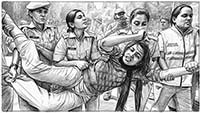
Monday’s planned opposition INDIA Bloc demonstration will show whether the confrontation is likely to continue. The opposition alliance has announced a protest against Gyanesh Kumar and plans to submit a memorandum seeking the Chief Justice of India’s intervention. A peaceful demonstration could keep attention on the electoral-roll dispute and give the authorities another opportunity to respond to the concerns raised. Further detentions or clashes, nevertheless, could push the original issue into the background. The outcome will depend partly on how the police manage the gathering and whether organisers keep it peaceful. Just as importantly, the Election Commission must decide how it will respond to questions about the revision. Clear explanations and a straightforward way to challenge errors would do more to address public concerns than another round of political accusations.
There is a way out of this confrontation, but it requires more than clearing roads or trading accusations. The police must maintain order without imposing unnecessary restrictions. Protest organisers must keep their demonstrations peaceful and support their claims with evidence. The Election Commission, for its part, should explain its decisions and ensure that eligible voters can correct mistakes. None of these steps requires the parties to agree on everything; they require each to take its responsibilities seriously. The central question is therefore not merely whether Monday’s (today) protest goes ahead, but whether the concerns behind it receive a meaningful response. The streets may become quiet again, but unless people get clear answers about the voter lists and the process behind them, the dispute is unlikely to end there.
The writer is Editorial Assistant, The Daily Observer

Loading...
Loading...
Also read



Editor : Iqbal Sobhan Chowdhury
Published by the Editor on behalf of the Observer Ltd. from Globe Printers, 24/A, New Eskaton Road, Ramna, Dhaka.
Editorial, News and Commercial Offices : Aziz Bhaban (2nd floor), 93, Motijheel C/A, Dhaka-1000.
Phone: PABX- 41053001-06; Advertisement: 41053012; 01793317829, 01550707291, E-mail: [email protected], [email protected] Online: email: [email protected] 41053014; 01550707297 Advertisement: 01550707296
Published by the Editor on behalf of the Observer Ltd. from Globe Printers, 24/A, New Eskaton Road, Ramna, Dhaka.
Editorial, News and Commercial Offices : Aziz Bhaban (2nd floor), 93, Motijheel C/A, Dhaka-1000.
Phone: PABX- 41053001-06; Advertisement: 41053012; 01793317829, 01550707291, E-mail: [email protected], [email protected] Online: email: [email protected] 41053014; 01550707297 Advertisement: 01550707296


