



| HEADLINE |

|

How Legal Delays Are Wasting Tk 2,500cr outside Our Thanas
Published : Sunday, 25 October, 2026 at 12:00 AM
Saraf Al Sakif


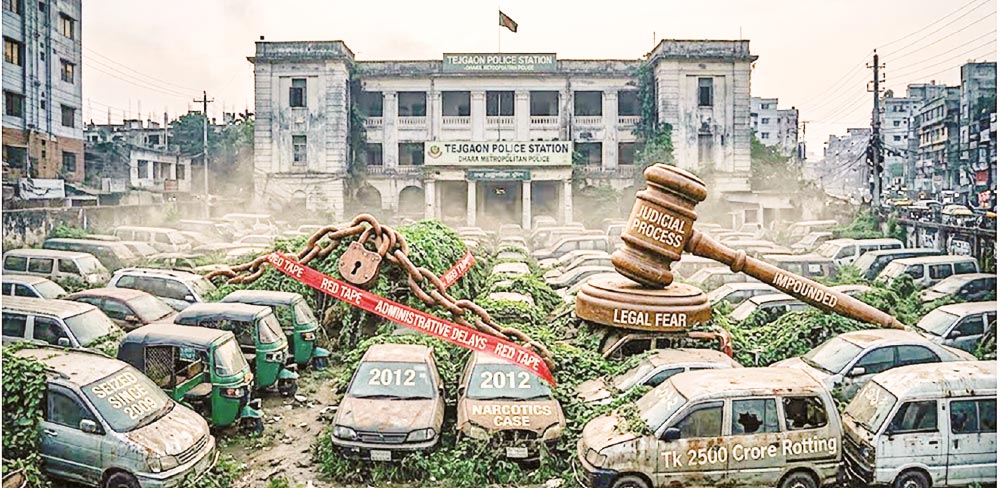
Along the roads outside Tejgaon, Kafrul and Banani police stations in Dhaka, rows of Toyota sedans, microbuses, CNG auto-rickshaws and covered vans sit beneath thick layers of dust and overgrown vines. Their tyres have deflated, windshields have shattered, and engine components have succumbed to corrosion and theft. Across more than 600 thanas and highway outposts in Bangladesh, an estimated 40,000 to 50,000 seized vehicles are deteriorating in open-air storage. Their collective value is conservatively estimated at Tk 1,500 crore to Tk 2,500 crore, yet prolonged exposure to the elements can reduce their worth to less than five per cent of their original purchase price. In the Dhaka Metropolitan Police (DMP) area alone, more than 8,000 impounded vehicles occupy public footpaths, obstruct traffic and create public health hazards.
This is not merely a storage problem; it reflects the failure to apply existing legal provisions effectively. Under the Police Regulations Bengal (PRB), investigating officers are responsible for seized property kept in police malkhanas. Sections 25-27 of the Police Act 1861 also provide a framework for reporting unclaimed property to local magistrates for public auction. Meanwhile, the Code of Criminal Procedure 1898 contains provisions for managing seized assets before prolonged litigation destroys their value. Yet thousands of vehicles remain stranded for years, exposing a gap between the law and its practical application.
Sections 523 and 525 of the Code offer potential remedies. Section 523 requires police to report relevant seizures to a magistrate, who may issue appropriate orders concerning custody or restoration. Section 525 empowers a magistrate to order a public sale when seized property is perishable or its sale would benefit the owner. However, courts often interpret perishability narrowly, overlooking how rain, humidity, corrosion and component theft rapidly diminish a vehicle's economic value. Instead, they frequently defer disposal under Section 517 until criminal proceedings conclude. With cases in Bangladesh reportedly taking an average of eight to 14 years, retaining vehicles as physical evidence can effectively destroy their value before a verdict is delivered.
Applications for interim custody, or zimmanama, under Section 516A reportedly face rejection over minor documentation discrepancies. This happens despite High Court Division precedents cited in support of temporary custody for registered owners unless retaining the property is strictly necessary. The problem becomes more complicated when special penal legislation applies. More than 60 per cent of vehicles impounded at metropolitan thanas are reportedly linked to narcotics allegations. Section 47 of the Narcotics Control Act 2018 provides for the confiscation of conveyances used in drug trafficking upon conviction. Fearing that interim release or an early auction might conflict with a future confiscation order, magistrates may avoid taking action. Consequently, a private car worth Tk 30 lakh can deteriorate for years while its case proceeds through the courts.
Administrative bottlenecks deepen the crisis. Investigations into tampered chassis or engine numbers under the Road Transport Act 2018 can take 12 to 24 months because of backlogs at Criminal Investigation Department forensic laboratories. Ownership verification, paperwork and fitness checks at Bangladesh Road Transport Authority (BRTA) district offices can take several years. Auction procedures also stall while joint valuation committees comprising magistrates, police representatives, BRTA inspectors and accounts officers are formed. Moreover, reserve prices may remain unrealistically high when inspectors rely on original vehicle values instead of accounting for depreciation, damage and scrap value.
Addressing this asset trap requires decisive judicial administration and better coordination, rather than necessarily introducing new legislation. The Supreme Court of Bangladesh could consider issuing a practice directive requiring magistrates to review property reported under Section 523 within 60 days of seizure. After assessing ownership, evidentiary needs and possible confiscation, courts could decide whether to grant interim custody under Section 516A or order an auction under Section 525. High-resolution photographs, video records, certified chassis rubbings and verified technical reports could preserve essential evidence when physical retention is unnecessary.
Auction proceeds could be deposited in court-managed fixed deposit receipts. If the accused is acquitted, the entitled owner could receive the amount determined under the applicable legal framework, together with accrued interest. If confiscation is ordered following conviction, the proceeds could be transferred to the state treasury in accordance with the law. Meanwhile, BRTA could introduce a digital depreciation matrix based on a vehicle's age, condition, damage and recoverable scrap value. Standardised valuation guidelines and time-bound procedures would make auctions more transparent and efficient.
The vehicles rusting outside police stations represent the economic cost of procedural delay and administrative fragmentation. Thousands of crores in potential value are being lost while public roads and footpaths remain obstructed. Bangladesh already has legal provisions that could help prevent this waste. Their effective application, supported by reliable evidentiary practices and accountable administration, could protect property owners, restore public space and preserve assets for lawful confiscation or return. Vehicles seized in the name of justice must not become casualties of the justice system itself.
This is not merely a storage problem; it reflects the failure to apply existing legal provisions effectively. Under the Police Regulations Bengal (PRB), investigating officers are responsible for seized property kept in police malkhanas. Sections 25-27 of the Police Act 1861 also provide a framework for reporting unclaimed property to local magistrates for public auction. Meanwhile, the Code of Criminal Procedure 1898 contains provisions for managing seized assets before prolonged litigation destroys their value. Yet thousands of vehicles remain stranded for years, exposing a gap between the law and its practical application.
Sections 523 and 525 of the Code offer potential remedies. Section 523 requires police to report relevant seizures to a magistrate, who may issue appropriate orders concerning custody or restoration. Section 525 empowers a magistrate to order a public sale when seized property is perishable or its sale would benefit the owner. However, courts often interpret perishability narrowly, overlooking how rain, humidity, corrosion and component theft rapidly diminish a vehicle's economic value. Instead, they frequently defer disposal under Section 517 until criminal proceedings conclude. With cases in Bangladesh reportedly taking an average of eight to 14 years, retaining vehicles as physical evidence can effectively destroy their value before a verdict is delivered.
Applications for interim custody, or zimmanama, under Section 516A reportedly face rejection over minor documentation discrepancies. This happens despite High Court Division precedents cited in support of temporary custody for registered owners unless retaining the property is strictly necessary. The problem becomes more complicated when special penal legislation applies. More than 60 per cent of vehicles impounded at metropolitan thanas are reportedly linked to narcotics allegations. Section 47 of the Narcotics Control Act 2018 provides for the confiscation of conveyances used in drug trafficking upon conviction. Fearing that interim release or an early auction might conflict with a future confiscation order, magistrates may avoid taking action. Consequently, a private car worth Tk 30 lakh can deteriorate for years while its case proceeds through the courts.
Administrative bottlenecks deepen the crisis. Investigations into tampered chassis or engine numbers under the Road Transport Act 2018 can take 12 to 24 months because of backlogs at Criminal Investigation Department forensic laboratories. Ownership verification, paperwork and fitness checks at Bangladesh Road Transport Authority (BRTA) district offices can take several years. Auction procedures also stall while joint valuation committees comprising magistrates, police representatives, BRTA inspectors and accounts officers are formed. Moreover, reserve prices may remain unrealistically high when inspectors rely on original vehicle values instead of accounting for depreciation, damage and scrap value.
Bangladesh can learn from India, where the Supreme Court has addressed similar concerns under the corresponding procedural framework. In Sunderbhai Ambalal Desai v State of Gujarat, the court emphasised the need to prevent seized vehicles from remaining at police stations indefinitely. It also recognised that photographs, detailed seizure records (panchnama) and other reliable documentation can preserve evidence without requiring vehicles to remain physically available throughout a trial. In State of Madhya Pradesh v Madhukar Rao, the court considered the relationship between special confiscation laws and magistrates' powers over interim custody. These judgments offer useful comparative guidance, although their application must be assessed under Bangladesh's own laws and precedents.
Auction proceeds could be deposited in court-managed fixed deposit receipts. If the accused is acquitted, the entitled owner could receive the amount determined under the applicable legal framework, together with accrued interest. If confiscation is ordered following conviction, the proceeds could be transferred to the state treasury in accordance with the law. Meanwhile, BRTA could introduce a digital depreciation matrix based on a vehicle's age, condition, damage and recoverable scrap value. Standardised valuation guidelines and time-bound procedures would make auctions more transparent and efficient.
The vehicles rusting outside police stations represent the economic cost of procedural delay and administrative fragmentation. Thousands of crores in potential value are being lost while public roads and footpaths remain obstructed. Bangladesh already has legal provisions that could help prevent this waste. Their effective application, supported by reliable evidentiary practices and accountable administration, could protect property owners, restore public space and preserve assets for lawful confiscation or return. Vehicles seized in the name of justice must not become casualties of the justice system itself.
The writer is a law student and legal researcher at Bangladesh University of Professionals

Loading...
Loading...
Also read





Editor : Iqbal Sobhan Chowdhury
Published by the Editor on behalf of the Observer Ltd. from Globe Printers, 24/A, New Eskaton Road, Ramna, Dhaka.
Editorial, News and Commercial Offices : Aziz Bhaban (2nd floor), 93, Motijheel C/A, Dhaka-1000.
Phone: PABX- 41053001-06; Advertisement: 41053012; 01793317829, 01550707291, E-mail: [email protected], [email protected] Online: email: [email protected] 41053014; 01550707297 Advertisement: 01550707296


