



| HEADLINE |

|

Debt spiral poses threat to microcredit's role in poverty alleviation: Experts
Research initiative needed to tackle the debt spiral
Published : Sunday, 11 January, 2026 at 12:00 AM
Business Correspondent


 Concerns over overlapping loans and rising debt burdens are increasingly overshadowing the achievements of microcredit sector, prompting calls for deeper research and policy intervention.
Officials and experts warn that many borrowers are becoming trapped in a "debt spiral", taking on new loans to repay old ones, undermining the sector's long-held reputation as a tool for poverty alleviation.
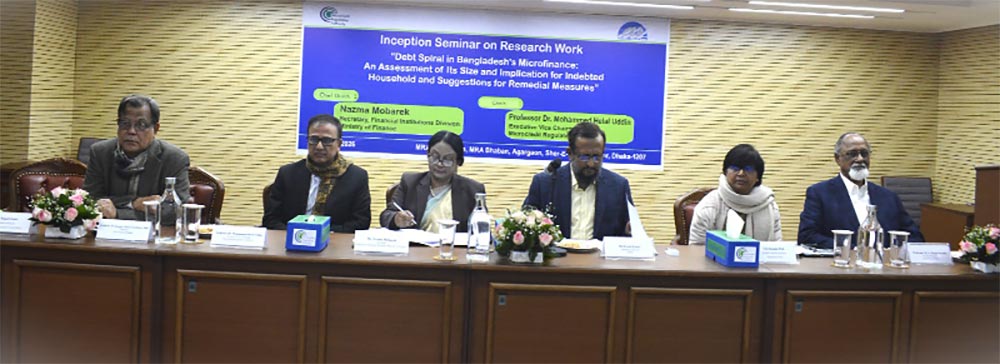
These concerns were highlighted on Thursday at an inception seminar titled "Debt Spiral in Bangladesh's Microfinance: An Assessment of Its Size and Implication for Indebted Households and Suggestions for Remedial Measures", organised by the Microcredit Regulatory Authority (MRA).
The seminar was attended by representatives from various government departments, senior officials of microfinance institutions, researchers, and policymakers.
Financial Institutions Division Secretary Nazma Mobarek attended the seminar as chief guest, while MRA Executive Vice-Chairman Mohammad Helal Uddin presided over the event.
Also present as speakers were Mohammad Yakub Hossain, Executive Director of the MRA, Md Fazlul Kader, Managing Director of the Palli Karma-Sahayak Foundation (PKSF); Dr. MA Baqui Khalily, former professor at the University of Dhaka; and Dr. Lila Rashid, member of the PKSF Governing Board and former Executive Director of Bangladesh Bank.
In her keynote speech, Nazma Mobarak, Secretary of the Financial Institutions Division, said, "While the microcredit sector plays an important role in poverty alleviation, excessive indebtedness and the debt spiral have now become a matter of policy concern. Evidence-based recommendations from this research will help make the microcredit sector more humane and sustainable."
She also noted that last year's annual report of the MRA shows that a few large institutions dominate the sector, while most are very small and financially fragile. She emphasized the need for more research to both study these issues and support the sustainable development of the sector.
ERG Executive Director Sajjad Zohir, in a presentation on the study's framework, said the long-celebrated role of microfinance in poverty reduction is increasingly being questioned.
According to him, many believe that rising debt burdens are eroding earlier gains, making it essential to reassess the sector's real-world impact.
The study, now under way, aims to assess the scale of the problem and propose remedies to make microfinance more sustainable and borrower-friendly.
The research is being conducted by the Economic Research Group (ERG) under the initiative of the MRA. Fieldwork will cover 32 upazilas across 16 districts, with the objective of generating realistic and effective policy recommendations based on ground-level evidence.

Loading...
Loading...
Also read



Editor : Iqbal Sobhan Chowdhury
Published by the Editor on behalf of the Observer Ltd. from Globe Printers, 24/A, New Eskaton Road, Ramna, Dhaka.
Editorial, News and Commercial Offices : Aziz Bhaban (2nd floor), 93, Motijheel C/A, Dhaka-1000.
Phone: PABX- 41053001-06; Advertisement: 41053012; 01793317829, 01550707291, E-mail: [email protected], [email protected] Online: email: [email protected] 41053014; 01550707297 Advertisement: 01550707296
Published by the Editor on behalf of the Observer Ltd. from Globe Printers, 24/A, New Eskaton Road, Ramna, Dhaka.
Editorial, News and Commercial Offices : Aziz Bhaban (2nd floor), 93, Motijheel C/A, Dhaka-1000.
Phone: PABX- 41053001-06; Advertisement: 41053012; 01793317829, 01550707291, E-mail: [email protected], [email protected] Online: email: [email protected] 41053014; 01550707297 Advertisement: 01550707296


