



| HEADLINE |

|

Ishraque banks as 'son of the area', Dr Mannan pitches change in Dhaka 6
Published : Friday, 6 February, 2026 at 12:00 AM
Staff Correspondent


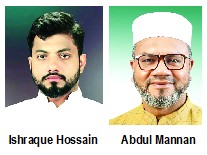 As Bangladesh moves toward the 2026 National Parliament elections, Dhaka-6-one of the capital's most politically sensitive and strategically important constituencies-has emerged as a key battleground, with a high-stakes contest shaping up between BNP's Engineer Ishraque Hossain and Jamaat-e-Islami's Dr Abdul Mannan.
The constituency, long known for fierce electoral battles and ideological rivalry, is once again witnessing intense political mobilisation. With more than 280,000 registered voters, Dhaka-6 is expected to play a decisive role in shaping urban political alignments in the coming polls.
Officially the 179th parliamentary constituency, Dhaka-6 comprises wards 34 and 37 to 46 of Dhaka South City Corporation, covering areas such as Wari, Gendaria, Sutrapur, and parts of Kotwali and Bangshal. Historically, the seat has mirrored Dhaka's shifting political mood, alternating between the Awami League and BNP, with intermittent victories by the Jatiya Party.
From Awami League's Qurban Ali in 1973 to BNP's AQM Badruddoza Chowdhury in 1979 and Mirza Abbas's consecutive wins in 1991 and 2001, Dhaka-6 has reflected national political tides. In recent years, the seat was held by the Jatiya Party in 2014 and 2018 before Awami League's Mohammad Sayeed Khokon won it in 2024.
BNP candidate Ishraque Hossain, son of late Dhaka mayor Sadeque Hossain Khoka, has already begun grassroots campaigning. Framing his bid as part of a broader democratic struggle, he said, "This fight is not just for one seat; it is about restoring democracy and standing beside the people."
He highlighted gas shortages, traffic congestion, waterlogging, and pollution as major challenges, alongside pledges to improve education, healthcare, and employment. The Gono Odhikar Parishad candidate Mohammad Fakhrul Islam has withdrawn from the race in support of Ishraque.
Jamaat-e-Islami's Dr Abdul Mannan, backed by a 10-party alliance, is positioning himself as a symbol of change. "To build a new Bangladesh, leadership must be honest, corruption-free and free of terrorism," he said, promising welfare-oriented and inclusive governance.

Loading...
Loading...
Also read



Editor : Iqbal Sobhan Chowdhury
Published by the Editor on behalf of the Observer Ltd. from Globe Printers, 24/A, New Eskaton Road, Ramna, Dhaka.
Editorial, News and Commercial Offices : Aziz Bhaban (2nd floor), 93, Motijheel C/A, Dhaka-1000.
Phone: PABX- 41053001-06; Advertisement: 41053012; 01793317829, 01550707291, E-mail: [email protected], [email protected] Online: email: [email protected] 41053014; 01550707297 Advertisement: 01550707296
Published by the Editor on behalf of the Observer Ltd. from Globe Printers, 24/A, New Eskaton Road, Ramna, Dhaka.
Editorial, News and Commercial Offices : Aziz Bhaban (2nd floor), 93, Motijheel C/A, Dhaka-1000.
Phone: PABX- 41053001-06; Advertisement: 41053012; 01793317829, 01550707291, E-mail: [email protected], [email protected] Online: email: [email protected] 41053014; 01550707297 Advertisement: 01550707296


