



| HEADLINE |

|

Old BNP stronghold faces stiff Jamaat challenge in Barguna-2



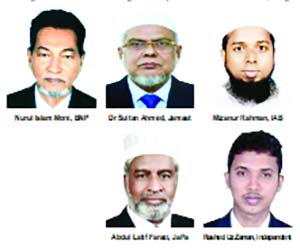 PATHARGHATA, BARGUNA, Feb 7: The political equation in Barguna-2 (Patharghata, Bamna and Betagi) is rapidly shifting ahead of the upcoming national parliamentary election, as Bangladesh Jamaat-e-Islami mounts a serious challenge to the long-standing dominance of the BNP in what has traditionally been considered one of its safest strongholds.
The constituency has a total of 337,744 voters, including 169,775 women and 167,965 men. With women forming a slight majority, all candidates are placing special emphasis on winning their support. Voting will take place at 122 polling centres.
Once regarded as a "safe seat" for the BNP, the constituency is now witnessing an intense contest, with Jamaat emerging as a formidable rival. Observers say the main battle is shaping up to be between BNP heavyweight candidate Mohammad Nurul Islam Moni and Jamaat nominee Dr Sultan Ahmed.
Moni, a former lawmaker, is a familiar and influential figure in the area. He was elected to parliament in 1988, 1991 and 2001, building a strong political base over decades. Senior voters still recall his contributions to road construction and infrastructure development during his previous terms, and many credit him for laying the foundation of regional connectivity.
Challenging his dominance is Dr Sultan Ahmed, who has long worked quietly at the grassroots and has now emerged as a central figure in the electoral race. With no allegations of corruption in his professional or personal life, he enjoys a positive public image. Jamaat leaders believe his clean reputation, education and polite demeanour could attract voters beyond traditional party lines.
Amid the BNP-Jamaat rivalry, Islami Andolan Bangladesh (IAB) is also steadily expanding its presence. Its candidate, Mohammad Mizanur Rahman, has been campaigning intensively across Patharghata, Bamna and Betagi, seeking to build grassroots support through religious and social outreach.
Jamaat's growing engagement with women voters has become a key concern for the BNP camp. While Moni is relying on his long political experience and established voter base, Dr Sultan is banking on his personal credibility and Jamaat's disciplined organisational strength.
Election analysts say if BNP votes split significantly in favour of Jamaat, the race could become extremely tight. Across the constituency, the central question is whether the BNP can hold on to its traditional fortress or whether Jamaat's momentum and clean-image candidate can rewrite decades-old political equations.
Besides the three major contenders, six other candidates are in the race, though they remain relatively unfamiliar to most voters. They include Mohammad Sabbir Ahmed (Bangladesh Congress - Green coconut ), Mohammad Kamruzzaman Liton (Bangladesh Jatiya Party - Jackfruit), Abdul Latif Farazi (Jatiya Party - Plough), Syed Mohammad Najes Afroz (NDM - Lion), Mohammad Sulaiman (NPP - Mango), and Mohammad Rashed Uz Zaman (Independent - Ship).
Mohammad Mostafa, a 60-year-old voter from Kalmegha in Patharghata, said Moni has long been a dominant political figure. "This was once unquestionably a BNP stronghold. Moni sahib has experience and long-standing ties with the people. But this time, there is growing discussion about Jamaat's Dr Sultan. He is seen as educated and well-mannered. If BNP fails to consolidate its support, it will be difficult to predict the outcome," he said.
A female voter from Betagi, housewife Farida Begum, 38, said peace and security were her top priorities. "Jamaat's women activists regularly keep in touch with us. Dr Sultan speaks well and seems like a good person. Moni sahib is a big leader, but when voting, we now think more about personal character and who stands by us in difficult times," she said.
Local voters believe this election will prioritise personal integrity and development promises over traditional party loyalty. Whether BNP can defend its bastion or Jamaat can script a political upset remains to be seen.

Loading...
Loading...
Also read



Editor : Iqbal Sobhan Chowdhury
Published by the Editor on behalf of the Observer Ltd. from Globe Printers, 24/A, New Eskaton Road, Ramna, Dhaka.
Editorial, News and Commercial Offices : Aziz Bhaban (2nd floor), 93, Motijheel C/A, Dhaka-1000.
Phone: PABX- 41053001-06; Advertisement: 41053012; 01793317829, 01550707291, E-mail: [email protected], [email protected] Online: email: [email protected] 41053014; 01550707297 Advertisement: 01550707296
Published by the Editor on behalf of the Observer Ltd. from Globe Printers, 24/A, New Eskaton Road, Ramna, Dhaka.
Editorial, News and Commercial Offices : Aziz Bhaban (2nd floor), 93, Motijheel C/A, Dhaka-1000.
Phone: PABX- 41053001-06; Advertisement: 41053012; 01793317829, 01550707291, E-mail: [email protected], [email protected] Online: email: [email protected] 41053014; 01550707297 Advertisement: 01550707296


