



| HEADLINE |

|
CPD warns of economic strain, calls for reform-focused national budget
Published : Wednesday, 11 March, 2026 at 12:00 AM
Business Desk


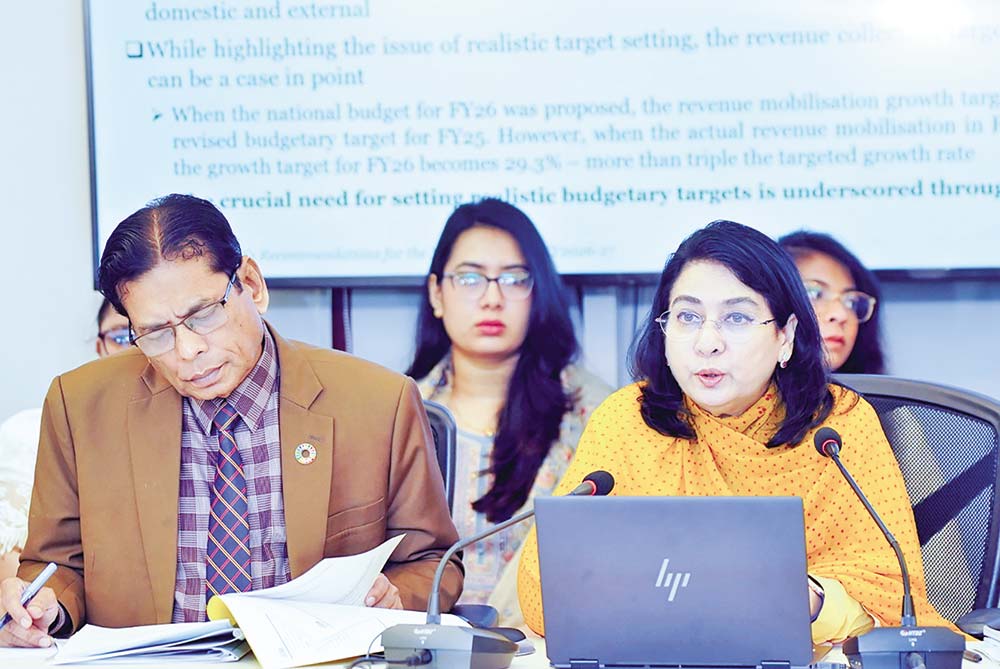 As Bangladesh's economy faces mounting pressures on multiple fronts, the upcoming national budget for FY2026-27 will be a crucial test for policymakers, demanding a careful balance between immediate macroeconomic stabilisation and deeper structural reforms to restore confidence and sustain long-term growth.
Economists at the Centre for Policy Dialogue (CPD) cautioned that the economy is navigating a complex and fragile phase marked by persistently high inflation, weak revenue mobilisation, sluggish investment, slow implementation of development projects and structural vulnerabilities in the financial sector.
The observations were made at a media briefing titled "Recommendations for the National Budget FY2026-27", organised in Dhaka on Tuesday under CPD's flagship research initiative, the Independent Review of Bangladesh Development.
"This budget will be particularly significant as it will be the first for the newly elected administration," said Fahmida Khatun, Executive Director of CPD.
"Bangladesh must also prepare for major structural transitions, including its impending graduation from the Least Developed Country (LDC) category and evolving global trade dynamics", she said.
According to CPD, recent fiscal performance reveals notable implementation gaps that are undermining macroeconomic management.
Revenue mobilisation remains far below the annual target of 34.5 per cent. Achieving the target would require revenue collection to surge by 59.4 per cent between February and June, which is highly unlikely under current trends.
Public spending has also lagged behind expectations. Implementation of the Annual Development Programme (ADP) reached just 20.3 per cent during July-January, marking the slowest progress in fifteen years and raising concerns about the efficiency of development spending.
Inflationary pressure remains another major concern for policymakers. Dr Khatun said inflation in Bangladesh is largely supply-driven, requiring coordinated policy responses that address both supply-side constraints and demand-side pressures.
She suggested that fiscal policy should combine prudent expenditure management with targeted subsidies and stronger social protection programmes to shield vulnerable groups from rising living costs.
To strengthen domestic resource mobilisation, CPD urged the government to pursue its target of raising the tax-to-GDP ratio to 15 per cent by 2035 through a clear policy roadmap backed by strong political commitment.
The think tank recommended introducing meaningful taxation on wealth and property and considering taxes on the expanding digital economy in order to broaden the tax base while reducing reliance on indirect taxes.
CPD also called for discontinuing ad-hoc tax incentives from FY27 and adopting a more transparent and selective approach to fiscal incentives to enhance fiscal discipline.
Private investment has declined to 22.03 per cent of GDP, the lowest level in a decade, while foreign direct investment remains below 0.5 per cent of GDP, significantly lower than in many comparable economies. To address these challenges, CPD recommended establishing an integrated digital one-stop service platform to simplify business registration, licensing, taxation and regulatory compliance.
CPD proposed prioritising the Energy Division's budget to finance the drilling of 150 new gas wells in order to reduce reliance on volatile liquefied natural gas imports. At the same time, the think tank urged the government to reduce high import duties-currently as much as 58.6 per cent-on solar and wind energy components to accelerate the transition towards renewable energy.
Bangladesh has set a target of generating 40 per cent of its electricity from clean energy sources by 2041, but CPD warned that existing fiscal incentives and budget allocations remain inadequate to meet that ambition.
Khatun further pointed to emerging fiscal challenges arising from global developments, including Bangladesh's forthcoming LDC graduation and evolving trade negotiations such as the proposed Bangladesh-United States Agreement on Reciprocal Trade and the Economic Partnership Agreement with Japan. Tariff liberalisation under the Bangladesh-US agreement alone could lead to a potential revenue loss of around Tk 1,327 crore, underscoring the need for careful fiscal planning.
CPD concluded that the FY2026-27 budget should prioritise realistic macroeconomic targets, stronger domestic resource mobilisation, improved social protection, a more dynamic investment climate and greater resilience against both domestic and external economic shocks.
"The upcoming budget offers a crucial opportunity for the government to demonstrate decisive fiscal leadership and lay a robust foundation for sustainable economic recovery," Khatun said.
Loading...
Loading...
Also read



Editor : Iqbal Sobhan Chowdhury
Published by the Editor on behalf of the Observer Ltd. from Globe Printers, 24/A, New Eskaton Road, Ramna, Dhaka.
Editorial, News and Commercial Offices : Aziz Bhaban (2nd floor), 93, Motijheel C/A, Dhaka-1000.
Phone: PABX- 41053001-06; Advertisement: 41053012; 01793317829, 01550707291, E-mail: [email protected], [email protected] Online: email: [email protected] 41053014; 01550707297 Advertisement: 01550707296
Published by the Editor on behalf of the Observer Ltd. from Globe Printers, 24/A, New Eskaton Road, Ramna, Dhaka.
Editorial, News and Commercial Offices : Aziz Bhaban (2nd floor), 93, Motijheel C/A, Dhaka-1000.
Phone: PABX- 41053001-06; Advertisement: 41053012; 01793317829, 01550707291, E-mail: [email protected], [email protected] Online: email: [email protected] 41053014; 01550707297 Advertisement: 01550707296


